Find Your Tour

Annapurna Base Camp Trek

Based On 12 ReviewsDuration:14 DaysActivities:Trekking in NepalModerate

Trip Facts

Destination:Nepal

Group Size:02–12

Region:Annapurna Region

Trip Duration:14 Days

Activities:Trekking, Hiking & Cultural Sightseeing

Culture:Gurung & Magar Communities • Hindu & Buddhist Heritage

Meals:Breakfast in Kathmandu & Pokhara • All Meals During the Trek

Accommodation:Hotels in Kathmandu & Pokhara • Mountain Lodges/Teahouses During the Trek

Max Elevation:Annapurna Base Camp (4,130 m)

Best Month:Mid-February–May & September–Mid-December

Trip Grade:Moderate

Trip Starts / Ends:Kathmandu

Transportation:Private Vehicle & Tourist Bus • Optional Pokhara–Kathmandu Flight

Overview

The Annapurna Base Camp Trek is one of Nepal’s classic Himalayan journeys, combining spectacular mountain scenery, traditional villages, rhododendron forests and a night at Annapurna Base Camp (4,130 m) in the heart of the Annapurna Sanctuary.

Our 14-day Annapurna Base Camp Trek begins in Kathmandu and continues to Pokhara before following the beautiful Ghorepani–Poon Hill route into the Annapurna region. This longer approach adds one of the trek’s great highlights: an early-morning hike to Poon Hill (3, 210 m) for panoramic views of the Annapurna and Dhaulagiri ranges.

From Ghorepani, the trail continues through Tadapani and Chhomrong before entering the narrow Modi Khola valley. Forested trails lead through Bamboo, Dovan and Himalaya toward Machhapuchhre Base Camp (3,700 m), where the landscape opens dramatically into the high mountains.
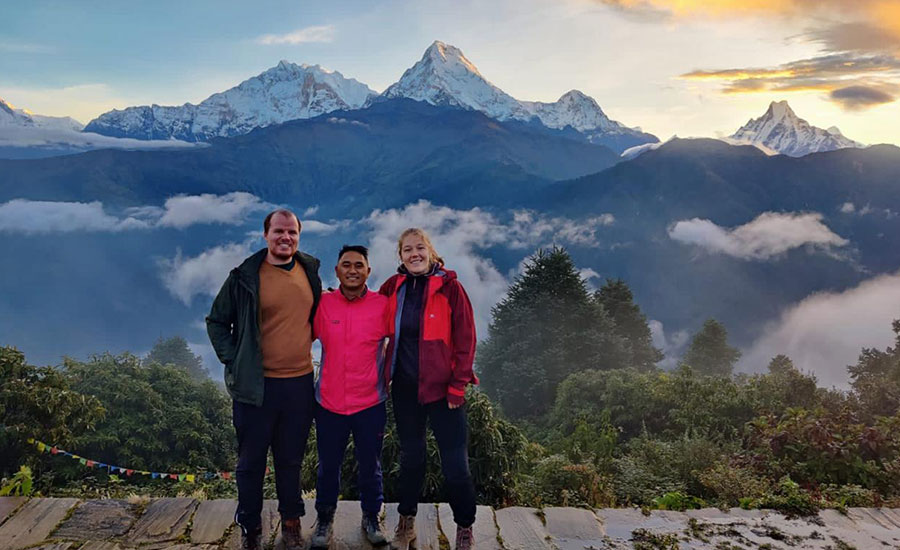
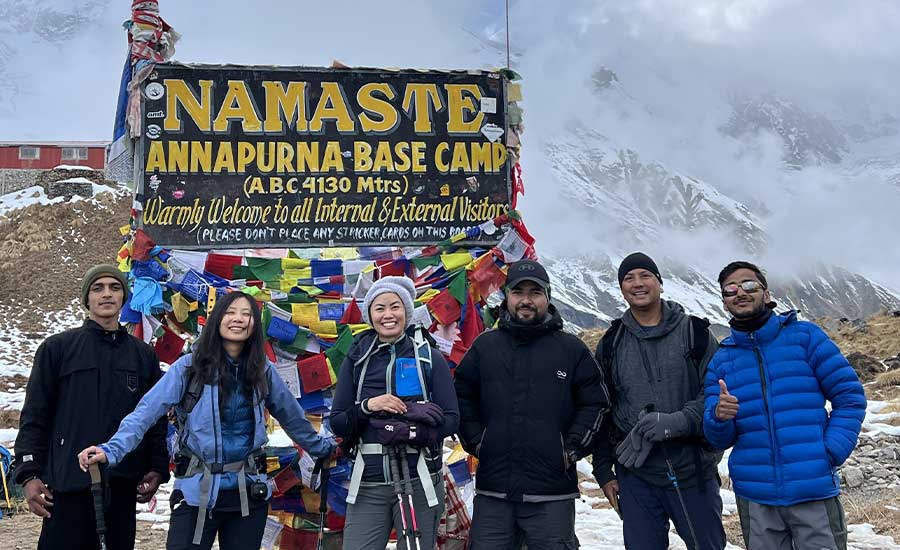
The final approach leads into the Annapurna Sanctuary and Annapurna Base Camp at 4,130 metres. Here you spend the night surrounded by an extraordinary Himalayan amphitheatre dominated by Annapurna I (8,091 m), Annapurna South, Hiunchuli, Gangapurna and Machhapuchhre (Fishtail).

The return journey follows the valley back through the forest to Jhinu Danda, where you can visit the natural hot springs before returning to Pokhara.
With a maximum sleeping altitude of 4,130 m and no technical climbing involved, the ABC Trek is considered a moderate high-altitude trek. Previous trekking experience is helpful but not essential. Good general fitness, preparation and a comfortable walking pace are more important.

For travellers who want more than the shortest route to base camp, this 14-day Annapurna Base Camp itinerary with Poon Hill offers a rewarding combination of Himalayan scenery, village life, varied landscapes and time to experience both Kathmandu and Pokhara.

Annapurna Base Camp Trek Highlights

  • Explore Kathmandu’s UNESCO World Heritage Sites before beginning your Himalayan adventure.
  • Travel to Pokhara, Nepal’s beautiful lakeside gateway to the Annapurna region.
  • Watch the sunrise from Poon Hill (3, 210 m) over the Annapurna and Dhaulagiri ranges.
  • Trek through traditional Gurung and Magar villages, terraced hillsides and rhododendron forests.
  • Follow the spectacular Modi Khola valley deep into the Annapurna Sanctuary.
  • Pass Machhapuchhre Base Camp (3, 700 m) on the final approach to Annapurna Base Camp.
  • Reach Annapurna Base Camp (4, 130 m) in the heart of a spectacular Himalayan amphitheatre.
  • Enjoy close-up views of Annapurna I (8, 091 m), Annapurna South, Hiunchuli and Machhapuchhre.
  • Stay overnight at Annapurna Base Camp surrounded by Himalayan peaks.
  • Experience local mountain hospitality while staying in traditional teahouses and lodges along the trail.
  • Walk through the protected landscapes and diverse ecosystems of the Annapurna Conservation Area.
  • Relax at the natural hot springs near Jhinu Danda after descending from the high mountains.

Annapurna Base Camp Trek - Short Itinerary

DayActivitiesAccommodation
Day 01Arrival in Kathmandu and transfer to hotelHotel in Kathmandu
Day 02Kathmandu Valley UNESCO World Heritage sightseeing and trek preparationHotel in Kathmandu
Day 03Drive from Kathmandu to PokharaHotel in Pokhara
Day 04Drive from Pokhara to Hile and trek to UlleriMountain Teahouse
Day 05Trek from Ulleri to GhorepaniMountain Teahouse
Day 06Sunrise hike to Poon Hill and trek to TadapaniMountain Teahouse
Day 07Trek from Tadapani to ChhomrongMountain Teahouse
Day 08Trek from Chhomrong to HimalayaMountain Teahouse
Day 09Trek via Machhapuchhre Base Camp to Annapurna Base CampMountain Teahouse
Day 10Sunrise at Annapurna Base Camp and trek down to BambooMountain Teahouse
Day 11Trek from Bamboo to Jhinu Danda and visit the natural hot springsMountain Teahouse
Day 12Trek from Jhinu Danda to Syauli Bazaar and drive to PokharaHotel in Pokhara
Day 13Drive from Pokhara to Kathmandu • Optional flight availableHotel in Kathmandu
Day 14Transfer to Tribhuvan International Airport for final departure

Annapurna Base Camp Trek Difficulty

The Annapurna Base Camp Trek is considered a moderate trek and is suitable for reasonably fit travellers, including beginners who prepare properly. No technical climbing or mountaineering experience is required, but trekkers should be comfortable walking for several hours on consecutive days.

The main challenges are the 4,130 m altitude at Annapurna Base Camp, long uphill and downhill sections, and numerous stone staircases around Ulleri and Chhomrong.

Difficulty FactorWhat to Expect
Overall DifficultyModerate
Maximum AltitudeAnnapurna Base Camp – 4,130 m
Daily WalkingApprox. 4–7 hours
Trail ConditionsStone steps, forest trails, rocky paths and mountain terrain
Altitude ChallengeModerate to high; slower walking is important above 3,000 m
Technical ClimbingNot required
Previous ExperienceHelpful, but not essential
Fitness LevelGood general fitness recommended
Suitable for BeginnersYes, with proper preparation
Main ChallengesAltitude, stone staircases, sustained ascents and long descents

Annapurna Base Camp Trek Altitude & Acclimatization

The highest point of the Annapurna Base Camp Trek is Annapurna Base Camp at 4,130 m (13,550 ft). The journey begins at much lower elevations and gradually enters the high-altitude environment of the Annapurna Sanctuary, passing Machhapuchhre Base Camp (3,700 m) before reaching ABC.

Although the ABC Trek does not normally require a separate acclimatization day, altitude sickness (AMS) can occur above 2,500 m and should always be taken seriously. Our guides maintain a comfortable walking pace, encourage proper hydration and regularly observe trekkers for signs of altitude-related illness.

Key LocationAltitude
Pokhara822 m
Ulleri2,050 m
Ghorepani2,875 m
Poon Hill3,210 m
Chhomrong2,170 m
Himalaya2,900 m
Machhapuchhre Base Camp (MBC)3,700 m
Annapurna Base Camp (ABC)4,130 m

How Do We Acclimatize on the ABC Trek?

Our 14-day Annapurna Base Camp itinerary spends several days trekking through lower elevations before reaching Annapurna Base Camp (4,130 m). We maintain a slow, steady pace with regular breaks, proper hydration and adequate rest to support acclimatization.

Our experienced guides monitor trekkers for symptoms of Acute Mountain Sickness (AMS), especially above 3,000 m. Any headache, nausea, dizziness or unusual fatigue should be reported immediately.

Safety always comes first. If altitude symptoms become concerning, we will adjust the itinerary or descend rather than continue ascending.

Best Time for Annapurna Base Camp Trek

The best time for the Annapurna Base Camp Trek is spring (March–May) and autumn (September–November), when conditions are generally most favourable for trekking, with good mountain visibility and comfortable daytime temperatures. Spring is especially beautiful for rhododendron forests, while autumn is known for clearer post-monsoon skies.

The ABC Trek is also possible in late February and December, although temperatures are colder at higher elevations and snow may affect the trail. The summer monsoon months bring warmer temperatures but also more rain, cloud, slippery trails and reduced mountain visibility on the southern side of the Annapurna range.

SeasonMonthsTypical ConditionsRecommendation
SpringMarch–MayMild days, blooming rhododendrons and good mountain viewsHighly Recommended
Summer / MonsoonJune–AugustWarm, humid and rainy with cloudier mountain viewsPossible, but less ideal
AutumnSeptember–NovemberGenerally stable weather and excellent Himalayan visibilityHighly Recommended
WinterDecember–FebruaryColder, quieter trails with possible snow at higher elevationsGood for prepared trekkers

Annapurna Base Camp Trek Cost

The Annapurna Base Camp Trek cost varies depending on group size, travel dates and accommodation preferences. Our 14-day package includes hotels in Kathmandu and Pokhara, mountain lodges, meals during the trek, guide and porter service, permits, transportation and airport transfers.

Private departures, hotel upgrades and optional Kathmandu–Pokhara flights can be arranged at additional cost. Contact Himalayan Dream Team for the latest ABC Trek price and a personalised quotation.

Permits for Annapurna Base Camp Trek

For the Annapurna Base Camp Trek, trekkers require permits for entering and trekking within the Annapurna region. Himalayan Dream Team arranges the required trekking permits before the trek, so you do not need to manage the paperwork yourself.

PermitPurpose
Annapurna Conservation Area Permit (ACAP)Required for trekking within the Annapurna Conservation Area
TIMS CardTrekker registration and safety information

Guide & Porter Service for the Annapurna Base Camp Trek

Your Annapurna Base Camp Trek is led by an experienced, government-licensed, first-aid-trained English-speaking trekking guide who manages the daily route, accommodation, safety and altitude awareness throughout the journey.

Porter service is included, with one porter shared between two trekkers and a maximum load of 22 kg per porter. Our trekking staff receive appropriate wages, meals, accommodation, equipment and insurance.

As a women-led trekking company in Nepal, Himalayan Dream Team is committed to professional local employment, responsible trekking practices and personal support throughout your journey.

Additional porter service can be arranged on request for trekkers who prefer extra luggage support.

Transportation During the Annapurna Base Camp Trek
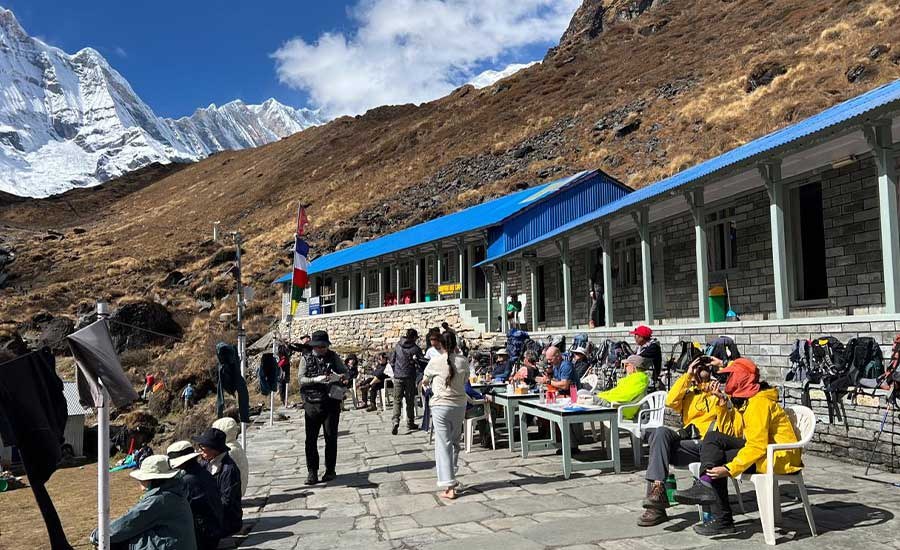
All transportation required for the Annapurna Base Camp Trek is arranged by Himalayan Dream Team according to the itinerary.

RouteTransportation
Kathmandu Airport → HotelPrivate Vehicle
Kathmandu → PokharaTourist Bus
Pokhara → Trekking TrailheadPrivate / Local Vehicle
Trek End → PokharaPrivate / Local Vehicle
Pokhara → KathmanduTourist Bus
Kathmandu → AirportPrivate Vehicle
Kathmandu ↔ PokharaOptional Domestic Flight

Accommodation During the Annapurna Base Camp Trek

Accommodation on the Annapurna Base Camp Trek includes comfortable hotels in Kathmandu and Pokhara and locally operated mountain lodges/teahouses during the trek.

LocationAccommodationRoom Type
KathmanduComfortable HotelTwin-Sharing
PokharaComfortable HotelTwin-Sharing
Trekking RouteMountain Lodges / TeahousesTwin-Sharing
Annapurna Base CampBest Available Mountain LodgeTwin-Sharing / Shared When Necessary

At higher elevations, especially around Machhapuchhre Base Camp and Annapurna Base Camp, accommodation is more basic and rooms can be limited during peak trekking seasons. Himalayan Dream Team arranges the best available accommodation according to the itinerary.


Day to Day Itinerary

Food/Meals

Welcome Dinner

Accommodation

Hotel

Max Elevation

1,335 m

Drive Time

30-45 minutes

Arrival in Kathmandu and transfer to the hotel Welcome to Nepal! A Himalayan Dream Team representative will welcome you with a Nepali flower at Tribhuvan International Airport in Kathmandu and facilitate your private transfer to the hotel. You can relax and recover from your journey at the hotel and, when you feel ready, enjoy a gentle stroll around the neighborhood to get your first taste of the city. As an introduction to your journey, we would like to treat you to dinner at one of best restaurant, which is guaranteed to give you the best impression of authentic local cuisine and hospitality.

Food/Meals

Breakfast

Accommodation

Hotel

Max Elevation

1,335 m

Drive Time

1 hour

Activity Duration

3-4 hrs

Following your breakfast at the hotel, your guide will take you on a full day exploration of the profound cultural and spiritual heritage of Kathmandu, taking you to multiple UNESCO world heritage sites.

Swayambhunath (Monkey Temple): You will start the day at this lofty Buddhist stupa resting on a hill with its eye catching views of the entire Kathmandu Valley. This site is one of the oldest by gaining importance as a relious center in Nepal where it is worshiped by Buddhists and Hindus.

Pashupatinath Temple: You will then proceed to Nepal’s most revered Hindu temple complex located on the banks of Bagmati River. Here, you will observe traditional cremation services and you will see sadhus (Hindu religious hermits) practicing their spirituality.

Kathmandu Durbar Square: You can take a walk at the serene old royal palace region of historic Kathmandu after lunch. This square is a living exposition of older temples and courtyards along with houses sculptured and wooden buildings in newari style architecture.

Local Markets Visit: To end the day, you can roam around kathmandu spice and vegetable markets which will allow you to experience the daily life of Kathmandan locals and provide opportunities for street photography.

Food/Meals

Breakfast

Accommodation

Hotel

Max Elevation

822 m

Drive Time

6-7 hrs

After breakfast, we’ll drive to Pokhara, Nepal’s most scenic lakeside city (about 200 km from Kathmandu). The drive follows the Trishuli River, offering views of lush green hills, charming villages and terraced farmlands.

Upon arrival in Pokhara, you’ll be greeted by stunning views of Dhaulagiri, Manaslu, Machhapuchhre (Fishtail), and the Annapurna range. Pokhara is often called the “City of Lakes” and serves as the starting point for all Annapurna treks.

In the afternoon, enjoy a relaxing walk or boat ride on Phewa Lake, where the reflection of Machhapuchhre shimmers in the water. You may also explore the lively Lakeside area for shopping or dinner by the lake.

Food/Meals

Breakfast, Lunch & Dinner

Accommodation

Teahouse

Max Elevation

2,050 m

Trek Time

2-3 hrs

After breakfast in Pokhara, we drive through the countryside toward Hile (1,430 m), where our trek into the Annapurna region begins. The journey passes terraced farmland, traditional villages and the green foothills surrounding Pokhara.

From Hile, we begin walking through small settlements and subtropical landscapes toward Tikhedhunga. The trail then starts climbing toward Ulleri, with stone steps forming the most demanding section of today's walk.

We take the ascent at a comfortable pace, with time for short breaks along the way. As we climb higher, the surrounding hills and rural landscapes open up around us.

By afternoon, we reach Ulleri (2,050 m), where we settle into a local teahouse for our first night on the trekking trail.

Food/Meals

Breakfast, Lunch & Dinner

Accommodation

Teahouse

Max Elevation

2,875 m

Trek Time

5-6 hrs

After breakfast, we leave the stone-built village of Ulleri and begin our gradual ascent through beautiful forests of rhododendron, oak and maple. The trail passes through the peaceful hamlets of Banthanti and Nangethanti, where we can rest and enjoy the refreshing mountain air.

As we climb higher, the scenery becomes even more enchanting. During spring, the entire forest glows with red and pink rhododendron blossoms, making this stretch one of the most picturesque in the Annapurna region.

After about five to six hours of walking, we arrive at Ghorepani, a welcoming mountain village that once served as a rest stop for traders traveling between Nepal and Tibet. The name Ghorepani means “horse water,” referring to its historical role as a watering point for caravans.

Today, Ghorepani is a popular resting place for trekkers, offering cozy teahouses, small shops and breathtaking views of Annapurna South, Dhaulagiri, Hiunchuli, and Nilgiri. As evening falls, the air turns cool and refreshing, inviting you to relax by the fire and enjoy a hearty dinner before resting for the night.

Food/Meals

Breakfast, Lunch & Dinner

Accommodation

Teahouse

Max Elevation

3,210 m

Trek Time

6-7 hrs

Today is one of the most memorable days of the trek.
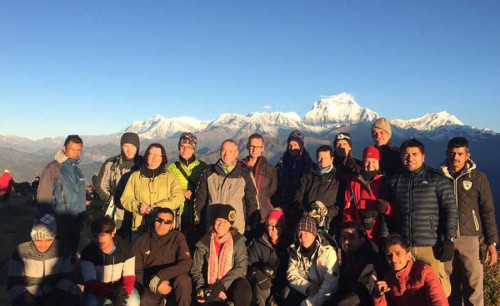
Before dawn, we make an early start for a short but steep climb to Poon Hill (3,210 m) - the most famous viewpoint in the Annapurna region. Reaching the top just in time for sunrise, we are rewarded with a breathtaking panorama as the first golden rays touch the towering peaks of Dhaulagiri, Annapurna South, Machhapuchhre (Fishtail), Hiunchuli and many more. The sight of over twenty Himalayan summits glowing in the morning light is truly unforgettable.

After enjoying the views and a warm cup of tea or coffee at the top, we return to Ghorepani for a hearty breakfast. From here, our trail continues east, climbing gently along a forested ridge and then descending through beautiful rhododendron and pine woods, passing small streams and waterfalls.

By afternoon, we reach Tadapani, a peaceful village nestled among the trees with close-up views of Machhapuchhre, Annapurna South and Hiunchuli. This is one of the most beautiful stops on the trek, surrounded by nature and mountain silence.

Dinner and overnight stay at a comfortable teahouse in Tadapani.

Food/Meals

Breakfast, Lunch & Dinner

Accommodation

Teahouse

Max Elevation

2,700 m

Trek Time

5-6 hrs

After breakfast, we begin our descent from Tadapani (2700m) , a quiet village surrounded by dense forest and mountain views. The trail soon splits — the southern route leads to Ghandruk, while we follow the eastern path toward Chhomrong.

Our route descends through lush rhododendron and oak forests to reach Gurjung, a small Gurung settlement just across a suspension bridge over the Kimrong Khola River. The walk through this section is peaceful and filled with the sounds of birds and flowing streams.

From Gurjung, the path gradually climbs and then levels out as we approach Chhomrong, one of the most charming villages in the Annapurna region. Nestled on the lap of the mighty Annapurna Massif, Chhomrong offers spectacular views of Annapurna South and Machhapuchhre (Fishtail) towering above the valley.

Once a traditional Gurung village, Chhomrong today combines local heritage with the comforts of modern mountain lodges.
A perfect place to relax and enjoy a warm evening meal.

Food/Meals

Breakfast, Lunch & Dinner

Accommodation

Teahouse

Max Elevation

2,900 m

Trek Time

6-7 hrs

After breakfast in Chhomrong, we descend the long stone staircase to the Chhomrong Khola and cross the river before climbing steadily toward Sinuwa.

From Sinuwa, the trail enters a quieter section of the Annapurna Sanctuary route, passing through dense forests of bamboo, rhododendron and oak. We continue through Bamboo and Dovan, with waterfalls, steep valley walls and the Modi Khola accompanying much of the journey.

As we gain elevation, the air becomes cooler and the settlements become smaller. The landscape gradually feels more remote as we move deeper into the mountains.

By afternoon, we reach Himalaya (2,900 m), where we stay overnight and rest before entering the higher-altitude section of the trek the following morning.

Food/Meals

Breakfast, Lunch & Dinner

Accommodation

Teahouse

Max Elevation

4,130 m

Trek Time

6-7 hrs

After breakfast, we leave Himalaya and begin one of the most rewarding days of the Annapurna Base Camp Trek. The trail climbs through the upper Modi Khola valley toward Deurali, where the dense forest gradually gives way to a more open high-mountain landscape.

From Deurali, we continue steadily toward Machhapuchhre Base Camp (3,700 m). As we gain altitude, the scenery becomes increasingly dramatic, with impressive views of Machhapuchhre (Fishtail), Annapurna South, Hiunchuli and Gangapurna.

After a well-earned rest at Machhapuchhre Base Camp, we continue at a slow and steady pace into the Annapurna Sanctuary. The valley opens into a spectacular natural amphitheatre surrounded by towering Himalayan peaks.

By afternoon, we reach Annapurna Base Camp (4,130 m), the highest point of our trek. From here, we enjoy magnificent close-up views of Annapurna I (8,091 m), Annapurna South, Hiunchuli, Gangapurna and Machhapuchhre.

We stay overnight at Annapurna Base Camp, giving us time to experience the remarkable high-altitude setting and prepare for sunrise over the Annapurna Sanctuary the following morning.

Food/Meals

Breakfast, Lunch & Dinner

Accommodation

Teahouse

Max Elevation

4,130 m

Trek Time

6-7 hrs

We wake early to experience sunrise at Annapurna Base Camp, when the first light reaches the surrounding Himalayan peaks. Weather permitting, this is one of the finest moments of the entire trek, with close views across the Annapurna Sanctuary.

After breakfast, we begin our descent from ABC, retracing the trail through Machhapuchhre Base Camp, Deurali, Himalaya and Dovan.

As we lose altitude, the alpine landscape gradually changes back into bamboo and rhododendron forest. Although most of today's route is downhill, the long descent requires a steady pace and care on stone and uneven sections of trail.

By afternoon, we reach Bamboo (2,335 m), where we settle into our mountain lodge for a well-earned rest after completing the highest section of the Annapurna Base Camp Trek.

Food/Meals

Breakfast, Lunch & Dinner

Accommodation

Teahouse

Max Elevation

2,335 m

Trek Time

5-6 hrs

After breakfast in Bamboo, we continue our descent through bamboo and rhododendron forests toward Sinuwa. The trail then leads back to the Chhomrong Khola, followed by a climb up the stone steps to Chhomrong Village.

From Chhomrong, we descend toward Jhinu Danda (1,610 m), enjoying the changing scenery as we return to the warmer lower elevations of the Annapurna region.

After reaching our lodge, you can visit the natural hot springs near Jhinu Danda, located beside the Modi Khola. A relaxing soak in the warm water is a rewarding way to rest tired legs after the journey to Annapurna Base Camp.

Food/Meals

Breakfast & Lunch

Accommodation

Hotel

Max Elevation

1,610 m

Drive Time

2-3 hrs

Trek Time

3-4 hrs

After breakfast, we begin the final walking section of our Annapurna Base Camp Trek, following the lower Modi Khola valley through terraced farmland, small villages and subtropical countryside.

After approximately three to four hours of walking, we reach the road head around Syauli Bazaar, where our trekking journey comes to an end. We meet our vehicle and drive back to Pokhara.

On arrival, we transfer to our hotel. The rest of the day is free to relax, enjoy the cafés and restaurants around Phewa Lake, or simply rest after completing the trek.

Food/Meals

Breakfast

Accommodation

Hotel

Max Elevation

1,335 m

Drive Time

6-7 hrs

After breakfast, we return to Kathmandu, marking the end of our wonderful mountain adventure.
By default, we travel by comfortable tourist bus (6–7 hours) for the scenic 200 km drive along the Trishuli River Valley. The journey offers beautiful views of villages, terraced farmlands and lush hills, providing one last glimpse of Nepal’s countryside and daily life.

Optional Flight  (25 minutes):
If you prefer to save time and avoid the long drive, you can choose a short and scenic flight back to Kathmandu. The flight provides breathtaking aerial views of the Himalayan ranges, rolling hills, and rivers , a quick and comfortable way to end your trek.

Upon arrival in Kathmandu, our team will meet you and transfer you to your hotel. The rest of the day is free to relax, take a warm shower or enjoy some last-minute shopping .

Food/Meals

Breakfast

Accommodation

Hotel

Drive Time

30-45 minutes

After breakfast (or lunch, depending on your flight schedule), our team will transfer you to Tribhuvan International Airport for your flight home.

If your flight departs in the evening, you may leave your luggage safely at the hotel and enjoy one last relaxed day exploring the city, visit local markets, sip coffee in Thamel, or simply stroll through the old streets to capture your final memories of Nepal.

For those who have extra days, we warmly invite you to extend your holiday with short cultural or adventure add-ons. You can enjoy:

  • A Kathmandu Valley Cultural Tour to explore ancient temples and heritage sites.
  • A relaxing stay in Pokhara, the city of lakes and mountain views.
  • A wildlife safari in Chitwan National Park, home to rhinos, elephants, and Bengal tigers.

Whatever you choose, the team of Himalayan Dream Team Treks & Tours will be happy to make all arrangements for you.

We wish you a safe journey and hope to welcome you back to Nepal soon for another unforgettable adventure.

Services Included on Price

Service Includes

  • Airport arrival and departure transfers in Kathmandu by private vehicle. 
  • Traditional Nepali welcome dinner upon arrival in Kathmandu. 
  • Comfortable hotel accommodation in Kathmandu and Pokhara on a twin-sharing, bed and breakfast basis. 
  • Guided Kathmandu Valley sightseeing tour with an experienced cultural guide and private transportation. 
  • Tourist bus transportation between Kathmandu and Pokhara. 
  • Required ground transportation between Pokhara and the trekking trailhead, and from the trek endpoint back to Pokhara. 
  • Mountain lodge/teahouse accommodation throughout the Annapurna Base Camp Trek. 
  • Breakfast, lunch and dinner during the trekking period. 
  • Experienced, government-licensed, first-aid-trained English-speaking trekking guide throughout the trek. 
  • Porter service (1 porter for every 2 trekkers, maximum 22 kg per porter), including their meals, accommodation, salary, equipment and insurance. 
  • Annapurna Conservation Area Permit (ACAP) and Trekkers’ Information Management System (TIMS) card. 
  • Emergency assistance and rescue coordination when required. 
  • All applicable government taxes and official service charges.

Service Excludes

  • International airfare to and from Nepal. 
  • Nepal tourist visa fees. 
  • Lunch and dinner in Kathmandu and Pokhara. 
  • Monument entrance fees during the included Kathmandu sightseeing tour. 
  • Optional Kathmandu–Pokhara or Pokhara–Kathmandu domestic flights. 
  • Personal trekking equipment and personal expenses. 
  • Travel and medical insurance, including emergency evacuation and helicopter rescue costs. 
  • Personal expenses during the trek such as Wi-Fi, battery charging, hot showers, laundry, bottled or hot water, soft drinks and alcoholic beverages. 
  • Extra hotel nights caused by early arrival, late departure, early return from the trek, road delays, weather conditions or changes to the scheduled itinerary. 
  • Additional porter service or excess luggage beyond the included porter allowance. 
  • Tips for trekking guides, porters, drivers and other local staff. 
  • Any services, activities or expenses not mentioned in the Service Includes section.

Altitude Graph

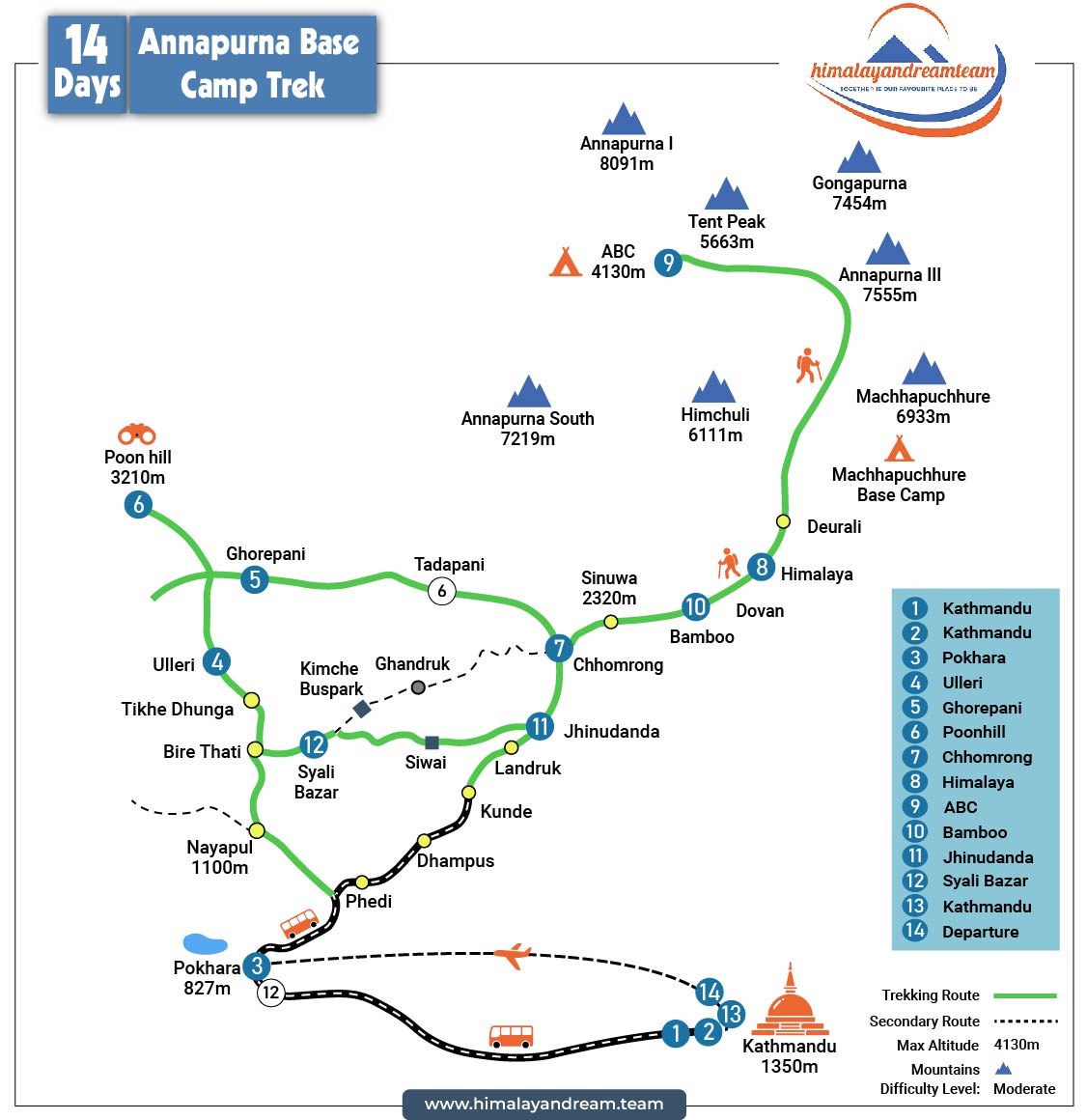
Route Map

Annapurna Base Camp Trek route map

Frequently Asked Questions for Annapurna Base Camp Trek

The best time for the Annapurna Base Camp Trek is spring (March–May) and autumn (September–November). These seasons generally offer favourable trekking conditions and good Himalayan visibility. Spring is especially beautiful for blooming rhododendron forests, while autumn is popular for clearer post-monsoon mountain views. Nepal Tourism Board also identifies March–May and September–November as the main seasons for the Annapurna Conservation Area. 

The trek is also possible in late February and December, but colder temperatures and snow are more likely at higher elevations.

The Annapurna Base Camp Trek is considered a moderate trek. No technical climbing or mountaineering experience is required, but you should be reasonably fit and comfortable walking approximately 4–7 hours per day over consecutive days.

The main challenges are long stone staircases, sustained uphill and downhill sections, uneven mountain trails and the altitude at 

Annapurna Base Camp (4,130 m). Regular walking, hiking, stair climbing and cardiovascular training before your trip will make the trek more enjoyable.

Our Annapurna Base Camp Trek is a 14-day journey from arrival to departure in Kathmandu.

The program includes Kathmandu sightseeing, Pokhara, the Ghorepani–Poon Hill route, Annapurna Base Camp, Jhinu Danda and the return to Kathmandu. The actual mountain trekking portion runs from Day 4 to Day 12.

Shorter ABC itineraries are possible, but our route is designed to include more of the Annapurna region rather than simply reaching base camp as quickly as possible.

Yes. Under Nepal's current revised TIMS provisions, the Poon Hill–ABC Trek is among the routes where trekkers are required to travel with a licensed trekking guide and carry a trekking-agency-issued TIMS card.

Himalayan Dream Team provides an experienced, government-licensed, first-aid-trained English-speaking trekking guide throughout your trek. Your guide manages the route, daily logistics, accommodation, altitude awareness and assistance in case of an emergency.

The trek requires an Annapurna Conservation Area Permit (ACAP) and the applicable Trekkers' Information Management System (TIMS) card for this route. Nepal Tourism Board specifically lists the Poon HillABC route under its revised TIMS system.

Himalayan Dream Team arranges the required trekking permits before the trek, and the permits included in the package are listed in our Service Includes section.

You stay in comfortable hotels in Kathmandu and Pokhara and locally operated mountain lodges or teahouses during the trek.

Rooms on the trekking route are generally simple and twin-sharing. Facilities become more basic as you climb higher, particularly around Machhapuchhre Base Camp and Annapurna Base Camp, where accommodation is limited.

Himalayan Dream Team arranges the best available accommodation according to the itinerary and local availability.

Twin-sharing private rooms are generally available at many stops, but attached bathrooms cannot be guaranteed throughout the Annapurna Base Camp route.

At higher elevations, accommodation is more basic and toilets or bathrooms may be shared. During busy trekking periods, room availability at Machhapuchhre Base Camp and Annapurna Base Camp can also be limited.

If you have a particular room preference, please let us know when booking.

Mountain teahouses offer a surprisingly varied menu. Common choices include dal bhat, rice, noodles, soups, potatoes, pasta, momos, fried rice, eggs, porridge, pancakes and other Nepali and simple international dishes.

Our package includes breakfast, lunch and dinner during the trekking period. Breakfast is included at your hotels in Kathmandu and Pokhara.

Vegetarian meals are widely available. If you have dietary requirements, please inform us before the trek so our guide can assist wherever possible.

Yes. Drinking water is available at lodges and settlements along the route. Depending on the location, trekkers can obtain boiled, filtered or treated water.

We recommend carrying a reusable water bottle and an appropriate water-treatment method rather than relying entirely on disposable plastic bottles.

Staying properly hydrated is particularly important as you gain altitude.

Yes. Annapurna Base Camp reaches 4,130 m, so Acute Mountain Sickness (AMS) is possible.

Symptoms can include headache, nausea, dizziness, loss of appetite and unusual fatigue. Our guides maintain a sensible pace and monitor trekkers as the route climbs into the higher elevations.

You should always tell your guide immediately if you experience symptoms. If symptoms become concerning, we will adjust the itinerary or descend rather than continue ascending.

Most trekking days involve approximately 4–7 hours of walking, depending on the route, elevation, trail conditions and your individual pace.

Some days involve significant ascents or descents, particularly around Ulleri, Chhomrong and the Annapurna Sanctuary. Day 9, from Himalaya through Machhapuchhre Base Camp to Annapurna Base Camp, is one of the most demanding high-altitude days.

There is no need to rush. Your guide sets an appropriate pace and regular rest stops are taken along the way.

Yes. The ABC Trek can be suitable for first-time Himalayan trekkers who are healthy, reasonably fit and prepare properly before travelling.

You do not need previous mountaineering experience or technical climbing skills. However, being a beginner does not mean the trek is easy. You should be prepared for consecutive trekking days, stone staircases, changing weather and elevations above 4,000 m.

Essential equipment includes well-broken-in trekking boots, moisture-wicking base layers, warm mid-layers, a waterproof jacket and trousers, down jacket, trekking trousers, gloves, warm hat, sun hat, sunglasses, sunscreen, trekking poles, reusable water bottle and personal medication.

A suitable sleeping bag may also be required depending on the season and lodge conditions.

You do not need to carry everything yourself because porter service is included. Himalayan Dream Team provides a detailed recommended packing list after booking so you can prepare according to your trekking season.

Yes. Porter service is included, with one porter shared between two trekkers and a maximum luggage load of 22 kg per porter.

You carry only your daypack with items needed during the day's walk, such as water, a warm layer, camera, sunscreen and personal essentials.

Our porters are provided with appropriate wages, meals, accommodation, equipment and insurance. Additional porter service can be arranged on request.

Yes. Charging facilities are available at many teahouses along the Annapurna Base Camp route, although an additional fee is normally charged.

Electricity becomes less reliable and more limited at higher elevations, so we recommend bringing a fully charged power bank and keeping batteries warm in colder conditions.

Charging costs during the trek are considered personal expenses and are not included in the package.

Wi-Fi and mobile coverage are available at various locations along the route, but the connection can become slower or unreliable as you travel higher into the mountains.

Hot showers are available at many teahouses for an additional charge, although facilities become simpler at higher elevations.

We recommend treating internet access, charging and hot showers as optional mountain services rather than guaranteed facilities.

Yes. We strongly recommend comprehensive travel and medical insurance that covers high-altitude trekking up to at least 4,130 m, as well as emergency medical treatment and helicopter evacuation where applicable.

Your insurance should cover the full duration of your trip and the activities included in your itinerary.

Himalayan Dream Team can assist with emergency and rescue coordination if required, but medical treatment, evacuation and helicopter rescue costs are not included in the trek price.

Our 14-day journey travels from Kathmandu to Pokhara by tourist bus. From Pokhara, transportation is arranged to Hile, where the walking section of our itinerary begins.

At the end of the trek, we arrange transportation from the roadhead back to Pokhara.

For travellers who prefer to save time, a domestic flight between Kathmandu and Pokhara can be arranged on request at an additional cost.

Your trekking guide is your first point of assistance in an emergency. Depending on the situation, this may involve rest, changing the itinerary, descending to a lower elevation, obtaining local medical assistance or coordinating an evacuation.

Himalayan Dream Team provides emergency assistance and rescue coordination when required.

All trekkers should have suitable travel insurance because medical treatment, emergency evacuation and helicopter rescue costs are the traveller's responsibility unless covered by their insurer.

Yes. Solo travellers are welcome to book with Himalayan Dream Team. Because the Poon Hill–ABC route is covered by Nepal's guide and TIMS requirements, we arrange the trek with the required licensed guide and permits.

Private departures can be arranged, or you can ask us whether a suitable group departure is available for your preferred dates.

Client Reviews

Book Now Inquiry

Similar Packages

Enjoy the popular trekking and tour packages in Nepal Himalayas. 2026.