kanchenjunga-circuit-trek-map-itinerary-cost-distance-difficulty
Welcome to Nepal! A Himalayan Dream Team representative will welcome you with a Nepali flower at Tribhuvan International Airport in Kathmandu and facilitate your private transfer to the hotel. You can relax and recover from your journey at the hotel and, when you feel ready, enjoy a gentle stroll around the neighborhood to get your first taste of the city. As an introduction to your journey, we would like to treat you to dinner at one of best restaurant, which is guaranteed to give you the best impression of authentic local cuisine and hospitality.
Following your breakfast at the hotel, your guide will take you on a full day exploration of the profound cultural and spiritual heritage of Kathmandu, taking you to multiple UNESCO world heritage sites.
Swayambhunath (Monkey Temple): You will start the day at this lofty Buddhist stupa resting on a hill with its eye catching views of the entire Kathmandu Valley. This site is one of the oldest by gaining importance as a relious center in Nepal where it is worshiped by Buddhists and Hindus.
Pashupatinath Temple: You will then proceed to Nepal’s most revered Hindu temple complex located on the banks of Bagmati River. Here, you will observe traditional cremation services and you will see sadhus (Hindu religious hermits) practicing their spirituality.
Kathmandu Durbar Square: You can take a walk at the serene old royal palace region of historic Kathmandu after lunch. This square is a living exposition of older temples and courtyards along with houses sculptured and wooden buildings in Newari style architecture.
Local Markets Visit: To end the day, you can roam around Kathmandu spice and vegetable markets which will allow you to experience the daily life of Kathmandu locals and provide opportunities for street photography.
Today begins the transition from the capital to Nepal’s far eastern Himalayan frontier.
In the morning, we take a scenic flight from Kathmandu to Bhadrapur (approximately 45 minutes). During clear weather, you may enjoy aerial views of the Himalayan range stretching across northern Nepal.
Upon arrival, we continue by private vehicle toward Taplejung. The drive takes approximately 8–9 hours, passing through rolling hills, terraced farmlands, river valleys, and tea gardens of eastern Nepal. The road gradually climbs through lush mid-hill settlements and traditional Limbu villages, offering a glimpse into rural Himalayan life.
Taplejung serves as the administrative gateway to the Kanchenjunga region and marks the true beginning of your remote Himalayan adventure.
Your trekking journey officially begins today.
After breakfast in Taplejung, we start descending through gentle mid-hill trails surrounded by lush greenery. The path winds through traditional Limbu villages where mud-brick houses, prayer flags, and local farming life reflect the authentic culture of eastern Nepal.
Along the way, you will pass terraced rice fields, millet farms, and large cardamom plantations — one of the region’s major cash crops. The landscape is subtropical and fertile, with warm temperatures and rich biodiversity.
As we gradually descend, the trail follows the powerful Tamor River, whose steady flow accompanies us throughout the afternoon. The river valley scenery, suspension bridges, and quiet rural atmosphere make this a pleasant first trekking day.
By late afternoon, we reach Mitlung, a small riverside settlement where we stay at a local lodge or homestay. This peaceful village offers a beautiful introduction to the remote Kanchenjunga region and a chance to experience genuine local hospitality.
Today we continue our trek through beautiful mid-hill landscapes and traditional eastern Nepal villages. The trail passes through the Limbu and Tamang settlements of Sinwa, Tawa, and Porke, where daily rural life unfolds among terraced fields and forested hillsides.
Along the way, we walk across sections of old landslide areas and rocky river deposits shaped by monsoon waters over time. The terrain is varied but manageable, offering both gentle climbs and gradual descents.
After descending toward Thiwa Khola, we cross a wooden bridge and follow the trail to Chiruwa, a lively village situated beside the Tamor River. Chiruwa is a pleasant stop with several teahouses and small shops serving trekkers and locals.
After breakfast, we head further north into the Kanchenjunga Conservation Area. Today’s trail passes through Taplethok, where permits are checked before entering the more remote section of the trek.
We continue through the villages of Tamewa, Hellok, and Lelep, walking alongside the Tamor River. The valley gradually narrows, and the landscape becomes more dramatic and rugged.
As we approach the confluence with Simbu Khola - a glacial river originating from the Yalung Glacier - the environment feels increasingly wild. From here, we enter the steep and narrow Ghunsa Khola valley, trekking through forested trails and crossing suspension bridges.
By late afternoon, we arrive at Sukethum, a small settlement nestled along the river gorge.
Today’s trek brings noticeable altitude gain as we follow the powerful Ghunsa Khola upstream.
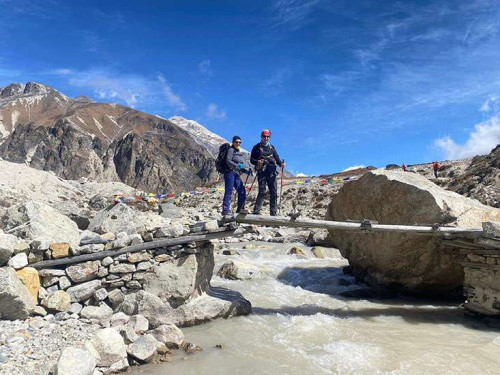
The trail climbs steadily through steep sections carved into the hillside, with some exposed areas offering dramatic views down to the river below. We cross several suspension bridges and walk through forests of bamboo, rhododendron, and pine.
As we gain elevation, the vegetation gradually changes and the air becomes cooler. By afternoon, we reach Amjilosa, a small Tibetan-influenced village perched above the valley. Prayer flags, stone houses, and Buddhist culture begin to shape the atmosphere of this remote Himalayan region.
After an early breakfast, we begin our ascent toward Gyabla (also known as Kyapra), gradually gaining elevation as we move deeper into the northern Kanchenjunga region.
The trail today passes through dense forests of bamboo, rhododendron, and pine. This section is peaceful and less populated, offering a true sense of wilderness. With fewer settlements along the way, you can fully appreciate the untouched beauty of the landscape and the sound of the rushing Ghunsa Khola below.
We cross suspension bridges and walk along narrow mountain paths carved into steep hillsides. One highlight of today’s trek is a large waterfall cascading down the opposite side of the valley - a dramatic and photogenic sight.
The trail involves a steady ascent, with some steep sections followed by gentler stretches before reaching Gyabla. As we gain altitude, the vegetation begins to thin and the air becomes noticeably cooler.
Gyabla is a small Tibetan-influenced village where most residents follow Buddhist traditions. Stone houses, prayer flags, and a quiet alpine atmosphere reflect the strong cultural connection to Tibet.
Today’s trek brings us into the true alpine heart of the Kanchenjunga region.
Leaving Gyabla behind, we begin by ascending through forested trails lined with pine and rhododendron. The valley gradually opens into wider alpine meadows, offering a noticeable change in scenery compared to the lower subtropical sections of previous days.
After several hours of steady walking, we reach Phole (also spelled Pahle) at 3,240 m - a small Tibetan refugee settlement known for its traditional handicrafts and carpet weaving. This peaceful village reflects strong Tibetan cultural influence and offers a quiet rest stop before continuing higher.
From Phole, the trail continues gently uphill along the Ghunsa River through forests and open pastureland. Before reaching Ghunsa, you may notice a side trail branching toward Nango La Pass (4,795 m), which leads to the ancient trading village of Olangchung Gola - a historic route once used for cross-border trade with Tibet.
Continuing straight ahead, we arrive at Ghunsa (3,595 m), one of the most important and largest villages in the region. Built with traditional wooden houses and surrounded by prayer flags and mani walls, Ghunsa is a key acclimatization stop on the Kanchenjunga North Base Camp Trek. The village has basic but important facilities including a micro-hydropower plant, school, health post, and several well-managed lodges.
Today is an important acclimatization day to help your body adjust to the increasing altitude before heading above 4,000 meters.
After breakfast, we take a short acclimatization hike to a nearby ridge on the opposite side of the Ghunsa Khola, gaining approximately 350–400 meters in elevation. This gradual climb helps improve oxygen adaptation while offering stunning panoramic views of the surrounding peaks and valleys.
From the higher viewpoint, you may enjoy clear views of Kumbhakarna Peak (7,711 m), also known as Jannu - one of the most impressive and technically challenging mountains in eastern Nepal. The dramatic snow-covered ridges provide an unforgettable Himalayan backdrop.
After descending back to the village for lunch, the afternoon is free to rest or explore Ghunsa. You can visit the local monastery, spin prayer wheels, and observe the strong Tibetan Buddhist influence that shapes daily life here. The village is rich in culture, with stone houses, mani walls, and prayer flags fluttering in the alpine wind.
This balanced day of light hiking and rest plays a crucial role in preparing you safely for the higher elevations ahead.
Today we leave Ghunsa and move deeper into the high alpine wilderness of the Kanchenjunga region.
The trail follows the south bank of the Ghunsa Khola, gradually climbing through pine and rhododendron forests. Along the way, we pass several mani walls and chortens, reminders of the strong Tibetan Buddhist influence in this remote Himalayan valley.
As we progress, the forest begins to thin and the landscape opens dramatically. We walk through alpine meadows that, during spring and early summer, are filled with colorful wildflowers. After crossing a bridge near Rampuk Kharka, the trail continues along the riverbank toward a striking waterfall cascading down from the cliffs above.
One challenging section today involves crossing a landslide-prone area with loose rocks and scree. Careful footing is required, but the reward is worth it - as the valley widens, the magnificent north face of Mount Jannu (7,710 m), also known as Kumbhakarna, begins to dominate the skyline.
The final stretch involves walking across glacial moraines and rocky terrain before reaching Kambachen (also spelled Khangpachen), a small Tibetan settlement surrounded by towering peaks and dramatic mountain scenery.
Today’s trek takes us into a dramatic glacial landscape as we move closer to the northern face of Kanchenjunga.
Leaving Khangbachen behind, the trail gradually ascends over rocky terrain and alpine pastures. Vegetation becomes sparse as we gain elevation, and the scenery transforms into a rugged high-altitude wilderness.
After reaching the upper source region of the Ghunsa Khola, we continue trekking along the lateral moraine of the Kanchenjunga Glacier. The path follows the northern side of the glacier, offering breathtaking views of ice formations, rocky ridges, and vast Himalayan expanses.
The terrain is mostly gradual but exposed, with cold winds often sweeping across the valley. As we approach Lhonak, the landscape opens into a wide glacial plateau. Despite the harsh alpine environment, the panoramic mountain views are extraordinary.
From Lhonak, you can witness stunning peaks including:
Wedge Peak (6,802 m)
Mera Peak (6,364 m)
Nepal Peak (7,177 m)
The Twins (7,350 m)
And numerous unnamed Himalayan giants surrounding the Kanchenjunga massif
At this altitude, the air is crisp and thin, and temperatures drop significantly, especially in the evening. However, the raw beauty of the high Himalayas makes this one of the most memorable days of the trek.
No reviews yet. Traveled with us on this trip? Be the first to share your experience.
Enjoy the popular trekking and tour packages in Nepal Himalayas. 2026.
© 2011 - 2026 All rights reserved. Himalayan Dream Team