

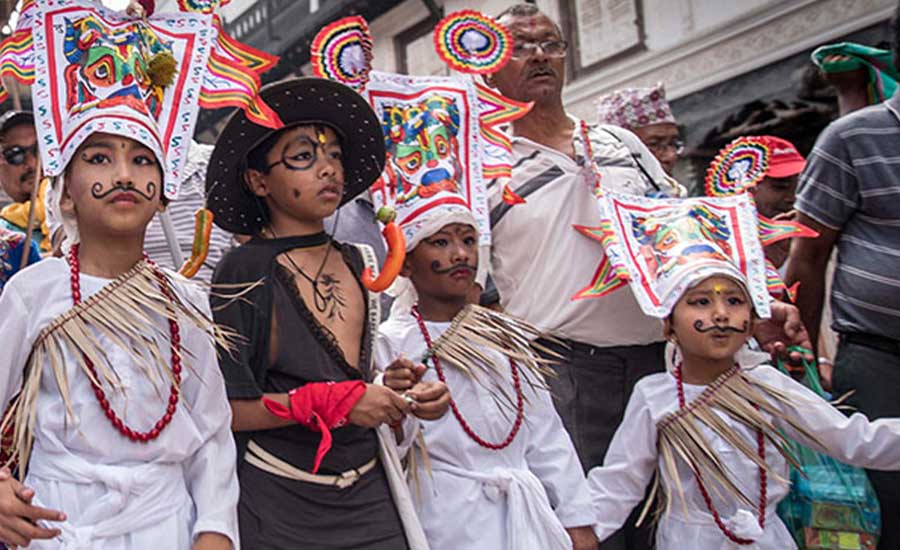
The Gaijatra Festival in Nepal, also known as Gai Jatra and Sa Paru in Nepal Bhasa, is one of the Kathmandu Valley's most remarkable cultural traditions. It brings together two emotions that rarely appear side by side in a festival: remembrance and laughter.
Families who have lost a loved one during the previous year take part in memorial processions, while the streets also fill with traditional music, costumes, humour, satire and community performances. The result is a festival that acknowledges the reality of death while helping families share grief with the wider community.
In 2027, Gaijatra falls on Wednesday, 18 August, corresponding to Bhadra 2, 2084 B.S. The festival is celebrated most prominently by the Newar communities of the Kathmandu Valley, with particularly distinctive traditions in Kathmandu, Bhaktapur and Patan.
For travellers, Gaijatra provides a rare opportunity to experience Nepal's living Newar heritage rather than simply visiting its historic monuments. Ancient streets, courtyards and temple squares become active cultural spaces filled with memorial processions, music, traditional dress and performances.
This complete Gaijatra Festival in Nepal 2027 guide explains its date, history, Newar name Sa Paru, cow symbolism, rituals, Kathmandu and Bhaktapur traditions, humour and satire, traditional food, photography etiquette, weather and practical travel information.
Gaijatra Festival 2027 at a Glance
| Festival Information | Details |
|---|---|
| Festival | Gaijatra / Gai Jatra |
| Newar Name | Sa Paru |
| Gaijatra Date 2027 | Wednesday, 18 August 2027 |
| Nepali Date | Bhadra 2, 2084 B.S. |
| Main Community | Newar community |
| Main Region | Kathmandu Valley |
| Major Celebration Areas | Kathmandu, Bhaktapur, Patan, Kirtipur and other Newar settlements |
| Main Purpose | Remembering family members who died during the previous year |
| Main Symbol | Cow or symbolic representation of a cow |
| Main Activities | Memorial processions, traditional music, costumes, performances, humour and satire |
| Religion & Culture | Newar traditions with Hindu and local cultural elements |
| Season | Monsoon |
| Best Places for Travellers | Bhaktapur and old Kathmandu |
| Suitable for Visitors | Yes, with sensitivity towards grieving families and religious traditions |
When Is Gaijatra Festival in Nepal in 2027?
Gaijatra Festival in Nepal falls on Wednesday, 18 August 2027, corresponding to Bhadra 2, 2084 B.S.
Gaijatra follows Nepal's lunar festival calendar, so its Gregorian date changes every year.
The festival takes place immediately after the full-moon festival period of Janai Purnima / Gun Punhi and falls on the first day of the waning lunar fortnight.
| Year | Festival | Nepali Date | Gregorian Date | Day |
|---|---|---|---|---|
| 2027 | Gaijatra / Sa Paru | Bhadra 2, 2084 B.S. | 18 August 2027 | Wednesday |
Travel Tip: Because Gaijatra follows the lunar calendar, travellers planning a Nepal holiday specifically around the festival should always reconfirm the date for their year of travel.
What Is Gaijatra Festival in Nepal?
Gaijatra literally combines the Nepali words gai, meaning cow, and jatra, meaning festival or procession.
However, describing it simply as the "Cow Festival" does not explain its deeper meaning.
Gaijatra is fundamentally a festival of remembrance.
Families who have experienced the death of a relative during the previous year participate in processions through their town or city. Traditionally, a cow may form part of the procession, or children and symbolic structures may represent the cow.
The cow has sacred significance in Hindu tradition and is associated with helping the departed soul on its journey after death.
But Gaijatra does something unusual with grief.
Alongside remembrance come music, costumes, humour, parody and satire. Instead of isolating bereaved families, the festival brings them into the streets together and reminds them that loss is shared by many people.
This balance between grief and laughter is what makes Gaijatra one of Nepal's most distinctive cultural festivals.
What Does Sa Paru Mean?
Among Newar communities, Gaijatra is commonly known as Sa Paru.
The festival is deeply connected with the traditional urban culture of the Kathmandu Valley, particularly the historic Newar cities of Kathmandu, Bhaktapur and Lalitpur.
Although the English phrase "Cow Festival" is convenient for visitors, understanding the Newar identity of Sa Paru is important.
This is not simply a nationwide parade involving cows. It is a living Newar cultural tradition with different rituals, procession styles, music and performances depending on the city and community.
The History of Gaijatra Festival
The most famous story associated with Gaijatra takes us back to the Malla period of the Kathmandu Valley.
According to popular tradition, King Pratap Malla of Kathmandu faced a family tragedy when his son died.
The queen was overwhelmed by grief, and the king was unable to console her.
To help her understand that death had affected many other families as well, the king is said to have ordered every household that had lost someone during the previous year to participate in a procession.
When the queen saw family after family passing through the city, she realised that she was not alone in experiencing loss.
The story continues that the king encouraged performers to use jokes, unusual costumes, comedy and satire in an effort to make the grieving queen smile.
Whether every detail of this popular legend can be established historically or not, the story perfectly expresses the philosophy that Gaijatra represents today:
Grief becomes easier to carry when it is shared.
King Pratap Malla and Gaijatra
King Pratap Malla was one of the most influential Malla rulers of Kathmandu during the 17th century.
The Malla era played an extraordinary role in shaping the architecture, art, festivals and urban traditions that visitors still experience across the Kathmandu Valley today.
Kathmandu, Bhaktapur and Patan were historically separate kingdoms, each developing its own royal squares, temples and cultural traditions.
Many of the festivals that continue through the old streets today are therefore closely linked to the history of these cities.
Gaijatra is an excellent example of how the Kathmandu Valley's historic urban spaces remain active parts of community life rather than functioning only as monuments.
Why Is a Cow Important During Gaijatra?
The cow is one of the most recognisable symbols of Gaijatra.
In Hindu traditions, cows are sacred and have long been connected with religious merit, ritual giving and beliefs surrounding the journey after death.
During Gaijatra, the cow symbolically helps guide the departed soul on its journey.
Families traditionally participating in the festival may:
- Lead a cow in the procession
- Dress a child symbolically to represent a cow
- Use decorative cow imagery
- Carry a symbolic structure representing the deceased and the cow
The exact form varies considerably between Kathmandu Valley communities.
Travellers should therefore avoid expecting every Gaijatra procession to look identical.
Remembering Family Members Who Died During the Previous Year
The emotional heart of Gaijatra lies with families who have lost someone during the previous year.
Participating publicly serves several purposes.
It honours the deceased, but it also allows the family to see other households experiencing the same reality.
Neighbours and community members witness the procession, offer support and share the remembrance.
This makes grief a community experience rather than a completely private burden.
For visitors, understanding this aspect is essential.
The colourful clothing, music and unusual processions may appear festive, but many participants are commemorating someone they loved.
Photography and observation should therefore always be approached with sensitivity.
How Is Gaijatra Celebrated?
Gaijatra traditions differ between Kathmandu, Bhaktapur, Patan, Kirtipur and other Newar settlements.
However, several elements commonly appear.
Memorial Processions
Families who lost relatives during the previous year participate in processions along traditional routes through their neighbourhood or city.
Cow Symbolism
A cow, a child representing a cow or another symbolic form may accompany the memorial procession.
Traditional Music
Drums, cymbals and other traditional instruments accompany processions and performances.
Costumes and Performances
Participants may wear colourful, comic or symbolic costumes.
Humour and Satire
Comedy and social commentary have become defining features of Gaijatra.
Community Participation
Residents gather along traditional procession routes to watch, support participating families and take part in the wider festival atmosphere.
Why Are Humour and Satire Important During Gaijatra?
Gaijatra's relationship with humour is one of its most fascinating features.
The festival developed a tradition in which comedians, performers and ordinary people could make jokes about social behaviour, public figures and contemporary problems.
This transformed Gaijatra into an important annual period for Nepali satire and social commentary.
Over time, Gaijatra humour moved beyond street performance into theatre, newspapers, radio, television and, more recently, digital and social media.
Political leaders, bureaucracy, corruption, social habits and current events may all become subjects of Gaijatra humour.
The underlying idea is powerful: society can sometimes confront uncomfortable truths more easily through laughter.
Gaijatra – Turning Grief into Shared Strength
The combination of mourning and humour may initially seem contradictory.
But this is precisely what gives Gaijatra its emotional strength.
The festival does not suggest that the loss of a loved one should simply be forgotten.
Instead, it acknowledges grief publicly and surrounds grieving families with other people who understand loss.
Humour then creates emotional space for life to continue.
In this way, Gaijatra communicates a timeless message:
Death is part of life, grief is shared, and laughter can exist alongside remembrance.
Gaijatra in Kathmandu
Old Kathmandu is one of the most interesting places to experience Gaijatra.
The historic streets around Kathmandu Durbar Square, Basantapur and the old Newar neighbourhoods provide the setting for processions and cultural activities.
Kathmandu Durbar Square is especially meaningful because of its connection with the Malla kings and King Pratap Malla, whose story is so closely associated with the popular origin of Gaijatra.
Visitors can experience a fascinating contrast between Kathmandu's centuries-old temples and palaces and the living festival moving through the same urban landscape.
What Travellers May See in Kathmandu
- Memorial processions
- Children in symbolic costumes
- Traditional Newar music
- Families carrying photographs or memorial symbols
- Colourful costumes
- Comic characters
- Satirical performances
- Busy old-city streets
Gaijatra in Bhaktapur – One of the Best Places to Experience the Festival
If you want to experience the cultural depth of Gaijatra, Bhaktapur is one of the best places to visit.
Bhaktapur has preserved an exceptionally strong Newar cultural identity, and its Gaijatra traditions are particularly elaborate.
The festival period in Bhaktapur extends beyond the main Gaijatra day, with different processions and performances forming part of a longer cultural cycle.
Tahamacha – Bhaktapur's Distinctive Memorial Structures
One of Bhaktapur's most recognisable Gaijatra traditions involves memorial structures commonly known as Tahamacha.
These are constructed using bamboo and cloth and symbolically represent the deceased. Their appearance and decoration can vary.
Families carry or accompany these structures along the traditional procession routes of the city.
For visitors, the Tahamacha processions demonstrate why Bhaktapur's Gaijatra should not simply be described as people walking through the streets with real cows.
Ghintang Ghisi Dance in Bhaktapur
Another famous feature of Bhaktapur's festival season is the energetic Ghintang Ghisi dance.
Groups move through the streets rhythmically striking sticks together while traditional music accompanies the procession.
The repetitive sound, coordinated movement and large groups of performers create one of the most energetic scenes associated with Bhaktapur's Gaijatra period.
Visitors interested in traditional Newar culture should allow enough time in Bhaktapur rather than visiting the city only briefly.
Gaijatra in Patan – Lalitpur
Patan, or Lalitpur, has its own Newar communities and Gaijatra traditions.
Celebrations are woven into the old neighbourhoods, courtyards, temples and traditional procession routes of the city.
The atmosphere can differ from both Kathmandu and Bhaktapur, demonstrating an important point about festivals in the Kathmandu Valley:
Shared festivals do not necessarily mean identical traditions.
Kathmandu, Bhaktapur and Patan developed for centuries as distinct urban centres, and their local customs continue to reflect those histories.
Gaijatra in Kirtipur and Other Newar Communities
Gaijatra is not limited to the three famous Durbar Square cities.
Kirtipur and other traditional Newar settlements also maintain local forms of the festival.
Newar communities outside the Kathmandu Valley may also celebrate Sa Paru according to their own local traditions.
Travellers particularly interested in anthropology, festivals or Newar heritage may find these smaller celebrations fascinating because they often provide a more local atmosphere than the busiest tourist centres.
Kathmandu vs. Bhaktapur vs. Patan – Where Should Travellers Go?
| Place | Festival Character | Best For |
|---|---|---|
| Kathmandu | Historic processions, old-city atmosphere, costumes and satire | First-time visitors and photographers |
| Bhaktapur | Strong traditional Newar character, Tahamacha and Ghintang Ghisi traditions | Travellers wanting a deeper cultural experience |
| Patan | Local processions within historic Newar neighbourhoods | Travellers interested in community traditions |
| Kirtipur | More local Newar celebration | Repeat visitors and cultural travellers |
Our recommendation: If your schedule permits, experience the main festival in Bhaktapur and explore Kathmandu's Gaijatra traditions as part of a broader Kathmandu Valley cultural journey.
Traditional Music and Dance During Gaijatra
Music gives Gaijatra its distinctive street atmosphere.
Different Newar communities use drums, cymbals and other traditional instruments to accompany processions and dances.
Rhythm helps transform the procession from an individual family's act of remembrance into a shared community event.
Bhaktapur is particularly famous for the rhythmic sound associated with Ghintang Ghisi performances.
Because musical traditions vary between neighbourhoods and cities, travellers should view Gaijatra as a collection of local cultural practices rather than one standardised national parade.
Costumes, Masks and Characters During Gaijatra
Gaijatra streets can be visually extraordinary.
Depending on the city and procession, visitors may encounter participants wearing:
- Traditional Newar clothing
- Cow-inspired decorations
- Comic costumes
- Masks
- Elaborate headpieces
- Symbolic dress
- Satirical costumes representing contemporary personalities
The playful appearance is part of the festival's ability to combine serious remembrance with humour.
However, not every costume has the same meaning, and travellers should avoid making assumptions without asking a knowledgeable local guide or participant.
Gaijatra and Modern Social Commentary
Gaijatra has evolved alongside Nepali society.
Traditional street satire remains important, but contemporary Gaijatra humour can also appear through comedy shows, cartoons, newspapers, television programmes and online content.
Subjects may include:
- Politics
- Government bureaucracy
- Corruption
- Social inequality
- Current events
- Changing lifestyles
- Technology
- Everyday frustrations
Although the methods have changed, the principle remains similar: humour provides a way to examine society critically.
Gaijatra and Nepal's LGBTQ+ Community
In modern Kathmandu, Gaijatra has also become associated with public visibility for Nepal's sexual and gender minority communities.
Over the years, LGBTQ+ groups have used the festival period for public gatherings and pride-related events.
This modern development sits alongside Gaijatra's long tradition of costumes, role reversal, humour and temporary freedom of public expression.
It is important, however, to distinguish contemporary pride activities from the festival's original memorial and Newar religious-cultural traditions. They are related through the modern public space of Gaijatra but are not the same historical ritual.
Traditional Food During Gaijatra
Unlike festivals centred around one specific ritual meal, Gaijatra does not have a single menu that every family follows.
However, because the festival is deeply connected with Newar communities, visitors may encounter traditional Newar foods during family and community gatherings.
| Food | Description |
|---|---|
| Samay Baji | Traditional Newar ceremonial platter with beaten rice and several accompaniments |
| Chiura | Beaten rice commonly eaten with different Newar dishes |
| Bara | Savoury lentil pancake associated with Newar cuisine |
| Choila | Spiced meat dish popular in Newar cuisine |
| Aloo | Spiced potato preparations often served as part of Newar meals |
| Ju Ju Dhau | Bhaktapur's famous rich yoghurt, especially worth trying when visiting the city |
| Seasonal Fruits & Sweets | May be offered or shared according to family tradition |
Food traditions vary between households, so these should be understood as examples of Newar cuisine you may encounter during your visit, rather than compulsory Gaijatra dishes.
Is Gaijatra a Hindu or Buddhist Festival?
Gaijatra cannot be understood fully through a simple Hindu-versus-Buddhist classification.
The Newar civilisation of the Kathmandu Valley includes both Hindu and Buddhist traditions, often existing side by side within the same urban cultural landscape.
The sacred role of the cow and beliefs about the journey after death have strong Hindu associations, while the communities participating in Sa Paru belong to the broader Newar cultural world.
For travellers, it is more useful to understand Gaijatra as a Newar festival of remembrance with important religious, social and historical layers.
Best Places to Experience Gaijatra Festival 2027
| Destination | Why Visit? |
|---|---|
| Bhaktapur | Exceptional traditional atmosphere, Tahamacha processions and Ghintang Ghisi |
| Kathmandu Durbar Square & Old Kathmandu | Historic setting associated with the Malla period and lively urban processions |
| Patan | Local Newar processions and historic neighbourhood atmosphere |
| Kirtipur | Smaller-scale local Newar cultural experience |
Can Tourists Experience Gaijatra?
Yes. International travellers can observe public Gaijatra processions and cultural activities.
It can be one of the most rewarding festivals in Nepal for visitors interested in:
- Newar culture
- Living heritage
- History
- Traditional music
- Photography
- Social traditions
- Nepali festivals
- Kathmandu Valley culture
However, visitors should always remember that many of the people in the procession are participating because someone in their family died during the previous year.
That requires a different level of sensitivity from photographing a purely celebratory parade.
Photography Etiquette During Gaijatra
Gaijatra offers exceptional opportunities for cultural photography, but respectful behaviour is essential.
Recommended Photography Etiquette
- Ask before taking close portraits.
- Be particularly sensitive when photographing grieving families.
- Do not block a memorial procession to get a photograph.
- Avoid intrusive close-ups of people who are visibly emotional.
- Do not touch memorial structures or ritual objects.
- Follow instructions from community organisers and local authorities.
- Avoid using flash during sensitive rituals.
- Keep a respectful distance when unsure.
- Never treat participating children as staged photo props.
A knowledgeable local cultural guide can be particularly valuable because they can explain which parts of the festival are appropriate to photograph.
Weather During Gaijatra Festival 2027
Gaijatra 2027 falls on 18 August, during Nepal's summer monsoon season.
In the Kathmandu Valley, conditions are normally warm and humid, with the possibility of sunshine, clouds and heavy rain occurring within the same day.
The monsoon should not discourage travellers from experiencing Gaijatra, but some preparation is useful.
What to Carry
- Lightweight breathable clothing
- Light rain jacket or umbrella
- Comfortable walking shoes with good grip
- Small daypack
- Reusable drinking-water bottle
- Camera rain protection
- Waterproof phone pouch
- Sun protection
Historic streets in Bhaktapur and old Kathmandu can become slippery during rain, so appropriate footwear is more important than it may appear.
What Should Tourists Wear During Gaijatra?
There is no special dress code for international visitors attending public Gaijatra celebrations.
Comfortable, modest clothing suitable for walking in warm monsoon weather is ideal.
Because the festival passes temples, shrines and traditional neighbourhoods, excessively revealing clothing is best avoided.
Comfortable shoes are essential because the best way to experience Gaijatra is generally on foot.
Gaijatra and the Kathmandu Valley's UNESCO Heritage
One of the most extraordinary aspects of experiencing Gaijatra is its setting.
The Kathmandu Valley's historic cities contain royal squares, temples, courtyards, shrines and neighbourhoods developed over centuries of Newar civilisation.
During Gaijatra, these are not simply tourist attractions.
They become the setting for living cultural traditions.
This is why experiencing a festival such as Gaijatra can provide a deeper understanding of Kathmandu, Bhaktapur and Patan than sightseeing alone.
Suggested Gaijatra Festival Nepal 2027 Itinerary
For travellers specifically interested in Gaijatra, we recommend arriving in Kathmandu at least one or two days before the festival.
| Date | Suggested Experience |
|---|---|
| 16 August 2027 | Arrive in Kathmandu and transfer to your hotel |
| 17 August 2027 | Explore Kathmandu's cultural heritage and learn about Newar traditions |
| 18 August 2027 | Experience Gaijatra / Sa Paru in Bhaktapur or old Kathmandu |
| 19 August 2027 | Visit Patan and explore its traditional Newar neighbourhoods |
| 20 August onward | Continue to Pokhara, Chitwan, Bandipur or another Nepal destination |
If Gaijatra is the main reason for your visit, Bhaktapur deserves more than a quick sightseeing stop. Allow enough time to observe the processions without rushing from one monument to another.
Combining Gaijatra with a Kathmandu Valley Cultural Tour
Gaijatra can be combined beautifully with a broader exploration of the Kathmandu Valley.
Important places to include are:
- Kathmandu Durbar Square
- Swayambhunath
- Boudhanath
- Pashupatinath
- Patan Durbar Square
- Bhaktapur Durbar Square
- Kirtipur
Seeing the historic sites before experiencing Gaijatra helps travellers understand the Malla history, Newar culture and religious traditions behind what they see during the festival.
Is August a Good Time to Visit Nepal?
August is part of Nepal's monsoon season, so it is not the classic peak trekking month.
However, it can be an excellent time for travellers whose main interests are culture, festivals, photography and greener landscapes.
Advantages of travelling during this period can include:
- Fewer international tourists than peak autumn
- Green Kathmandu Valley landscapes
- Important cultural festivals
- Active farming landscapes
- A different side of everyday Nepal
The main disadvantage is rain. Road delays, domestic flight disruption, cloud and slippery walking conditions are all possible.
Travellers should therefore maintain some flexibility in their itinerary.
Gaijatra Festival vs. Indra Jatra
Visitors sometimes confuse Gaijatra and Indra Jatra because both are major festivals associated with the Kathmandu Valley.
| Festival | Gaijatra | Indra Jatra |
|---|---|---|
| Main Meaning | Remembrance of people who died during the previous year | Major Kathmandu festival associated with Indra, Kumari and traditional city rituals |
| Main Cultural Identity | Newar memorial and social tradition | Newar religious and royal-city festival |
| Famous Features | Memorial processions, cow symbolism, humour and satire | Kumari chariot procession, masked dances and major ceremonies |
| Usual Period | August / September | August / September |
| Major Location | Kathmandu Valley, especially Bhaktapur and Kathmandu | Kathmandu old city |
Both festivals provide fascinating insights into Newar culture, but their meaning and rituals are very different.
Why Gaijatra Is Important to Nepal's Cultural Heritage
Gaijatra has survived because it remains meaningful.
It is not merely an old tradition repeated for tourists.
Families still remember relatives. Communities still participate. Musicians still play. Performers still use humour to discuss society.
The festival preserves:
- Newar cultural identity
- Traditional procession routes
- Music and dance
- Family remembrance traditions
- Community solidarity
- Satire and social commentary
- Traditional urban heritage
For younger generations, participating in Gaijatra provides a direct connection with family and community history.
For travellers, it offers something equally valuable: the opportunity to see heritage being lived rather than displayed.
Frequently Asked Questions About Gaijatra Festival in Nepal
When is Gaijatra Festival in Nepal in 2027?
Gaijatra falls on Wednesday, 18 August 2027, corresponding to Bhadra 2, 2084 B.S.
What is Gaijatra?
Gaijatra is a Newar festival of remembrance in which families who lost someone during the previous year participate in memorial processions. The festival also includes music, costumes, humour and satire.
What does Gaijatra mean?
The Nepali words gai and jatra can be translated as cow and festival/procession, which is why Gaijatra is often called the "Cow Festival."
What is Gaijatra called in Newari?
Gaijatra is commonly known as Sa Paru in Nepal Bhasa, the language of the Newar community.
Why is Gaijatra celebrated?
Gaijatra honours family members who died during the previous year and helps bereaved families share their grief with the wider community.
Why are cows used during Gaijatra?
In Hindu tradition, cows are sacred and are associated with helping departed souls on their journey after death. During Gaijatra, a cow or symbolic representation may accompany the memorial procession.
Who started Gaijatra in Nepal?
Popular tradition strongly associates the present form of Kathmandu's Gaijatra with King Pratap Malla, who is said to have organised a procession after his son's death to console his grieving queen.
Why is there comedy during a festival about death?
Humour helps balance grief and reminds families that life continues after loss. Gaijatra also developed a strong tradition of satire and social criticism.
Where is the best place to see Gaijatra?
Bhaktapur is one of the best places for travellers seeking traditional Gaijatra culture, while old Kathmandu is excellent for experiencing the festival in the historic setting associated with the Malla kings.
What is Tahamacha?
Tahamacha refers to distinctive memorial structures used during Bhaktapur's Gaijatra traditions. They are traditionally constructed using bamboo and cloth and represent the deceased.
What is Ghintang Ghisi?
Ghintang Ghisi is a famous rhythmic group dance associated with Bhaktapur's Gaijatra period. Participants move through the streets while striking sticks together in rhythm.
Is Gaijatra celebrated only in Kathmandu?
No. The festival is strongly associated with Newar communities throughout the Kathmandu Valley and is also observed by Newar communities in other parts of Nepal.
Can tourists attend Gaijatra?
Yes. Public processions can be observed by visitors. Travellers should behave respectfully, particularly around families participating in memory of a recently deceased relative.
Can I photograph Gaijatra?
Yes, in public areas where photography is permitted. However, ask before taking close portraits and be particularly sensitive when photographing bereaved families.
Is Gaijatra a public holiday?
Holiday arrangements for Gaijatra can apply specifically to relevant communities and locations rather than functioning in exactly the same way as a nationwide public holiday. Travellers should check the official Nepal holiday notice for their year of travel.
Is Bhaktapur Gaijatra different from Kathmandu?
Yes. Bhaktapur has distinctive traditions including Tahamacha memorial structures and Ghintang Ghisi performances. Kathmandu, Patan and other Newar settlements also have their own forms of the festival.
What should tourists wear during Gaijatra?
Comfortable and modest clothing suitable for warm monsoon weather is recommended. Carry rain protection and wear footwear with good grip.
Is August a good time to visit Kathmandu?
Yes for travellers interested in culture and festivals. August is monsoon season, so rain is common, but the Kathmandu Valley is green and culturally active.
Can Gaijatra be combined with other Nepal destinations?
Yes. After experiencing Gaijatra in the Kathmandu Valley, travellers can continue to Pokhara, Bandipur, Chitwan or other cultural destinations. Trekking plans during the monsoon should be selected carefully according to route and weather conditions.
Conclusion – Why Gaijatra Festival in Nepal Is So Special
The Gaijatra Festival in Nepal is one of the clearest examples of how culture can help people face one of life's most difficult experiences.
It begins with remembrance.
Families honour people they have lost, walk through the streets together and make their grief visible to the community.
Then something remarkable happens.
Music begins. Costumes appear. Satire challenges society. People laugh.
The sadness does not disappear, nor is it treated as unimportant. Instead, Gaijatra shows that grief and laughter can exist together.
In 2027, Gaijatra falls on Wednesday, 18 August, offering cultural travellers a special opportunity to experience Kathmandu Valley's living Newar heritage.
For visitors, Bhaktapur, Kathmandu and Patan provide very different perspectives on the festival. Bhaktapur is especially rewarding for its Tahamacha traditions and Ghintang Ghisi performances, while old Kathmandu connects the celebration with the history of the Malla kings and King Pratap Malla.
Yet Gaijatra should never be approached simply as a colourful event for photographs.
Behind every memorial procession is a family remembering someone important to them.
Travel with respect, give processions space, ask before photographing people and take time to understand the traditions you are witnessing.
With Himalayan Dream Team Treks & Tours, travellers can combine Gaijatra with a private Kathmandu Valley cultural journey, exploring the heritage of Kathmandu, Bhaktapur, Patan and other historic Newar communities.
Come to witness the tradition, stay to understand its meaning, and discover why Gaijatra remains one of Nepal's most human and extraordinary festivals.