

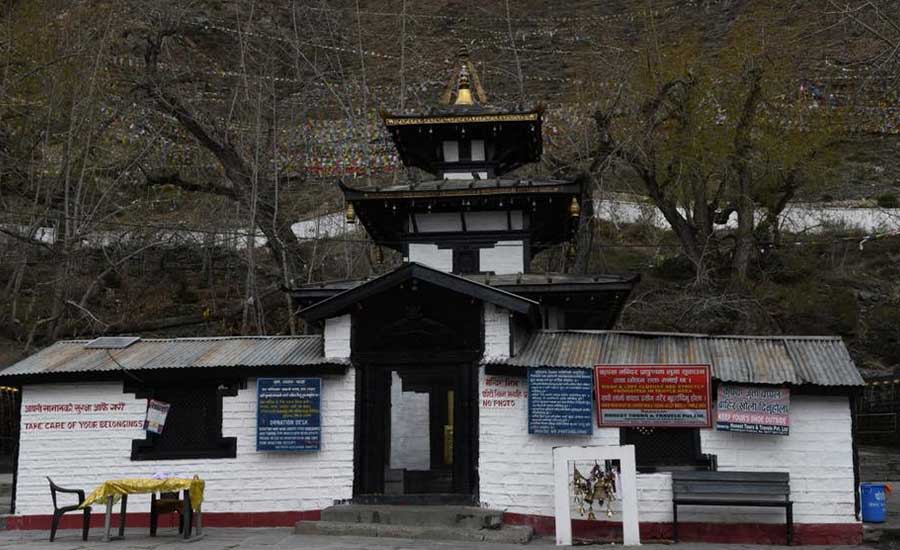
Muktinath Temple is one of Nepal’s most revered pilgrimage destinations, nestled in the remote Mustang district at an altitude of 3,762 meters in the Annapurna Himalayas. Known as the “Place of Liberation”, it holds immense spiritual importance for both Hindus and Buddhists who believe a visit here leads to salvation and freedom from the cycle of rebirth.
The temple is dedicated to Lord Vishnu and features a classic pagoda-style design with a golden roof. Around its courtyard flow 108 sacred water spouts, known as Mukti Dhara, where devotees take ritual baths to cleanse body and soul. Nearby stands the Jwala Mai Temple, where a natural eternal flame fueled by natural gas has burned for centuries, symbolizing divine presence.
For Hindus, Muktinath is among the 51 Shakti Peeths and one of the eight most sacred shrines of Lord Vishnu. Buddhists revere it as a site blessed by Guru Rinpoche (Padmasambhava), who meditated here during his Himalayan journey. This unique blend of two major religions makes Muktinath a rare center of spiritual harmony.
Beyond its religious significance, Muktinath is surrounded by breathtaking landscapes of Mustang—snowcapped peaks, deep gorges, and traditional villages like Kagbeni—making it not only a sacred pilgrimage but also a memorable Himalayan travel experience.
Historical and Religious Significance
Hindu Beliefs
According to Hindu mythology, Muktinath is one of the 108 Divya Deshams (sacred shrines of Lord Vishnu). Pilgrims believe that bathing in the 108 water spouts (Muktidhara) around the temple and cleansing in the two sacred ponds (Mukti Kunda) grants salvation from the cycle of rebirth. Devotees consider this temple an important stop in their spiritual journey toward liberation.
Buddhist Beliefs
For Buddhists, Muktinath is equally significant. It is revered as Chumig Gyatsa in Tibetan, meaning “Hundred Waters.” Guru Padmasambhava, the founder of Tibetan Buddhism, is said to have meditated here. The eternal flame (Jwala Mai), burning from natural gas, is worshipped as a sacred element symbolizing the union of earth, water, fire, and air.
Highlights of Muktinath Temple
Sacred Temple Complex: A pagoda-style temple dedicated to Lord Vishnu, blending Hindu and Buddhist traditions.
108 Water Spouts (Muktidhara): Pilgrims bathe under icy waters for spiritual purification.
Mukti Kunda (Sacred Ponds): Believed to cleanse sins and bring salvation.
Jwala Mai Temple: Houses an eternal natural flame, worshipped by both Hindus and Buddhists.
Panoramic Views: Stunning Himalayan landscapes including Dhaulagiri and Nilgiri ranges.
Cultural Fusion: Hindu priests conduct rituals while Buddhist nuns manage parts of the temple.
Best Time to Visit Muktinath
The temple is open throughout the year, but accessibility depends on weather:
Spring (March to May): Pleasant weather, blooming rhododendrons, and clear skies.
Autumn (September to November): Best season with crystal-clear Himalayan views and major festivals like Dashain and Tihar.
Winter (December to February): Cold and snowy, but fewer crowds.
Monsoon (June to August): Travel can be challenging due to landslides, but Mustang lies in the rain shadow, making it drier than other regions.
How to Reach Muktinath Temple
By Flight: Take a short flight from Pokhara to Jomsom and then drive/trek to Muktinath.
By Road (Jeep Tour): A popular option for pilgrims, driving from Pokhara or Kathmandu through Beni, Tatopani, Kagbeni, and Jomsom.
By Trek: Muktinath is a highlight of the Annapurna Circuit Trek, offering cultural immersion and breathtaking landscapes.
By Helicopter Tour: Luxury option from Pokhara or Kathmandu for those seeking a quick pilgrimage with Himalayan views.
Permits Required
Since Muktinath lies within the Annapurna Conservation Area, visitors require:
ACAP Permit (Annapurna Conservation Area Permit)
TIMS Card (Trekkers’ Information Management System)
These can be arranged in Kathmandu or Pokhara, or through trekking agencies like Himalayan Dream Team.
Travel Tips for Pilgrims and Trekkers
Carry warm clothes, as temperatures drop significantly at higher altitudes.
Acclimatize properly if trekking to prevent altitude sickness.
Respect local customs – remove shoes before entering the temple.
Photography may be restricted inside certain temple areas.
Bring cash, as ATMs are limited in Mustang.
Muktinath Temple in the Annapurna Circuit
For trekkers, Muktinath is often a spiritual highlight after crossing the Thorong La Pass (5,416m) on the Annapurna Circuit. Pilgrims and trekkers share the same path, creating a unique blend of adventure and devotion.
Suggested Itineraries
Annapurna Circuit Trek Itinerary (15–18 Days)

The Annapurna Circuit Trek is one of Nepal’s most famous trekking routes, circling the Annapurna Massif and crossing the high Thorong La Pass (5,416m). It combines Himalayan scenery, cultural diversity, and a visit to the sacred Muktinath Temple.
Day 1: Arrival in Kathmandu – transfer to hotel, trip briefing
Day 2: Drive to Besisahar, trek begins toward Bhulbhule
Day 3–5: Trek through Chamje, Dharapani, and Chame (beautiful Gurung & Tibetan villages)
Day 6–8: Pisang → Manang (acclimatization day)
Day 9: Trek to Yak Kharka / Ledar
Day 10: Trek to Thorong Phedi (base before pass)
Day 11: Cross Thorong La Pass (5,416m) – descend to Muktinath (pilgrimage site)
Day 12–13: Trek/drive through Jomsom, Marpha (famous for apples & monasteries)
Day 14: Fly or drive from Jomsom to Pokhara
Day 15–16: Return to Kathmandu, departure
Highlights: Crossing Thorong La Pass, visiting Muktinath Temple, cultural diversity, Annapurna and Dhaulagiri views.
Upper Mustang Trek Itinerary (14–16 Days)

The Upper Mustang Trek explores the restricted kingdom of Mustang, often called the Last Forbidden Kingdom of Nepal. It is a cultural trek through Tibetan-influenced villages, monasteries, and caves.
Day 1: Arrival in Kathmandu
Day 2: Drive/fly to Pokhara
Day 3: Fly to Jomsom (2,743m), trek to Kagbeni (gateway to Upper Mustang)
Day 4–5: Trek through Chele and Syangboche (desert landscapes & monasteries)
Day 6: Trek to Ghami via spectacular cliffs and mani walls
Day 7–8: Trek to Tsarang and Lo-Manthang (walled capital of Mustang)
Day 9: Explore Lo-Manthang – monasteries, caves, royal palace, festivals (Tiji or Yartung depending on season)
Day 10–12: Return journey via Drakmar, Ghiling, and Chhuksang
Day 13: Trek to Jomsom
Day 14: Fly to Pokhara
Day 15–16: Return to Kathmandu, departure
Highlights: Lo-Manthang (walled city), ancient caves, Tibetan culture, Mustang festivals, barren Himalayan desert landscapes.
Upper Mustang Jeep Tour Itinerary (10–12 Days)

For those who want to explore Mustang without long trekking, the Upper Mustang Jeep Tour offers comfort, speed, and cultural immersion. It follows the same route but by 4WD, making it ideal for families, senior travelers, or festival trips.
Day 1: Arrival in Kathmandu
Day 2: Drive/fly to Pokhara
Day 3: Drive to Tatopani (hot springs)
Day 4: Drive through Marpha and Jomsom to Kagbeni
Day 5: Drive to Ghami (cross Syangboche Pass, cultural stops en route)
Day 6: Drive to Lo-Manthang (explore monasteries, palaces, Tibetan villages)
Day 7: Explore Lo-Manthang – horse rides, Chhoser caves, monastery visits
Day 8: Drive back via Dhakmar & Ghiling
Day 9: Drive to Jomsom, overnight
Day 10: Drive/fly to Pokhara
Day 11–12: Return to Kathmandu, departure
Highlights: Quick access to Mustang, explore Lo-Manthang & monasteries by jeep, hot springs, Chhoser caves, Mustang festivals, dramatic Himalayan road trip.
Conclusion
Muktinath Temple in Mustang, Nepal, is not only a sacred pilgrimage site for Hindus and Buddhists but also a remarkable travel destination within the Annapurna Conservation Area. With its deep spiritual significance, natural beauty, and cultural fusion, Muktinath offers an unforgettable journey for pilgrims, trekkers, and travelers alike.
Whether you arrive by trek, jeep, or helicopter, a visit to this holy temple is a once-in-a-lifetime experience that combines spirituality, Himalayan adventure, and cultural exploration.