
Trekking Permits in Nepal Explained – TIMS, ACAP, RAP & More
Nepal is home to the world’s highest peaks, legendary trekking routes, and vibrant cultures. Every year, thousands of adventurers arrive in Kathmandu and Pokhara, eager to trek the Himalayas. But before setting foot on the trails, there is one important step every trekker must complete: obtaining the correct trekking permits.
In this guide, we’ll explain everything about trekking permits in Nepal — including TIMS, ACAP, RAP, MCAP, and other region-specific permits. You’ll learn why they are necessary, how much they cost, where to get them, and which treks require which permits.
Why Are Trekking Permits Required in Nepal?
Trekking permits are not just paperwork. They play an essential role in:
Safety: TIMS (Trekkers’ Information Management System) records details of trekkers, which is vital in case of emergencies.
Conservation: Permits like ACAP (Annapurna Conservation Area Permit) and MCAP (Manaslu Conservation Area Permit) fund conservation projects, wildlife protection, and trail maintenance.
Community Support: Part of the fees go directly to local communities, supporting schools, health posts, and sustainable tourism projects.
Controlled Access: Restricted Area Permits (RAP) regulate sensitive border regions, ensuring both security and cultural preservation.
Main Types of Trekking Permits in Nepal
1. TIMS Card (Trekkers’ Information Management System)
Required for: Most trekking areas in Nepal (except restricted regions).
Issued by: Nepal Tourism Board (Kathmandu & Pokhara), Trekking Agencies Association of Nepal (TAAN), and registered trekking agencies.
Cost:
Group trekkers (with agency): NPR 1,000 (approx. USD 8)
Independent trekkers: NPR 2,000 (approx. USD 15)
Why: Helps track trekkers’ movements and ensures rescue support in case of accidents.
2. ACAP (Annapurna Conservation Area Permit)
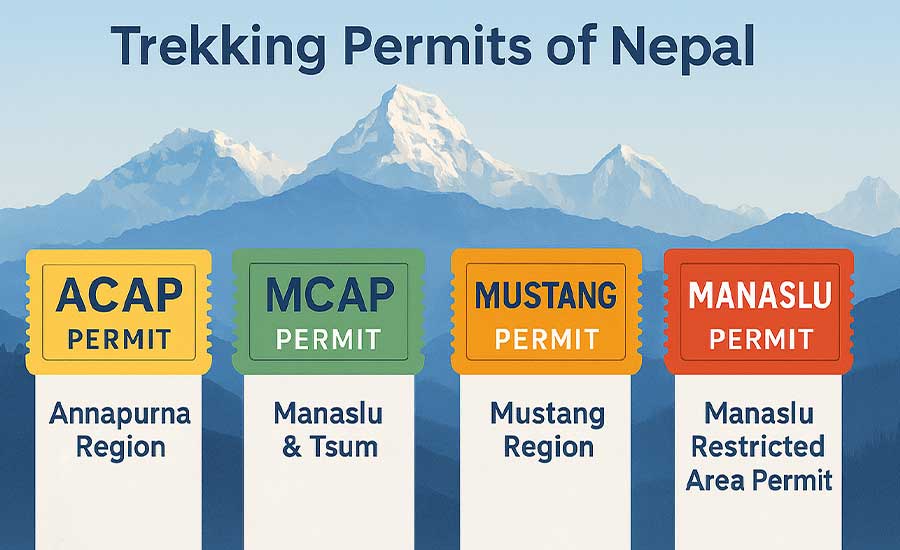
Required for: All treks inside the Annapurna region — including Annapurna Circuit Trek, Annapurna Base Camp Trek, Mardi Himal Trek, Poon Hill Trek, Tilicho Lake Trek.
Issued by: Nepal Tourism Board (Kathmandu & Pokhara).
Cost:
Foreign nationals: NPR 3,000 (approx. USD 23)
SAARC nationals: NPR 1,000 (approx. USD 8)
Why: Protects Annapurna’s fragile ecosystem and funds eco-tourism projects.
3. MCAP (Manaslu Conservation Area Permit)
Required for: Manaslu Circuit Trek, Tsum Valley Trek.
Issued by: Nepal Tourism Board.
Cost: NPR 3,000 (approx. USD 23)
Note: In addition to MCAP, trekkers need a Restricted Area Permit (RAP) for Manaslu and Tsum Valley.
4. Restricted Area Permit (RAP)
Certain areas of Nepal are classified as “restricted” because of their location near the Tibetan border and their unique culture. Independent trekking is not allowed here — you must trek with a registered trekking agency and a licensed guide.
Popular Restricted Areas & Permit Costs:
Manaslu Region (Jagat to Dharapani)
Sept–Nov: USD 100 per person (first 7 days), then USD 15 per day.
Dec–Aug: USD 75 per person (first 7 days), then USD 10 per day.
Tsum Valley
Sept–Nov: USD 40 per person (first 7 days), then USD 7 per day.
Dec–Aug: USD 30 per person (first 7 days), then USD 7 per day.
Upper Mustang
USD 500 per person (first 10 days), then USD 50 per day.
Upper Dolpo
USD 500 per person (first 10 days), then USD 50 per day.
Lower Dolpo
USD 20 per person per week.
Humla (Simikot – Hilsa route to Mt. Kailash)
USD 50 per person for 7 days.
Kanchenjunga & Makalu (restricted sections)
USD 20 per person per week.
5. Sagarmatha National Park Permit
Required for: Everest region treks, including Everest Base Camp, Gokyo Lakes, Three Passes, Everest Panorama Trek.
Issued at: Nepal Tourism Board (Kathmandu), or Monjo checkpoint near Namche Bazaar.
Cost: NPR 3,000 (approx. USD 23).
6. Khumbu Pasang Lhamu Rural Municipality Permit
Required for: All treks in the Khumbu (Everest) region.
Issued at: Lukla or Monjo.
Cost: NPR 2,000 per person (approx. USD 15).
Where to Get Trekking Permits in Nepal
Kathmandu:
Nepal Tourism Board office (Pradarshani Marg, near Ratna Park).
Trekking Agencies Association of Nepal (TAAN).
Pokhara:
Nepal Tourism Board office (near Damside).
On the Trail: Some permits like Sagarmatha NP and Khumbu Municipality can be obtained at entry checkpoints.
Through Agencies: Trekking agencies (like Himalayan Dream Team) arrange all permits for you, saving time and hassle.
Different Types of Trekking Permits
| Permit | Required Region | Cost (Foreigners) | Where to Issue |
|---|---|---|---|
| TIMS Card | Most trekking regions | USD 8–15 | NTB / TAAN / Agency |
| ACAP | Annapurna Region | USD 23 | NTB Kathmandu/Pokhara |
| MCAP | Manaslu & Tsum | USD 23 | NTB Kathmandu |
| RAP | Restricted areas (Mustang, Dolpo, Manaslu, Tsum, Humla) | USD 20–500 | NTB Kathmandu |
| Sagarmatha NP Permit | Everest Region | USD 23 | Monjo / NTB |
| Khumbu Rural Municipality | Everest Region | USD 15 | Lukla / Monjo |
Documents Needed for Permits
Valid passport copy.
Passport-size photos (2–4 pieces).
Visa details and entry stamp.
Permit application forms (handled by agency if booked).
Tips for Trekkers
Always carry cash in NPR: Permits are usually paid in local currency.
No permit, no trek: Checkpoints are strict, and fines are heavy if caught without permits.
Use a trekking agency: Especially for restricted regions like Mustang, Dolpo, and Manaslu, where a guide is mandatory.
Keep permits safe: You’ll need to show them at multiple checkpoints.
Final Thoughts – Trek Safely with Himalayan Dream Team
Getting trekking permits in Nepal might sound complicated, but with the right guidance, it’s simple and hassle-free. Each permit plays a role in conservation, safety, and community development. At Himalayan Dream Team, we arrange all your permits — from TIMS to RAP — so you can focus on the adventure, not the paperwork.
Whether you’re heading for the Everest Base Camp, Annapurna Circuit, Manaslu Circuit, or the forbidden kingdom of Upper Mustang, rest assured that your journey will be legal, safe, and well-supported.