Find Your Tour

Ghorepani Poon Hill Trek

Based On 1 ReviewDuration:11 DaysActivities:Trekking in NepalEasy to Moderate

Trip Facts

Destination:Nepal

Group Size:02–12 Persons

Region:Annapurna Region

Trip Duration:11 Days

Activities:Trekking, Hiking & Cultural Exploration

Culture:Gurung & Magar

Meals:Breakfast in Kathmandu & Pokhara • Full Board During the Trek

Accommodation:Hotel in Kathmandu & Pokhara • Mountain Lodge During the Trek

Max Elevation:Poon Hill – 3,210 m

Best Month:March–May & September–November

Trip Grade:Easy to Moderate

Trip Starts / Ends:Kathmandu

Transportation:Private Vehicle, Tourist Bus & Domestic Flight

Overview

Ghorepani Poon Hill Trek – 11 Days

The Ghorepani Poon Hill Trek is one of the most popular short treks in Nepal’s Annapurna region, combining spectacular Himalayan views, rhododendron forests and traditional Gurung and Magar villages. Reaching Poon Hill at 3,210 m, the trek is ideal for beginners, families and travellers looking for a rewarding Himalayan experience without trekking to extreme altitudes.

Himalayan Dream Team’s 11-day Ghorepani Poon Hill Trek combines the classic trekking route with cultural sightseeing in Kathmandu and time in the beautiful lakeside city of Pokhara. The trek follows a scenic route through Ulleri, Ghorepani, Poon Hill, Tadapani and Ghandruk, with comfortable teahouse accommodation along the trail.

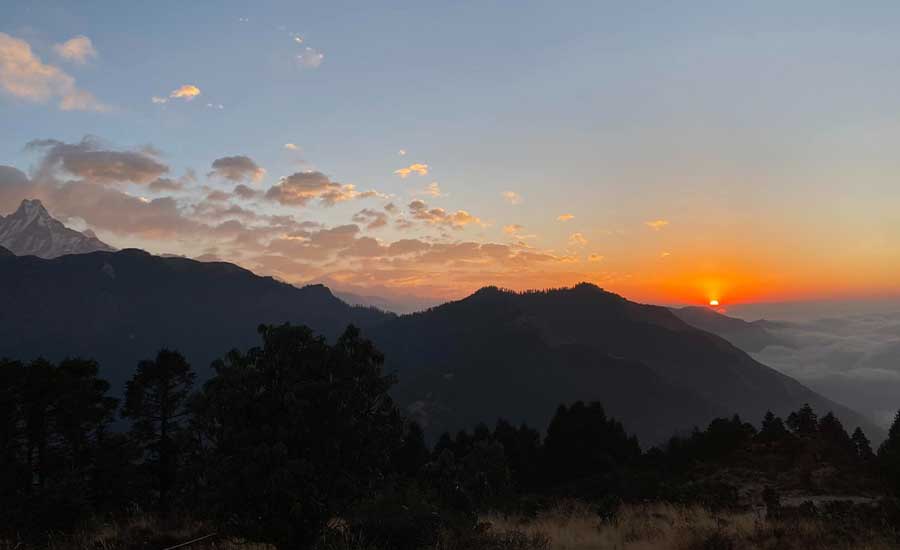
The highlight is the early-morning hike to Poon Hill (3,210 m) for sunrise. On a clear day, the viewpoint offers panoramic views across the Annapurna and Dhaulagiri ranges, including Annapurna I, Dhaulagiri I, Annapurna South, Hiunchuli, Nilgiri and Machhapuchhre (Fishtail).

Along the way, you walk through terraced farmland, rhododendron forests and mountain villages while experiencing the culture and hospitality of the Gurung and Magar communities. With moderate walking days and a maximum altitude below 3,500 m, the Ghorepani Poon Hill Trek is an excellent introduction to trekking in Nepal.

Ghorepani Poon Hill Trek Highlights

  • Discover the cultural highlights of Kathmandu before the trek.
  • Sunrise from Poon Hill (3, 210 m) with spectacular Himalayan views.
  • Panoramic views of the Annapurna and Dhaulagiri ranges.
  • See Annapurna I, Dhaulagiri I and Machhapuchhre (Fishtail).
  • Trek through beautiful rhododendron and oak forests.
  • Walk through the traditional villages of Ulleri, Ghorepani and Tadapani.
  • Experience authentic Gurung and Magar culture and hospitality.
  • Visit Ghandruk, one of the best-known Gurung villages in Nepal.
  • Stay in welcoming mountain teahouses and lodges along the trail.
  • Enjoy an easy-to-moderate trek suitable for beginners and families.
  • Experience the beautiful terraced hills and landscapes of the Annapurna region.
  • Relax and explore the lakeside city of Pokhara after trekking.
Ghorepani Poon Hill Trek – Short Itinerary

DayActivityAccommodation
Day 1Arrival in Kathmandu & welcome dinnerHotel
Day 2Kathmandu sightseeing & trek preparationHotel
Day 3Drive from Kathmandu to PokharaHotel
Day 4Drive to Nayapul & trek to UlleriMountain Lodge
Day 5Trek from Ulleri to GhorepaniMountain Lodge
Day 6Poon Hill sunrise hike & trek to TadapaniMountain Lodge
Day 7Trek from Tadapani to GhandrukMountain Lodge
Day 8Trek to Nayapul & drive to PokharaHotel
Day 9Pokhara sightseeing & leisureHotel
Day 10Fly from Pokhara to KathmanduHotel
Day 11Final departure & airport transfer

Difficulty Level of Ghorepani Poon Hill Trek

The Ghorepani Poon Hill Trek is graded easy to moderate and is suitable for beginners, families and trekkers with a reasonable level of fitness. No previous high-altitude trekking experience is required.

Most trekking days involve around 4–6 hours of walking on well-established mountain trails. The main challenges are the long stone staircases around Ulleri, together with regular uphill and downhill sections that can be tiring on the legs and knees.

The highest point is Poon Hill at 3,210 m, so the risk of serious altitude problems is considerably lower than on higher treks in Nepal. However, trekkers should still walk at a comfortable pace, stay hydrated and follow the advice of their guide.

Regular walking, stair climbing and light cardiovascular exercise before traveling will make the Ghorepani Poon Hill Trek more comfortable and enjoyable.

Best Time for Ghorepani Poon Hill Trek

The best time for the Ghorepani Poon Hill Trek is from March to May and September to November. These seasons generally offer comfortable trekking conditions, good mountain visibility and pleasant daytime temperatures. However, the trek can be done throughout most of the year with suitable preparation.

SeasonMonthsConditions & Highlights
SpringMarch–MayPleasant temperatures, good mountain views and colourful rhododendron forests in bloom.
Summer / MonsoonJune–AugustLush green landscapes, but frequent rain, clouds, slippery trails and leeches are possible.
AutumnSeptember–NovemberGenerally clear skies, excellent Himalayan views and some of the best trekking conditions.
WinterDecember–FebruaryQuieter trails and clear days, but cold mornings with possible frost or snow around Poon Hill.

Which Season Is Best?

October and November are particularly popular for clear mountain views, while March and April are excellent for trekkers who want to see the famous rhododendron forests of the Annapurna region in bloom.

Weather in the Himalayas can change quickly in any season, so mountain views and sunrise conditions can never be guaranteed.
Ghorepani Poon Hill Trek Route & Distance

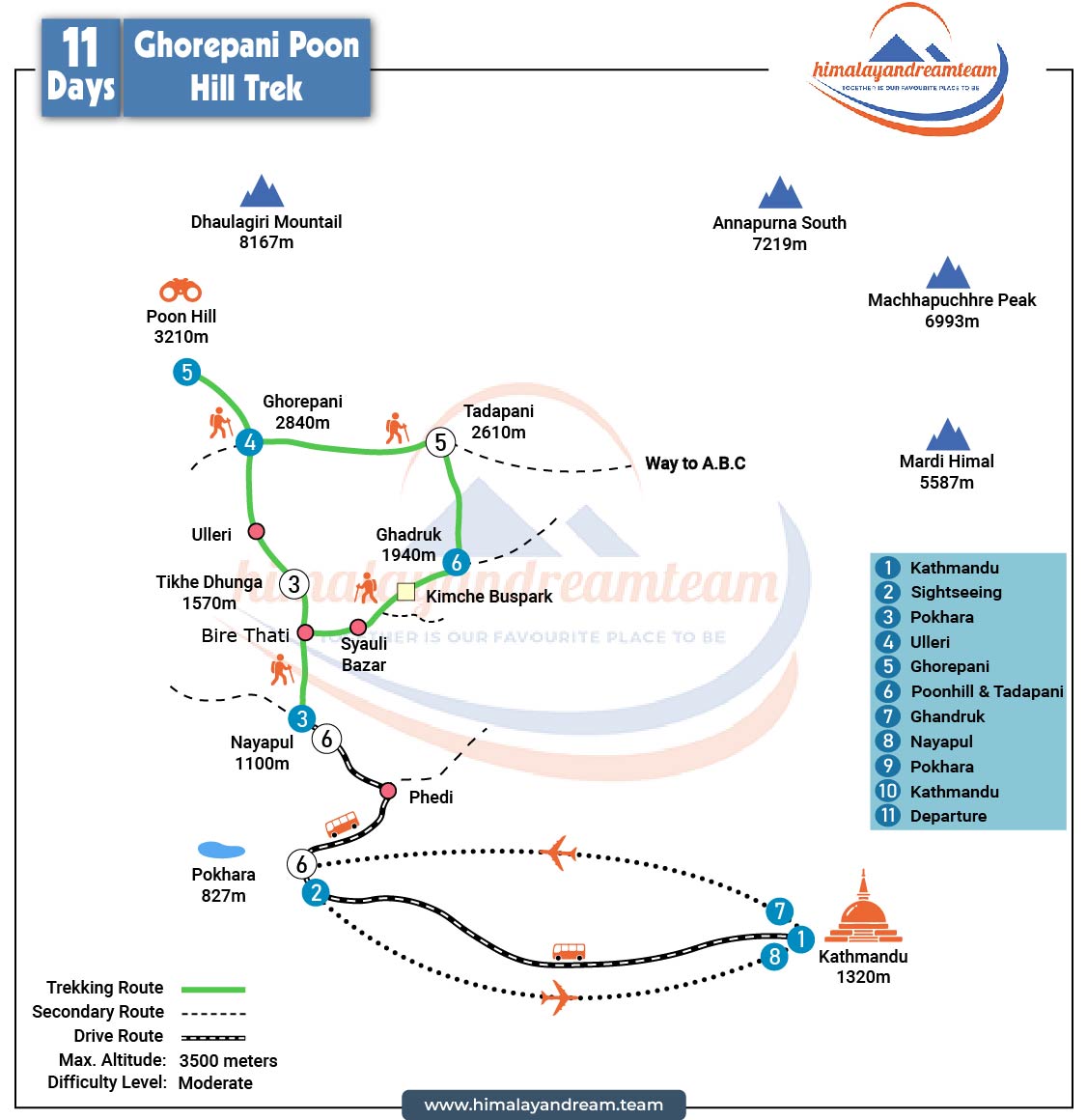
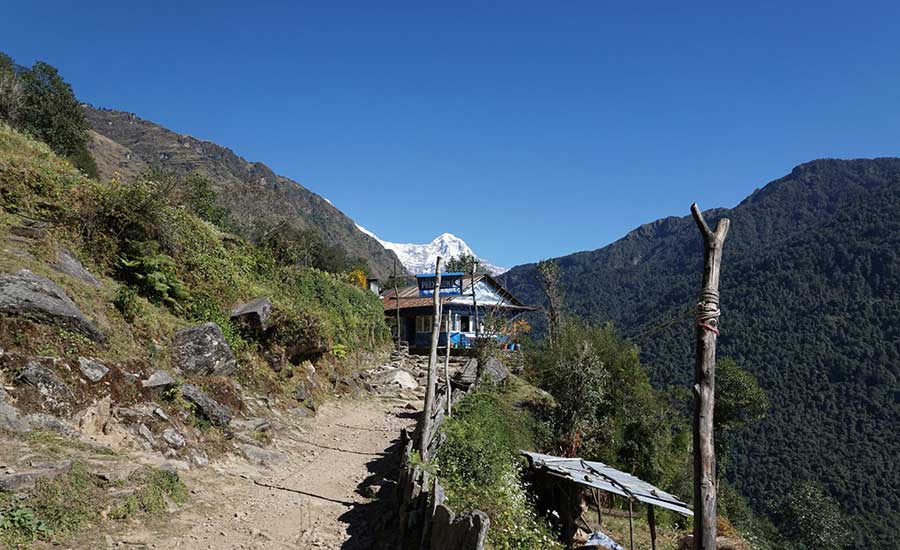
The classic Ghorepani Poon Hill Trek route follows Pokhara – Nayapul – Ulleri – Ghorepani – Poon Hill – Tadapani – Ghandruk – Nayapul – Pokhara.

Himalayan Dream Team’s itinerary includes five trekking days, with most days involving approximately 4–6 hours of walking. The exact walking distance can vary slightly depending on the trail and current road access around the trekking route.

Accommodation on the Ghorepani Poon Hill Trek

Accommodation includes comfortable hotels in Kathmandu and Pokhara and locally operated mountain lodges during the Ghorepani Poon Hill Trek. Trekking accommodation is generally clean, comfortable and twin-sharing.

LocationAccommodationWhat to Expect
KathmanduHotelComfortable room with private bathroom and breakfast
PokharaHotelComfortable room with private bathroom and breakfast
Ulleri & GhorepaniMountain LodgeTwin-sharing room with private bathroom
TadapaniMountain LodgeSimple twin-sharing room with shared bathroom facilities
GhandrukMountain LodgeTwin-sharing room with private bathroom

Bedrooms in mountain lodges are generally not heated, although dining areas may be heated during colder periods. Hot showers, Wi-Fi and battery charging are available at many lodges, sometimes for an additional charge. Facilities can vary depending on the lodge and season.

Meals on the Ghorepani Poon Hill Trek

During the Ghorepani Poon Hill Trek, breakfast, lunch and dinner are included on all trekking days. Meals are served at local mountain lodges along the route, while breakfast is included at your hotels in Kathmandu and Pokhara.

LocationMeals IncludedWhat to Expect
KathmanduBreakfastHotel breakfast • Welcome dinner on Day 1
PokharaBreakfastHotel breakfast
During the TrekBreakfast, Lunch & DinnerMeals from mountain lodge menus

During the trek, menus generally include a selection of Nepali and international-style dishes such as dal bhat, momos, soups, noodles, fried rice, pasta, potatoes, eggs, porridge, pancakes and Tibetan bread. Vegetarian meals are widely available, while vegan and other dietary requirements can often be accommodated with advance notice.

Please inform Himalayan Dream Team in advance about any food allergies or special dietary requirements so that suitable arrangements can be made wherever possible.

Tea, coffee, soft drinks, bottled or hot water and alcoholic beverages are not included unless specifically stated in the package.

Transportation During the Ghorepani Poon Hill Trek

All transportation required for the Ghorepani Poon Hill Trek is arranged by Himalayan Dream Team according to the itinerary.

RouteTransportation
Kathmandu Airport → HotelPrivate Vehicle
Kathmandu → PokharaTourist Bus
Pokhara → Nayapul / Trekking TrailheadPrivate / Local Vehicle
Nayapul / Trek End → PokharaPrivate / Local Vehicle
Pokhara → KathmanduDomestic Flight
Kathmandu → AirportPrivate Vehicle
Kathmandu → PokharaOptional Domestic Flight

The Kathmandu–Pokhara tourist bus and Pokhara–Kathmandu domestic flight are included in the standard itinerary. Travellers who prefer to fly from Kathmandu to Pokhara can request a domestic flight for an additional cost.

Why Trek Ghorepani Poon Hill with Himalayan Dream Team?

Choosing Himalayan Dream Team means trekking with a local Nepal-based team that knows the Annapurna region, its trails and communities. We focus on personal service, comfortable pacing and responsible trekking from your arrival in Kathmandu until your final departure.

  • Women-led local trekking company based in Kathmandu.
  • Experienced, government-licensed trekking guides.
  • Carefully planned itinerary with a comfortable trekking pace.
  • Quality hotels and selected mountain lodges throughout the trip.
  • Private and small-group departures available.
  • Suitable arrangements for beginners, families and older trekkers.
  • All required trekking permits and local logistics arranged.
  • Experienced porters to carry your main trekking luggage.
  • Clear inclusions and transparent pricing with no hidden costs.
  • 24-hour local support in Nepal throughout your journey.
  • Flexible options to customize or extend your Nepal trip.
  • Commitment to responsible tourism and local communities.

Day to Day Itinerary

Food/Meals

Welcome Dinner

Accommodation

Hotel

Max Elevation

1,335 m

Drive Time

30-45 minutes

Welcome to Nepal and the beginning of your Ghorepani Poon Hill Trek. Upon arrival at Tribhuvan International Airport in Kathmandu, a Himalayan Dream Team representative will meet you and transfer you by private vehicle to your hotel.

After check-in, the rest of the day is free to recover from your international journey or take a short walk around the nearby streets of Kathmandu.

In the evening, we will welcome you with a traditional Nepali dinner, giving you your first introduction to Nepali food and hospitality. Your guide will also brief you about the journey ahead and answer any initial questions about your trek in the Annapurna region.

Food/Meals

Breakfast

Accommodation

Hotel

Max Elevation

1,335 m

Drive Time

60-90 minutes

Activity Duration

3-4 hrs

Following your breakfast at the hotel, your guide will take you on a full day exploration of the profound cultural and spiritual heritage of Kathmandu, taking you to multiple UNESCO world heritage sites.

Swayambhunath (Monkey Temple): You will start the day at this lofty Buddhist stupa resting on a hill with its eye catching views of the entire Kathmandu Valley. This site is one of the oldest by gaining importance as a relious center in Nepal where it is worshiped by Buddhists and Hindus.

Pashupatinath Temple: You will then proceed to Nepal’s most revered Hindu temple complex located on the banks of Bagmati River. Here, you will observe traditional cremation services and you will see sadhus (Hindu religious hermits) practicing their spirituality.

Kathmandu Durbar Square: You can take a walk at the serene old royal palace region of historic Kathmandu after lunch. This square is a living exposition of older temples and courtyards along with houses sculptured and wooden buildings in newari style architecture.

Local Markets Visit: To end the day, you can roam around kathmandu spice and vegetable markets which will allow you to experience the daily life of Kathmandu locals and provide opportunities for street photography.

Food/Meals

Breakfast

Accommodation

Hotel

Max Elevation

1,335 m

Drive Time

6-7 hrs

After breakfast, we leave Kathmandu and travel west to Pokhara (822 m), the gateway to the Annapurna region. The journey follows winding highways through Nepal's middle hills, with views of rivers, terraced farmland, villages and green valleys along the way.

Upon arrival in Pokhara, we transfer to the hotel and check in. The remainder of the day is free to relax or enjoy a walk around the lively Lakeside area and Phewa Lake. On a clear day, the Annapurna range and Machhapuchhre (Fishtail) can be seen rising beyond the Pokhara Valley.

For travellers who prefer to avoid the long road journey, a Kathmandu–Pokhara domestic flight can be arranged at an additional cost.

Food/Meals

Breakfast, Lunch & Dinner

Accommodation

Lodge

Max Elevation

2,050 m

Drive Time

90 minutes

Trek Time

3-4 hrs

After breakfast, we drive from Pokhara to Nayapul (approximately 1,070 m), where our trek into the Annapurna foothills begins.

We walk through Birethanti and continue along the valley through terraced farmland and small settlements toward Tikhedhunga (approximately 1,540 m). From here, the trail becomes considerably steeper as we begin the famous stone staircase leading toward Ulleri.

The long climb is one of the more demanding sections of the Ghorepani Poon Hill Trek, so we take our time and maintain a comfortable pace. We eventually reach Ulleri (2,050 m), where we check into our mountain lodge for the night.

Food/Meals

Breakfast, Lunch & Dinner

Accommodation

Lodge

Max Elevation

2,874 m

Trek Time

4-5 hrs

After breakfast in Ulleri, we continue steadily uphill toward Ghorepani. The trail passes through Banthanti and Nangethanti before entering beautiful forests of oak and rhododendron.

Spring is particularly colourful along this section, when rhododendrons bloom across the hillsides. As we gain elevation, the air becomes cooler and glimpses of the surrounding Himalayan peaks begin to appear through the forest.

We arrive at Ghorepani (approximately 2,874 m) and settle into our mountain lodge. Weather permitting, the village offers beautiful views toward the Annapurna and Dhaulagiri ranges. We have an early evening in preparation for tomorrow morning's sunrise hike.

Food/Meals

Breakfast, Lunch & Dinner

Accommodation

Lodge

Max Elevation

3,210 m

Trek Time

6-7 hrs

We start before sunrise for the uphill hike from Ghorepani to Poon Hill (3,210 m), the highest point of the Ghorepani Poon Hill Trek.

On a clear morning, Poon Hill offers a magnificent panorama across the Annapurna and Dhaulagiri ranges, including Dhaulagiri I, Annapurna I, Annapurna South, Nilgiri, Hiunchuli and Machhapuchhre (Fishtail). As the morning light reaches the snow-covered peaks, we have time to enjoy the views and take photographs before returning to Ghorepani.

After breakfast at the lodge, we continue toward Tadapani. The trail climbs and descends through beautiful rhododendron and oak forests, crossing ridges and small streams before reaching Tadapani (approximately 2,610 m).

Tadapani is a peaceful mountain settlement surrounded by forest, with impressive views of Annapurna South and Machhapuchhre when the weather is clear.

Food/Meals

Breakfast, Lunch & Dinner

Accommodation

Lodge

Max Elevation

2,610 m

Trek Time

3-4 hrs

After breakfast, we leave Tadapani and descend through beautiful rhododendron and oak forests toward Ghandruk. This is a shorter trekking day, allowing us to walk at a relaxed pace and enjoy the changing scenery as we descend into the lower Annapurna foothills.

We arrive at Ghandruk (approximately 1,940 m), one of the best-known traditional Gurung villages in the Annapurna region. The village offers beautiful views of Annapurna South, Hiunchuli and Machhapuchhre (Fishtail) on a clear day.

After checking into our mountain lodge, there is time to explore the old village, learn more about Gurung culture and traditions, or simply relax and enjoy the mountain surroundings.

Food/Meals

Breakfast & Lunch

Accommodation

Hotel

Max Elevation

1,940 m

Drive Time

90 minutes

Trek Time

4-5 hrs

After breakfast, we begin our final day of trekking, descending from Ghandruk (1,940 m) through terraced farmland and traditional hillside settlements toward the Modi Khola Valley.

The trail continues downhill toward Birethanti, where we complete the main trekking route. From here, we make the final walk to Nayapul (approximately 1,070 m) and meet our vehicle for the drive back to Pokhara (822 m).

After arriving in Pokhara, we check into the hotel and the rest of the day is free. You can relax after the trek, enjoy the restaurants and cafés around Lakeside or take an evening walk beside Phewa Lake.

Food/Meals

Breakfast

Accommodation

Hotel

Max Elevation

822 m

Activity Duration

3-4 hrs

Today is reserved for sightseeing and relaxation in Pokhara after completing the Ghorepani Poon Hill Trek.

Our sightseeing program includes some of the city's well-known attractions, such as Devi's Fall and Gupteshwar Mahadev Cave. Depending on the program and available time, we can also explore local areas around Pokhara and enjoy views of the surrounding hills and mountains.

The remainder of the day is free to relax around Phewa Lake and Lakeside, enjoy a café or restaurant, do some shopping or simply rest after the trek.

Food/Meals

Breakfast

Accommodation

Hotel

Max Elevation

1,335 m

Drive Time

30-45 minutes

After breakfast, we transfer to Pokhara Airport for the short flight back to Kathmandu. Weather permitting, the flight offers beautiful aerial views of Nepal's hills and Himalayan ranges.

Upon arrival at Tribhuvan International Airport, a Himalayan Dream Team representative will meet you and transfer you to your hotel.

The remainder of the day is free for leisure. You may relax at the hotel, explore Kathmandu, enjoy some last-minute shopping or visit places you may have missed earlier in the trip.

Food/Meals

Breakfast

Max Elevation

1,335 m

Drive Time

30-45 minutes

Your 11-day Ghorepani Poon Hill Trek comes to an end today. After breakfast at the hotel, you will have some free time depending on the departure time of your international flight.

At the appropriate time, a Himalayan Dream Team representative will meet you at the hotel and transfer you by private vehicle to Tribhuvan International Airport for your onward journey. We normally arrange the transfer with sufficient time for international check-in, taking Kathmandu traffic conditions into consideration.

If your flight departs later in the day, you can leave your luggage at the hotel and enjoy some additional free time for last-minute shopping, sightseeing or relaxing before the airport transfer.

For travellers who would like to extend their stay in Nepal, Himalayan Dream Team can also arrange additional experiences in Chitwan, the Kathmandu Valley or other destinations.

Services Included on Price

Service Includes

  • Airport pickup and drop-off for international and domestic flights as required by the itinerary.
  • Traditional Nepali welcome dinner upon arrival in Kathmandu.
  • Hotel accommodation in Kathmandu and Pokhara on a twin-sharing basis with breakfast.
  • Mountain lodge accommodation during the Ghorepani Poon Hill Trek.
  • Breakfast, lunch and dinner during the trekking days.
  • Kathmandu–Pokhara tourist bus transportation.
  • Pokhara–Kathmandu domestic flight including airport transfers.
  • Guided sightseeing in Kathmandu and Pokhara with private transportation.
  • Monument and heritage-site entrance fees during the included sightseeing program.
  • Experienced, government-licensed English-speaking trekking guide.
  • Porter service during the trek, with one porter shared between two trekkers and a maximum combined luggage allowance of 20 kg per porter.
  • Annapurna Conservation Area Permit (ACAP) and required trekking permits.
  • All necessary local transportation according to the itinerary.
  • Staff expenses including salary, meals, accommodation, transportation and insurance.
  • All applicable government and local taxes.

Service Excludes

  • International airfare to and from Nepal.
  • Kathmandu–Pokhara domestic flight, if chosen instead of the included tourist bus.
  • Nepal tourist visa fees.
  • Lunch and dinner in Kathmandu and Pokhara, except for the included welcome dinner.
  • Travel and medical insurance, including emergency evacuation and rescue.
  • Personal trekking clothing, footwear and other personal equipment.
  • Personal expenses such as Wi-Fi, battery charging, hot showers, laundry, telephone calls, bottled or hot water, soft drinks and alcoholic beverages during the trek.
  • Additional porter service or excess personal luggage beyond the included porter allowance.
  • Extra hotel nights or additional expenses caused by flight delays, cancellations, weather conditions, road conditions, natural events, illness or other circumstances beyond our control.
  • Optional sightseeing, activities, accommodation or transportation not specified in the itinerary.
  • Tips for guides, porters, drivers and other staff.
  • Any other services or expenses not specifically mentioned under “Service Includes.”

Altitude Graph

Route Map

Ghorepani Poon Hill Trek route map

Frequently Asked Questions for Ghorepani Poon Hill Trek

The Ghorepani Poon Hill Trek is a popular short trek in Nepal's Annapurna region. The route passes through mountain villages, terraced hillsides and rhododendron forests before reaching Poon Hill (3,210 m), a well-known viewpoint overlooking the Annapurna and Dhaulagiri ranges.

Himalayan Dream Team's 11-day itinerary combines the trek with Kathmandu sightseeing, Pokhara and cultural experiences, making it a complete Nepal journey rather than only a short trekking package.

The trekking section of our itinerary takes approximately five days, following the route through Ulleri, Ghorepani, Poon Hill, Tadapani and Ghandruk.

Our complete Ghorepani Poon Hill Trek is 11 days, including arrival and departure days, sightseeing in Kathmandu, travel to Pokhara, the trek itself, sightseeing in Pokhara and the return flight to Kathmandu.

The trek is graded easy to moderate. It does not require technical climbing or previous mountaineering experience, but trekkers should be comfortable walking approximately 4–6 hours per day on mountain trails.

The most demanding sections include the long stone staircase toward Ulleri and the regular uphill and downhill walking throughout the route. A reasonable level of general fitness makes the trek considerably more enjoyable.

Yes. The Poon Hill Trek is one of the better choices for first-time trekkers in Nepal because the itinerary is relatively short, the trails are well established and the maximum altitude is considerably lower than on treks such as Everest Base Camp or the Annapurna Circuit.

Previous trekking experience is not required, although some preparation before travelling is recommended.

The highest point is Poon Hill at 3,210 metres (10,531 ft). Ghorepani, where you stay before the sunrise hike, is at approximately 2,874 m.

Because the trek only briefly reaches above 3,000 m and sleeps at lower elevations, altitude problems are less common than on Nepal's higher-altitude treks. However, every traveller responds differently to altitude, so you should walk comfortably, stay hydrated and inform your guide if you feel unwell.

A separate acclimatization day is normally not required for this itinerary. The trek gains altitude gradually from the lower Annapurna foothills, and the highest point at Poon Hill is reached only during the morning hike before descending again.

Our guides maintain a comfortable walking pace and monitor trekkers throughout the journey.

On a clear morning, Poon Hill (3,210 m) offers an extensive panorama across the Annapurna and Dhaulagiri ranges.

Visible mountains can include Dhaulagiri I (8,167 m), Annapurna I (8,091 m), Annapurna South, Hiunchuli, Nilgiri and Machhapuchhre (Fishtail), together with several surrounding Himalayan peaks.

Mountain visibility always depends on weather conditions.

The hike to Poon Hill begins early in the morning before sunrise from Ghorepani. The trail climbs steadily uphill to the viewpoint, normally taking around 45 minutes to 1 hour, depending on individual walking pace.

After watching the sunrise and enjoying the Himalayan views, we descend to Ghorepani for breakfast before continuing the day's trek toward Tadapani.

A headlamp, warm layers, gloves and a hat are particularly useful because the morning can be cold and the climb begins in darkness.

The main trekking seasons are March to May and September to November.

Spring (March–May) offers pleasant trekking temperatures and is particularly attractive when the rhododendron forests are in bloom.

Autumn (September–November) generally offers stable trekking conditions and good Himalayan visibility and is one of the most popular periods for the trek.

The trek is also possible during winter, although mornings and nights can be cold. The summer monsoon brings greener landscapes but also more rain, clouds, slippery trails and possible leeches.

Weather varies considerably with the season and elevation. Lower areas around Pokhara and the trailhead are generally warmer, while Ghorepani and Poon Hill can be considerably colder, particularly early in the morning.

Spring and autumn generally provide the most comfortable trekking conditions. Winter can bring frost and occasional snow at higher points, while the monsoon months are warmer and wetter.

Mountain weather can change quickly, so trekkers should carry layers and rain protection regardless of the season.

You do not need an intensive mountaineering training program. However, regular exercise before traveling will make the trek more comfortable.

We recommend walking, hiking, stair climbing, cycling or other cardiovascular exercise several times a week. If possible, practice walking on hills and stairs because the route includes many stone steps and repeated ascents and descents.

Strengthening your legs and knees is particularly helpful for the downhill sections.

Most trekking days involve approximately 4–6 hours of walking, although the exact duration depends on the day's route, trail conditions and individual walking pace.

The Poon Hill sunrise and Tadapani day is generally the longest, while the walk from Tadapani to Ghandruk is shorter.

Himalayan Dream Team's guides maintain a comfortable pace and allow time for rest, photographs and meals along the trail.

The exact trekking distance can vary depending on the trailhead, road access and trails used at the time of your trek.

Rather than focusing only on kilometres, trekkers should prepare for approximately five trekking days with an average of 4–6 hours of walking per day. Himalayan mountain trails include stone steps and significant elevation changes, so walking time is often more useful than distance when judging the difficulty.

The trek enters the Annapurna Conservation Area, so the applicable conservation-area entry permit and any other trekking documentation required for the itinerary must be arranged before trekking.

Himalayan Dream Team arranges the required trekking permits and documentation for our guests, and the applicable permit costs listed under the package inclusions are included in the trek price.

Permit regulations can change, so we use the requirements in force at the time of your trek rather than relying on outdated permit information.

Himalayan Dream Team operates the trek with an experienced, government-licensed trekking guide.

A guide provides much more than route finding. Your guide manages the daily itinerary, lodge arrangements and local logistics, monitors your wellbeing, assists if conditions change and helps you understand the communities, landscapes and culture encountered along the route.

Yes. Porter service is included in our standard package, normally with one porter shared between two trekkers and a maximum combined luggage allowance of 20 kg per porter.

You only need to carry a small daypack containing items you require during the day's walk, such as water, a camera, sun protection, rain protection and an extra layer.

Accommodation during the trekking section is in locally operated mountain lodges.

In Ulleri, Ghorepani and Ghandruk, Himalayan Dream Team normally arranges twin-sharing rooms with private bathroom facilities. In Tadapani, facilities are more basic and bathrooms are generally shared.

Bedrooms in mountain lodges are normally not heated, although dining rooms may be heated during colder periods. Hot showers, Wi-Fi and charging facilities are available at many lodges, sometimes for an additional fee.

Breakfast, lunch and dinner are included during the trekking days. Mountain lodge menus normally provide a selection of Nepali and international-style dishes.

Common options include dal bhat, momos, noodles, soups, fried rice, pasta, potatoes, eggs, porridge, pancakes and Tibetan bread.

Vegetarian food is widely available. Vegan meals and other dietary requirements can often be accommodated with advance notice. Guests with allergies or special dietary requirements should inform Himalayan Dream Team before arrival.

Yes. Drinking water is available along the trekking route. Depending on the location, trekkers can purchase boiled or treated water or refill bottles where suitable facilities are available.

We recommend carrying a reusable water bottle and following your guide's advice regarding safe drinking water. Avoid relying entirely on single-use plastic bottles where refill alternatives are available.

Wi-Fi and charging facilities are available at many mountain lodges along the Ghorepani Poon Hill route, although the quality and reliability can vary.

Some lodges charge separately for Wi-Fi, battery charging and hot showers. Electricity and internet connections can occasionally be interrupted, so carrying a power bank is useful.

You do not need expedition equipment, but you should bring clothing suitable for changing mountain conditions.

Essential items include comfortable trekking boots, moisture-wicking trekking clothes, warm layers, a fleece or light insulated jacket, waterproof jacket, trekking trousers, hat, gloves, sunglasses, sun protection, reusable water bottle, headlamp, small daypack and personal toiletries.

Trekking poles are particularly useful on the long staircases and downhill sections. The exact clothing required will depend on whether you trek in spring, autumn or winter.

Himalayan Dream Team can provide a more detailed recommended packing list before departure.

Mountain lodges provide beds, mattresses, pillows and blankets. However, a sleeping bag can provide additional warmth and comfort, particularly during colder months.

Whether you need one depends on the season and your personal preference. Himalayan Dream Team can advise you before departure based on the expected conditions.

Yes, for active families with children who are comfortable walking for several hours, Poon Hill can be an excellent introduction to trekking in Nepal.

The relatively moderate altitude and shorter trekking duration make it more suitable for families than many high-altitude Himalayan routes. However, suitability depends on the child's age, hiking experience, fitness and comfort in mountain environments.

For families, Himalayan Dream Team can adjust the walking pace and discuss private arrangements where appropriate.

Yes. Many active older travellers complete the Ghorepani Poon Hill Trek successfully. Age itself is less important than general health, mobility and fitness.

The main considerations are the long stone staircases, repeated uphill and downhill walking and several hours on the trail each day.

A private trek allows greater flexibility with walking pace, rest stops and daily arrangements.

The route passes through communities associated particularly with the Gurung and Magar people, two of the important ethnic groups of Nepal's middle hills.

Ghorepani has strong Magar cultural connections, while Ghandruk is particularly well known for its Gurung heritage. Staying in locally operated lodges and walking through traditional villages provides opportunities to experience local hospitality, architecture, farming life and mountain culture.

Visitors should respect local customs, ask permission before photographing people and follow their guide's advice when visiting cultural or religious places.

Yes. The trek can be done during December, January and February, and winter often brings quieter trails and clear mountain views.

However, temperatures are colder, especially in Ghorepani and during the early-morning Poon Hill hike. Frost and occasional snowfall are possible, so warmer clothing and appropriate footwear are important.

Yes, but June to August is not the main trekking season. The Annapurna foothills receive significant monsoon rainfall, which can bring clouds, muddy or slippery trails and leeches in forested areas.

The advantages are greener landscapes, fewer trekkers and a different atmosphere. Travellers choosing this period should carry reliable waterproof clothing and accept that Himalayan views may be less consistent.

Yes. The standard Himalayan Dream Team itinerary includes the tourist bus from Kathmandu to Pokhara and a domestic flight from Pokhara to Kathmandu.

If you prefer, we can arrange a Kathmandu–Pokhara flight instead of the tourist bus for an additional cost. Domestic flights remain subject to weather and operational conditions.

Yes. Himalayan Dream Team can organize the Ghorepani Poon Hill Trek as a private and customized journey.

Depending on your available time, fitness and interests, we can adjust hotel standards, transportation, walking pace or additional nights and discuss suitable extensions before or after the trek.

Yes. Ghorepani and Poon Hill can be incorporated into longer trekking programs in the Annapurna region.

Popular possibilities include combining the route with Annapurna Base Camp, while travellers looking for other trekking experiences can consider Mardi Himal, Khopra Danda or the Annapurna Circuit as separate or extended programs.

If you have additional time after trekking, Himalayan Dream Team can also arrange extensions to Chitwan, Bandipur, the Kathmandu Valley or other destinations in Nepal.

Himalayan Dream Team is a women-led local trekking company based in Kathmandu. Our Ghorepani Poon Hill Trek includes experienced licensed guides, porter support, selected accommodation, required trekking arrangements, transportation according to the itinerary and local support throughout your journey.

We aim to provide a comfortable trekking pace, clear package inclusions and personal service while supporting local guides, porters, lodges and communities along the route.

Client Reviews

Book Now Inquiry

Similar Packages

Enjoy the popular trekking and tour packages in Nepal Himalayas. 2026.