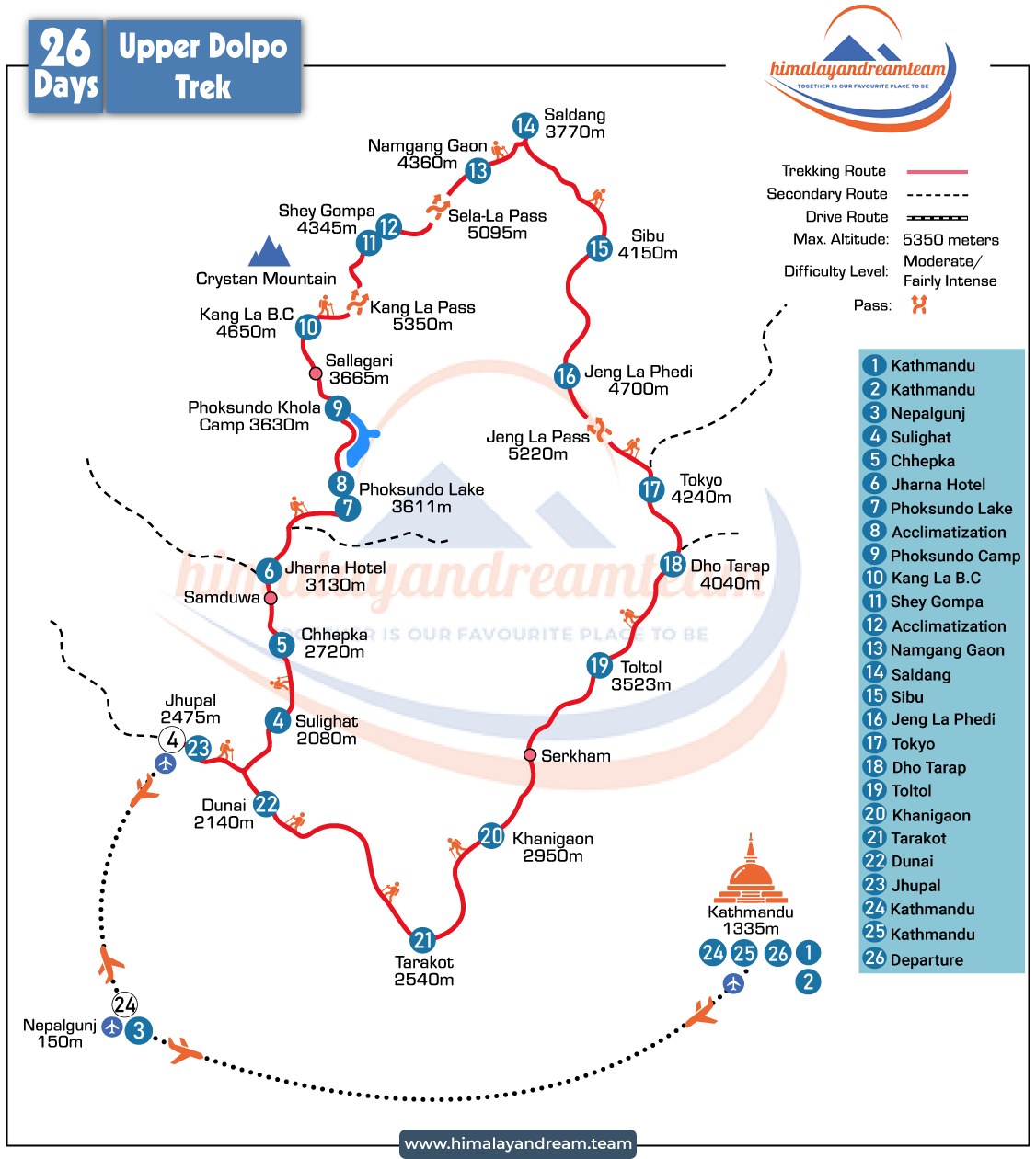
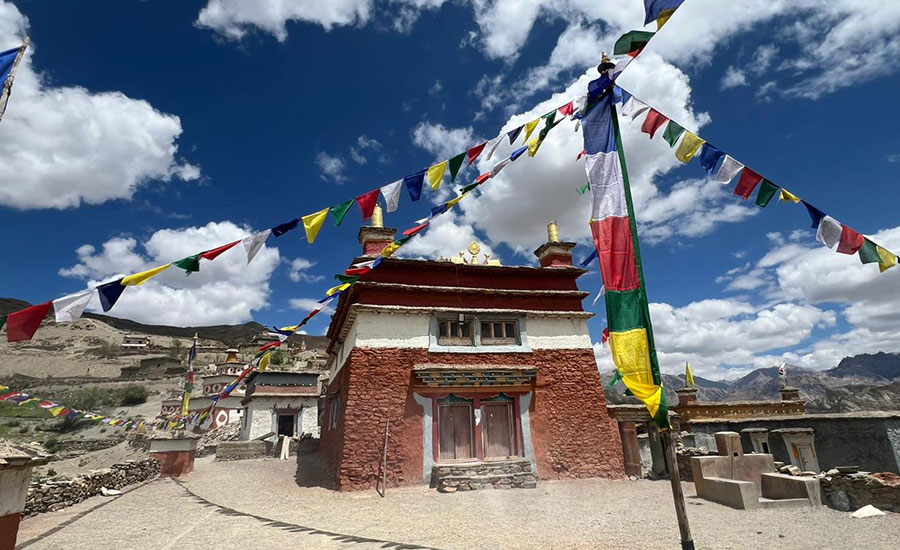
The Upper Dolpo Trek is a challenging journey through one of Nepal's most remote Himalayan regions. This 26-day private camping trek combines the turquoise waters of Phoksundo Lake, ancient monasteries, traditional Dolpo villages and three high mountain passes above 5,000 metres.
The journey begins with flights from Kathmandu via Nepalgunj to Juphal, the gateway to Dolpo. From here, the trail enters Shey-Phoksundo National Park and follows the Suli Gad Valley through Chhepka and Ringmo to spectacular Phoksundo Lake (3,611 m). After an acclimatization day beside the lake, the route continues deeper into Upper Dolpo and crosses Kang La Pass (5,350 m) to Shey Gompa and sacred Crystal Mountain.
Beyond Shey Gompa, the trek crosses Sela La Pass (5,095 m) and Jeng La Pass (5,220 m) while passing remote settlements including Namgung, Saldang, Sibu, Tokyu and Dho Tarap. Along the route, monasteries, chortens, mani walls and traditional villages reflect the region's strong Tibetan Buddhist and Bon cultural traditions.

Because accommodation and food services are limited along the remote sections of Upper Dolpo, this journey is operated as a fully supported private camping trek. Himalayan Dream Team provides an experienced trekking guide, cook, kitchen and support crew, camping equipment, freshly prepared meals and transportation of group equipment and personal baggage within the agreed allowance.
With dedicated acclimatization days at Phoksundo Lake and Shey Gompa, carefully planned high-pass crossings and a contingency day for the weather-dependent Juphal flight, this itinerary is designed for experienced trekkers looking for a well-supported journey through the remote landscapes and living culture of Upper Dolpo.
| Day | Activity | Accommodation |
|---|---|---|
| Day 1 | Arrival in Kathmandu (1,335 m) and transfer to hotel | Hotel |
| Day 2 | Kathmandu sightseeing and Upper Dolpo Trek preparation | Hotel |
| Day 3 | Fly from Kathmandu to Nepalgunj (150 m) | Hotel |
| Day 4 | Fly to Juphal (2,475 m) and trek to Sulighat (2,080 m) | Tented Camp |
| Day 5 | Trek from Sulighat to Chhepka (2,720 m) | Tented Camp |
| Day 6 | Trek from Chhepka to Jharana (3,130 m) | Tented Camp |
| Day 7 | Trek to Ringmo Village and Phoksundo Lake (3,611 m) | Tented Camp |
| Day 8 | Acclimatization and exploration day at Phoksundo Lake (3,611 m) | Tented Camp |
| Day 9 | Trek from Phoksundo Lake to Phoksundo Khola Camp (3,630 m) | Tented Camp |
| Day 10 | Trek to Kang La Base Camp (approx. 4,650 m) | Tented Camp |
| Day 11 | Cross Kang La Pass (5,350 m) and trek to Shey Gompa (4,345 m) | Tented Camp |
| Day 12 | Rest, acclimatization and exploration day at Shey Gompa (4,345 m) | Tented Camp |
| Day 13 | Cross Sela La Pass (5,095 m) and trek to Namgung (4,360 m) | Tented Camp |
| Day 14 | Trek from Namgung to Saldang (3,770 m) | Tented Camp |
| Day 15 | Trek from Saldang to Sibu (4,150 m) via Namdo | Tented Camp |
| Day 16 | Trek from Sibu to Jeng La Phedi (approx. 4,700 m) | Tented Camp |
| Day 17 | Cross Jeng La Pass (5,220 m) and trek to Tokyu (4,240 m) | Tented Camp |
| Day 18 | Trek from Tokyu to Dho Tarap (4,040 m) | Tented Camp |
| Day 19 | Trek from Dho Tarap to Toltol (3,523 m) | Tented Camp |
| Day 20 | Trek from Toltol to Khanigaon (2,950 m) | Tented Camp |
| Day 21 | Trek from Khanigaon to Tarakot (2,540 m) | Tented Camp |
| Day 22 | Trek from Tarakot to Dunai (2,140 m) | Tented Camp |
| Day 23 | Trek from Dunai to Juphal (2,475 m) | Tented Camp |
| Day 24 | Fly Juphal–Nepalgunj–Kathmandu (1,335 m) | Hotel |
| Day 25 | Contingency day in Kathmandu | Hotel |
| Day 26 | Final Departure – Transfer to Tribhuvan International Airport | — |
The Upper Dolpo Trek is a challenging high-altitude trek suitable for experienced trekkers with good physical fitness, stamina and preparation for long days in remote mountain terrain. No technical climbing skills are required, but the combination of altitude, three high passes above 5,000 metres, extended camping and limited infrastructure makes it more demanding than a typical teahouse trek in Nepal.
| Difficulty Factor | Upper Dolpo Trek |
|---|---|
| Trek Grade | Challenging |
| Highest Point | Kang La Pass – 5,350 m |
| High Passes | Kang La (5,350 m), Sela La (5,095 m) & Jeng La (5,220 m) |
| Average Walking | Approx. 5–7 hours per day |
| Longest Trekking Days | Approx. 7–8 hours on high-pass days |
| Accommodation | Fully Supported Tented Camping |
| Technical Climbing | Not Required |
| Previous Experience | Multi-day trekking experience strongly recommended |
| Main Challenges | High altitude, long trekking days, remote terrain & changing weather |
The itinerary includes dedicated acclimatization days at Phoksundo Lake (3,611 m) and Shey Gompa (4,345 m) before the major high-altitude sections. Even with careful acclimatization, trekkers should be prepared for several nights above 4,000 metres, cold conditions and consecutive days of walking far from road access and modern facilities.
Good preparation should include regular hill walking, hiking, cardiovascular exercise and endurance training in the months before departure. During the trek, you carry a personal daypack while the camping equipment, food and main baggage are transported by the support team within the included allowance of 10 kg per person, plus an additional 5 kg cabin-bag allowance.
Because Upper Dolpo is extremely remote, comprehensive travel insurance covering high-altitude trekking and emergency helicopter evacuation is essential. Your Himalayan Dream Team guide will monitor the group's condition and acclimatization throughout the trek and may adjust the program when necessary for safety.
The best time for the Upper Dolpo Trek is generally from May to June and September to October, when conditions are usually more suitable for trekking and crossing the region's high mountain passes. The route crosses Kang La (5,350 m), Sela La (5,095 m) and Jeng La (5,220 m), so snow conditions, temperatures and mountain weather are important when choosing your departure date.
Upper Dolpo lies in the rain-shadow region of the Himalayas and receives less monsoon rainfall than many trekking regions south of the main Himalayan range. This means trekking can also be possible during July and August, although domestic flights, river conditions and lower sections of the journey may still be affected by seasonal weather.
| Season | Typical Conditions | Recommendation |
|---|---|---|
| May–June | Warmer conditions, longer daylight hours and generally suitable conditions for high-pass trekking as winter snow reduces. | Highly Recommended |
| July–August | Upper Dolpo receives relatively little monsoon rainfall, but flights, rivers and lower access routes can still be affected by weather. | Possible with Flexibility |
| September–October | Generally stable post-monsoon conditions, good visibility and favourable temperatures for trekking. | Highly Recommended |
| November | Colder temperatures with an increasing possibility of snow and difficult conditions on the high passes. | Possible Early in the Month |
| December–April | Very cold at higher elevations, with snow potentially making the major passes difficult or impassable. | Generally Not Recommended |
May and June are excellent months for trekking in Upper Dolpo. Temperatures are generally warmer than in early spring, making conditions more comfortable for trekking and camping. As winter snow gradually recedes, access across the high passes usually improves, although snow conditions can vary from year to year.
September and October are among the best months for the Upper Dolpo Trek. Post-monsoon weather generally brings clearer mountain views and favourable daytime conditions for trekking. Nights at camps above 4,000 metres can still be cold, particularly later in October.
Yes. Unlike many trekking regions of Nepal, Upper Dolpo can be trekked during parts of July and August because it lies in the Himalayan rain shadow. However, the entire journey is not protected from monsoon conditions. Flights between Nepalgunj and Juphal may be delayed by poor visibility, while rivers, trails and access through lower elevations can also be affected.
For our 26-day Upper Dolpo Trek, we particularly recommend May–June and September–October. Conditions on the high passes can never be guaranteed, so the trekking guide will assess weather, snow and trail conditions and adjust the day's program when necessary for safety.
The Upper Dolpo Trek is located in a restricted trekking region of Nepal, so several permits and official trekking requirements apply. Unlike many standard trekking routes in Nepal, travellers cannot simply enter Upper Dolpo and trek independently.
For this 26-day itinerary, the required permits depend on the areas crossed between Juphal, Phoksundo Lake, Shey Gompa, Saldang, Dho Tarap and the return route through Lower Dolpo. Himalayan Dream Team arranges the necessary trekking permits and documentation before departure.
| Permit / Requirement | Upper Dolpo Trek |
|---|---|
| Upper Dolpo Restricted Area Permit | Required for entering the restricted areas of Upper Dolpo |
| Lower Dolpo Restricted Area Permit | Required for the applicable sections of this itinerary through Lower Dolpo |
| Shey-Phoksundo National Park Entry | Required for trekking inside Shey-Phoksundo National Park |
| TIMS Card | Required under the current trekking regulations for the Upper Dolpo Trek |
| Licensed Trekking Guide | Required; the trek is operated through a registered trekking agency |
No. Upper Dolpo is a restricted trekking area, and the required restricted-area permit must be arranged through a registered trekking agency. The Upper Dolpo Trek is therefore not suitable for independent trekking without the required permits and licensed trekking support.
Himalayan Dream Team arranges the Upper Dolpo trekking permits, national park entry, TIMS and required trekking documentation for our guests. Travellers need to provide the necessary passport and Nepal visa details within the requested time before the trek so that the permit process can be completed.
The required trekking permits are included in the Upper Dolpo Trek package unless otherwise stated. Permit regulations and government fees may change, so the applicable requirements are reconfirmed before departure.
The Upper Dolpo Trek is operated as a private, fully supported camping trek because accommodation and food services are very limited along the remote sections of the route. Unlike popular teahouse treks in the Everest or Annapurna regions, travelling through Upper Dolpo requires a dedicated trekking and camping crew to support the journey.
Himalayan Dream Team organizes the camping equipment, meals, trekking staff and transportation of group supplies throughout the trek. This allows you to experience remote places such as Phoksundo Lake, Shey Gompa, Saldang and Dho Tarap while the logistical arrangements are managed by our local team.
| Service | What to Expect |
|---|---|
| Trip Style | Private, fully supported camping trek |
| Accommodation During Trek | Twin-sharing sleeping tents with camping mattresses and included sleeping bags |
| Camp Facilities | Sleeping tents, dining tent, kitchen tent, toilet tent, tables and chairs |
| Meals During Trek | Breakfast, lunch and dinner prepared by the camping cook and kitchen team |
| Drinks | Tea and coffee provided during the camping trek. Drinking water is filtered. |
| Trekking Team | Licensed trekking guide, cook, kitchen staff and support crew according to group size |
| Baggage & Equipment Transport | Porters and/or pack animals transport personal baggage, camping equipment, food and group supplies within the included allowance of 10 kg per person, plus an additional 5 kg cabin-bag allowance |
| What You Carry | A personal daypack with water, extra clothing, camera and daily essentials |
During the trekking section, accommodation is in tented camps established by our support crew at suitable locations along the route. Sleeping tents, mattresses and sleeping bags are provided, together with a separate dining tent, kitchen tent and toilet tent. Tables and chairs are also carried for use at camp.
Camping facilities in Upper Dolpo are naturally more basic than hotel or lodge accommodation, particularly at remote high-altitude camps. However, having a dedicated crew allows the group to travel through areas where permanent trekking lodges and restaurants are unavailable or extremely limited.
During the camping trek, breakfast, lunch and dinner are included and prepared by our experienced cook and kitchen team. Meals are planned to provide sufficient energy for long trekking days and high-altitude conditions, using available fresh and dry ingredients carried or sourced along the route where practical.
Typical meals may include porridge, eggs, bread, pancakes, rice, noodles, pasta, potatoes, soups, vegetables, dal bhat and other Nepali or simple international-style dishes. The exact menu varies according to altitude, availability of ingredients and the length of time between supply points.
Before and after the camping trek, accommodation is provided in hotels in Kathmandu and Nepalgunj on a twin-sharing basis, as specified in the itinerary. Breakfast is included with the hotel stays. Lunch and dinner in Kathmandu and Nepalgunj are generally not included unless specifically mentioned in the itinerary.
The fully supported camping arrangement is an important part of travelling safely and comfortably through remote Upper Dolpo. Himalayan Dream Team manages the guide, cook, support crew, camping equipment, meals and transportation of supplies so that trekkers can focus on the journey itself.
Welcome to Nepal! Upon arrival at Tribhuvan International Airport in Kathmandu, a representative from Himalayan Dream Team will welcome you and transfer you to your hotel. After check-in, you can relax or explore the lively streets and markets of Thamel at your own pace.
In the evening, meet your trekking guide for an Upper Dolpo Trek briefing, where we discuss the itinerary, high-altitude conditions, camping arrangements and final preparations. Afterwards, enjoy a traditional Nepali welcome dinner.
After breakfast, enjoy a guided sightseeing tour of some of Kathmandu Valley's UNESCO World Heritage Sites. Visit Swayambhunath (Monkey Temple), an ancient Buddhist stupa overlooking the Kathmandu Valley, followed by Pashupatinath Temple, one of Nepal's most important Hindu pilgrimage sites on the banks of the Bagmati River.
The remainder of the day is reserved for final Upper Dolpo Trek preparations. Himalayan Dream Team will complete the necessary permit procedures, while your guide checks trekking equipment and discusses the camping arrangements, high-altitude conditions and journey ahead.
This preparation day also gives you time to purchase or rent any last-minute trekking equipment before traveling to western Nepal.
After breakfast, transfer to Kathmandu Domestic Airport for the flight to Nepalgunj (55-60 minutes), the main gateway for flights into the Dolpo region. The flight takes approximately one hour, with views across Nepal as the landscape changes from the Kathmandu Valley to the lowlands of western Nepal.
Upon arrival, transfer to your hotel and enjoy the remainder of the day at leisure. Your guide will make final preparations for the following morning's flight to Juphal, where the trekking section of your Upper Dolpo journey begins.
If time permits, you may visit Bageshwori Temple, an important Hindu pilgrimage site in Nepalgunj.
After an early breakfast, transfer to Nepalgunj Airport for the morning flight to Juphal, the main air gateway to the Dolpo region. The approximately 35–40-minute flight offers impressive views as the landscape changes from Nepal's western lowlands to the rugged hills of Dolpo.
Upon arrival in Juphal, meet the rest of our trekking and camping crew. After organizing the equipment and baggage, we begin our first trek, descending through villages and cultivated fields toward the Thuli Bheri River before continuing to our campsite at Sulighat.
This relatively gentle first walking day provides a good introduction to the landscapes of Dolpo before we enter Shey-Phoksundo National Park tomorrow.
After breakfast, we begin our trek following the Suli Gad River upstream and enter Shey-Phoksundo National Park. The trail leads through a narrow river valley surrounded by forested hills as we gradually make our way toward Chhepka.
Along the route, we cross several bridges, pass small settlements and walk through forests of pine, birch and other Himalayan vegetation. The gradual ascent offers a peaceful introduction to the increasingly remote landscapes of the Dolpo region.
On arrival at Chhepka, our camping crew will prepare the campsite while you relax and enjoy the surroundings.
After breakfast, we continue upstream through the beautiful Suli Gad Valley, following the river deeper into Shey-Phoksundo National Park. The trail winds through forested hills and crosses several wooden and suspension bridges along the way.
As we gradually gain altitude, the valley becomes more dramatic and the settlements increasingly remote. We continue toward Jharana, where our camping crew prepares the campsite for the night.
Today is one of the highlights of the Upper Dolpo Trek as we make our way toward spectacular Phoksundo Lake. The trail climbs through the valley to viewpoints overlooking the impressive Phoksundo waterfall before continuing toward the traditional settlement of Ringmo Village.
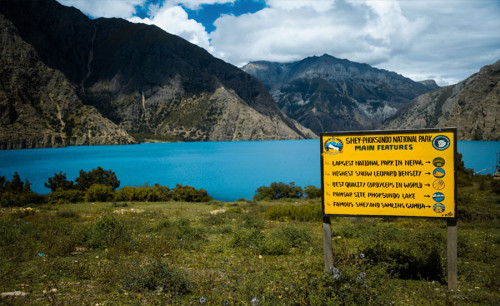
From Ringmo, a short walk brings us to the striking turquoise waters of Phoksundo Lake (3,611 m). Surrounded by steep cliffs and rugged mountains, the lake is one of the most remarkable natural sights in the Dolpo region.
Our campsite is set near the lake, where we spend the night surrounded by the peaceful landscapes of Shey-Phoksundo National Park.
Today is reserved for acclimatization at Phoksundo Lake before continuing into the higher and more remote areas of Upper Dolpo. Spending a second night at 3,611 metres gives the body valuable time to adjust before the significant altitude gain ahead.
After breakfast, we can explore Ringmo Village and visit the nearby monastery, providing an opportunity to learn more about the local culture and traditions of Dolpo.
The remainder of the day is kept relaxed, with time to rest beside Phoksundo Lake and enjoy the surrounding mountain scenery.
After breakfast, we leave our campsite and follow the dramatic trail along the western shore of Phoksundo Lake. Sections of the narrow trail traverse high above the turquoise water, offering impressive views across the lake and its surrounding cliffs.
Beyond the lake, we enter a much more isolated landscape and follow the valley toward Phoksundo Khola. Settlements become scarce as we move deeper into the remote terrain of Upper Dolpo.
We reach our campsite near Phoksundo Khola, where our crew prepares camp and a freshly cooked evening meal.
Today we leave the Phoksundo valley and begin a significant ascent toward Kang La Base Camp. The trail follows the upper valley through increasingly rugged terrain as we climb into the high Himalayan landscape.
We continue steadily toward our camp below Kang La Pass, gaining considerable altitude during the day. Because of the elevation, we maintain a comfortable pace, stay well hydrated and allow sufficient time for rest.
Our high camp at approximately 4,650 metres places us in position for tomorrow's challenging crossing of Kang La Pass (5,350 m) and the journey to Shey Gompa.
Today is one of the most challenging and rewarding days of the Upper Dolpo Trek. After an early breakfast, we begin the steady climb toward Kang La Pass (5,350 m), also known as Nagdalo La. Due to the high altitude and demanding ascent, we maintain a comfortable and steady pace.
From the top of Kang La, enjoy impressive views across the rugged mountains and remote valleys of Upper Dolpo. After taking time at the pass, we descend carefully and continue through the valley toward Shey Gompa.
Shey Gompa lies beneath sacred Crystal Mountain and is one of the most important spiritual sites in Dolpo. After this memorable high-pass crossing, we settle into our campsite for a well-earned rest.
After yesterday's demanding crossing of Kang La, today is reserved for rest, acclimatization and exploration at Shey Gompa. Spending a second night at this altitude also allows the body additional time to adjust before crossing another high mountain pass.
We visit historic Shey Gompa and learn about its spiritual importance to the people of Dolpo. Nearby Crystal Mountain is considered sacred and has long been associated with pilgrimage and religious traditions in the region.
The remainder of the day is kept relaxed, with time to rest at camp and enjoy the peaceful surroundings of this exceptionally remote part of Upper Dolpo.
After breakfast, we leave Shey Gompa and begin our ascent toward Sela La Pass (5,095 m), another major high-altitude crossing on the Upper Dolpo route.
The climb takes us through a stark and beautiful Himalayan landscape. From the pass, weather permitting, there are expansive views across the remote valleys and mountains of Dolpo.
We then descend through open high-altitude terrain toward Namgung, where our camping crew prepares the campsite near this traditional settlement.
Today's shorter trek gives us more time to experience the distinctive landscapes and traditional settlements of Upper Dolpo. From Namgung, the trail initially climbs through dry, high-altitude terrain before beginning its descent toward Saldang.
Saldang is one of the larger traditional villages in Upper Dolpo, situated above the Nagon Khola and surrounded by cultivated fields and barren mountain slopes. Its stone houses, agricultural terraces and remote setting provide an interesting glimpse into everyday life in this isolated Himalayan region.
After reaching our campsite, there is time to rest and explore the village and its surroundings.
After breakfast, we leave Saldang and follow the Nagon Khola through the remote valley. Along the way, we pass cultivated fields, traditional stone houses, chortens and mani walls that reflect the strong Tibetan Buddhist cultural influence of Upper Dolpo.
We continue through Namdo, another traditional Dolpo settlement, before following the valley toward Sibu. The surrounding landscape remains dry and dramatic, with scattered settlements contrasting against the high mountain terrain.
On reaching Sibu, our camping crew prepares the campsite for the night. We rest here before tomorrow's climb toward Jeng La Phedi and the next major high-pass crossing.
After breakfast, we leave Sibu and continue through the remote upper valley, gradually climbing toward Jeng La Phedi. As we gain altitude, the cultivated areas disappear and the landscape becomes increasingly rugged and barren.
The steady ascent takes us deeper into the high Himalayan terrain, with wide views across the surrounding valleys and mountains. We maintain a comfortable pace as we approach our campsite below Jeng La Pass.
The remainder of the afternoon is kept relaxed, allowing time to rest, acclimatize and prepare for tomorrow's demanding crossing of Jeng La Pass (5,220 m).
After an early breakfast, we begin the steady ascent from Jeng La Phedi toward Jeng La Pass (5,220 m), the third major high pass of our Upper Dolpo journey.
Reaching the top of Jeng La rewards us with impressive views across the surrounding mountains and, in clear weather, toward the Dhaulagiri massif. After taking time to enjoy the scenery, we descend carefully into the broad Tarap Valley.
The trail continues through the high valley toward Tokyu, a traditional settlement surrounded by cultivated fields and dramatic mountain landscapes. Here, our camping crew prepares the campsite for the night.
Today's shorter walk takes us through the beautiful upper Tarap Valley. After several demanding high-pass days, the gentler terrain allows more time to appreciate the traditional villages, cultivated fields, chortens and monasteries along the route.
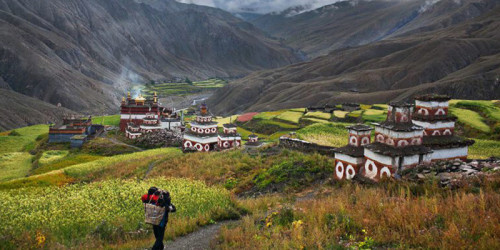
We gradually descend toward Dho Tarap, one of the most important traditional settlements in Dolpo. The village's stone houses, monasteries and surrounding fields reflect the strong Tibetan cultural influence found throughout this remote region.
After reaching camp, there is time to rest and explore Dho Tarap and its surroundings.
After breakfast, we leave Dho Tarap and begin our gradual descent through the Tarap Valley, following the Tarap Chu downstream.
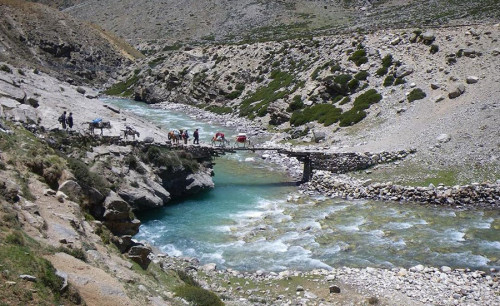
The trail passes through an impressive landscape of open valley, rocky cliffs and narrow sections of gorge. We cross the river at several points and pass seasonal grazing areas as we steadily descend toward lower elevations.
By afternoon, we reach Toltol, where our camping crew prepares the campsite beside the river for the night.
We continue our descent along the Tarap Chu, following the river through an increasingly narrow and dramatic gorge.
The trail passes beneath steep cliffs and crosses the river several times as we make our way toward lower elevations. As we descend, the landscape gradually becomes greener and the warmer conditions provide a noticeable contrast to the high, dry valleys of Upper Dolpo.
We eventually reach Khanigaon, where our camping crew prepares the campsite and we settle in for a well-earned rest.
After breakfast, we continue downstream through the lower Tarap Valley toward the confluence of the Tarap Chu and Barbung Khola. The trail follows the river through increasingly greener surroundings, crossing bridges and passing small settlements along the way.
We continue toward Tarakot, a historic settlement situated above the Thuli Bheri River. The lower elevation and changing vegetation provide a clear contrast to the high-altitude landscapes crossed earlier in the trek.
After reaching our campsite, the remainder of the afternoon is available to rest and, if time permits, explore the village and surrounding area.
After breakfast, we follow the Thuli Bheri River toward Dunai, passing small settlements, cultivated fields and the greener landscapes of lower Dolpo. Today's trail is relatively comfortable compared with the demanding high-altitude sections of the Upper Dolpo Trek. As we approach Dunai, we gradually return to a more populated part of the region.
Dunai is the administrative centre of Dolpa District and an important settlement in the region. On arrival, we settle into our campsite and enjoy a relaxing evening after completing another stage of our journey through Dolpo.
After breakfast, we begin the final walking day of our Upper Dolpo Trek. Leaving Dunai, we follow the valley before gradually climbing toward Juphal.
The final section leads through cultivated hillsides and small settlements as we make our way back to Juphal, where our trekking journey began. On arrival, we settle into our campsite and enjoy a well-earned rest after completing the trekking section of this remarkable journey through Dolpo.
This evening is also an opportunity to spend time with our guide, cook and camping crew who have supported us throughout the trek.
After an early breakfast, we transfer to Juphal Airport for the morning flight to Nepalgunj (35-40 minutes). The short mountain flight takes us out of the remote hills of Dolpo and back to the lowlands of western Nepal.
Upon arrival in Nepalgunj, we connect with our onward flight to Kathmandu (55-60 minutes). After landing, a Himalayan Dream Team representative will meet you at the airport and transfer you to your hotel. The remainder of the day is free to relax after the long journey through Upper Dolpo.
Flights from Juphal are dependent on weather, visibility and operational conditions, so schedules can occasionally change. For this reason, the following day is kept as a contingency day in Kathmandu.
Today is kept as a contingency day because flights between Juphal and Nepalgunj are weather-dependent. Including this additional day provides valuable flexibility in case the return flight from Dolpo is delayed or cancelled.
If all flights operate according to schedule, the day is free to enjoy Kathmandu at your own pace. You can relax at the hotel, explore the city, enjoy some last-minute shopping or simply rest after the trek. Optional sightseeing can also be arranged upon request.
Your 26-day Upper Dolpo Trek comes to an end today. After breakfast at the hotel, you will have free time depending on the departure time of your international flight.
At the appropriate time, a Himalayan Dream Team representative will meet you at the hotel and transfer you by private vehicle to Tribhuvan International Airport for your onward journey. We arrange the transfer with sufficient time for international check-in while taking Kathmandu traffic conditions into consideration.
If your flight departs later in the day, you can leave your luggage at the hotel and enjoy some additional free time in Kathmandu before the airport transfer.
If you would like to extend your stay in Nepal, Himalayan Dream Team can also arrange additional experiences in Pokhara, Chitwan, Bardia, the Kathmandu Valley or other destinations.
The Upper Dolpo Trek is not generally recommended as a first multi-day trek. It is a challenging, remote journey involving long walking days, extended camping and three passes above 5,000 metres.
You do not need technical climbing experience, but previous multi-day hiking or trekking experience, good cardiovascular fitness and preparation for consecutive days in mountain terrain are strongly recommended.
The Upper Dolpo Trek is graded challenging. Most trekking days involve approximately 5–7 hours of walking, with some high-pass days requiring around 7–8 hours or more depending on weather and trail conditions.
The principal challenges are high altitude, three passes above 5,000 metres, remote terrain, cold temperatures and the extended duration of the camping trek. No technical mountaineering skills are required
The highest point is Kang La Pass at approximately 5,350 metres. The itinerary also crosses Sela La Pass (5,095 m) and Jeng La Pass (5,220 m). These high-pass crossings are among the most demanding and scenic stages of the journey.
Our 26-day itinerary includes dedicated acclimatization days at Phoksundo Lake (3,611 m) and Shey Gompa (4,345 m). The route is planned to allow gradual progression towards the major high passes.
Trekkers should walk at a comfortable pace, stay well hydrated and immediately inform the guide of any symptoms associated with altitude. The guide may adjust the day's program when necessary for safety.
We particularly recommend May–June and September–October for this itinerary. These periods generally provide more suitable conditions for camping and crossing the high passes.
Upper Dolpo lies in the Himalayan rain shadow, so trekking can also be possible during parts of July and August. However, monsoon weather can still affect domestic flights, rivers and lower access routes. Winter is generally unsuitable for this itinerary because of extreme cold and possible heavy snow on the passes.
Yes. Upper Dolpo is a restricted trekking region, and special permits and entry documents are required. The itinerary also passes through Shey-Phoksundo National Park.
Himalayan Dream Team arranges the required permits and trekking documentation for our guests. You will need to provide the requested passport and Nepal visa details in sufficient time before departure.
No. Upper Dolpo is a restricted trekking area, and travelers must follow Nepal's applicable restricted-area trekking regulations. The required permits are arranged through an authorized trekking agency, and the trek is undertaken with licensed trekking support.
Himalayan Dream Team handles the necessary permit arrangements and provides an experienced trekking guide and support team.
Our journey begins with a domestic flight from Kathmandu to Nepalgunj in western Nepal. The following morning, we fly from Nepalgunj to Juphal (2,475 m), the starting point of the trekking route.
At the end of the trek, we return to Juphal and fly back to Kathmandu via Nepalgunj.
Flights to and from Juphal are weather, visibility and operational-condition dependent, so delays or cancellations can occur.
For this reason, our 26-day itinerary includes a contingency day in Kathmandu after the scheduled return from Juphal. If all flights operate normally, the contingency day becomes a free day for rest, sightseeing or shopping.
If a flight disruption occurs, Himalayan Dream Team will assist with the necessary arrangements and itinerary adjustments. Any additional expenses caused by delays or circumstances outside the company's control are subject to the trip's booking conditions.
Yes. This itinerary is operated as a private, fully supported camping trek. Permanent tourist accommodation and food services are limited across many remote sections of Upper Dolpo, making an organized camping operation the most suitable way to complete this route.
Our support team establishes camp and manages the equipment, kitchen and meal arrangements throughout the trekking section.
The camping setup includes sleeping tents, camping mattresses, included sleeping bags, a dining tent, kitchen tent, toilet tent, tables and chairs.
An experienced guide, cook, kitchen team and support crew accompany the trek. Porters and/or pack animals transport group camping equipment, food, supplies and personal baggage with a personal baggage allowance of 10 kg per person. An additional 5 kg cabin-bag allowance is provided.
During the camping section, breakfast, lunch and dinner are included and prepared by our cook and kitchen team. Tea and coffee are also provided.
Meals vary according to available ingredients and may include porridge, eggs, bread, pancakes, soups, rice, dal bhat, noodles, pasta, potatoes and vegetable dishes.
In Kathmandu and Nepalgunj, breakfast is included with the hotel accommodation. Other city meals are included only where specifically mentioned in the itinerary.
No. Your main trekking baggage is transported by the support team up to 10 kg per person. You also have an additional 5 kg cabin-bag allowance.
You normally carry only a daypack containing drinking water, extra layers, sun protection, camera, personal medication and other items you may need during the day's walk.
Hotels are used in Kathmandu and Nepalgunj, generally on a twin-sharing basis as specified in the itinerary.
During the trekking section from Juphal through Upper Dolpo and back to Juphal, accommodation is primarily in tented camps supported by our camping crew.
A sleeping bag is included in your Upper Dolpo Trek package, so you do not need to bring or rent one separately.
A warm sleeping bag is essential because several camps are at high altitude and nights can be very cold.
Drinking water provided during the trek is filtered. Bring reusable water bottles for your daily drinking water.
Do not drink untreated water directly from streams or other local sources. Follow your guide’s instructions on drinking water throughout the trek.
Electricity, mobile reception and internet access are very limited and unreliable once the trek enters remote Upper Dolpo. Some settlements may occasionally have charging or mobile facilities, but these should not be relied upon.
A power bank or spare batteries are useful for cameras and essential electronics. Trekkers should be prepared to spend several days without internet or mobile connectivity.
The camping team provides a basic toilet tent at camps where permanent facilities are unavailable.
Regular hot showers should not be expected on a remote Upper Dolpo camping trek. Washing facilities are basic and depend on water availability, weather and campsite conditions.
You should have good cardiovascular fitness, leg strength and endurance for repeated trekking days of approximately 5–7 hours.
Regular hill walking, hiking, stair climbing, cycling, running or other endurance training in the months before departure is useful. Training with the boots and daypack you intend to use on the trek is also recommended.
Previous high-altitude experience is strongly recommended but not necessarily compulsory for every physically fit trekker. More important is understanding how your body responds to altitude, following a gradual itinerary and communicating honestly with your guide.
If you have never trekked at altitude before, contact Himalayan Dream Team before booking so we can discuss whether Upper Dolpo is appropriate for you.
Comprehensive travel insurance is essential. Your policy should specifically cover high-altitude trekking above 5,000 metres, medical treatment, emergency evacuation and helicopter rescue where required.
Check the maximum trekking altitude covered by your insurer rather than assuming a standard travel policy includes high-altitude trekking.
Upper Dolpo is extremely remote, with limited access to medical facilities and road transport. Your guide will assess the situation and coordinate the most appropriate response depending on the location, weather and nature of the emergency.
In a serious situation, evacuation may require helicopter assistance when conditions permit. This is one reason adequate travel insurance is essential.
No. Crossing Kang La, Sela La and Jeng La depends on snow, weather and trail conditions at the time of the trek.
Safety takes priority over following the itinerary exactly. Your guide may change the walking schedule, campsite or route when conditions make an adjustment necessary.
You need equipment suitable for a remote high-altitude camping trek, including layered trekking clothing, waterproof outerwear, insulated clothing, well-broken-in trekking boots, gloves, warm headwear, sun protection, trekking poles, reusable water bottles and personal essentials. A sleeping bag is included in the package.
After booking, Himalayan Dream Team can provide a more detailed equipment checklist appropriate to the season of your departure.
Temperatures vary considerably according to the season, elevation, weather and campsite. Even during the main trekking seasons, nights above 4,000 metres can be very cold, while daytime temperatures at lower elevations may be comparatively warm.
Trekkers should therefore pack for both relatively warm walking conditions and sub-zero temperatures at high camps.
Upper Dolpo has strong Tibetan cultural influences and long-established Buddhist and Bon traditions. Along the route you encounter traditional villages, monasteries, chortens, mani walls, agricultural settlements and religious landscapes.
Important cultural locations on this itinerary include Ringmo Village, Shey Gompa, Saldang, Tokyu and Dho Tarap. Visitors should always follow the guide's advice regarding monastery etiquette, photography and local customs.
Shey-Phoksundo National Park supports a variety of Himalayan wildlife, but wildlife sightings are never guaranteed.
The trek should be chosen primarily for its landscapes, culture, Phoksundo Lake, remote villages and high mountain journey rather than with the expectation of seeing particular wild animals.
This itinerary is designed primarily as a private, fully supported camping trek. This allows the trekking and camping arrangements to be organized around your group while still respecting permit regulations, weather conditions and safe acclimatization.
Contact Himalayan Dream Team with your preferred travel dates and group size for current availability and arrangements.
Some customization may be possible depending on available time, permit requirements, domestic flight schedules, acclimatization needs and route conditions.
Because Upper Dolpo is remote and highly regulated, shortening the itinerary simply to save days is not always advisable. Any changes should preserve adequate acclimatization and realistic travel time.
Yes. After returning to Kathmandu, you can extend your stay with additional destinations such as Pokhara, Chitwan, Bardia National Park or cultural sites around the Kathmandu Valley.
Because the Upper Dolpo Trek is physically demanding, allowing some rest time before beginning another active program is a good idea.
No reviews yet. Traveled with us on this trip? Be the first to share your experience.
Enjoy the popular trekking and tour packages in Nepal Himalayas. 2026.
© 2011 - 2026 All rights reserved. Himalayan Dream Team