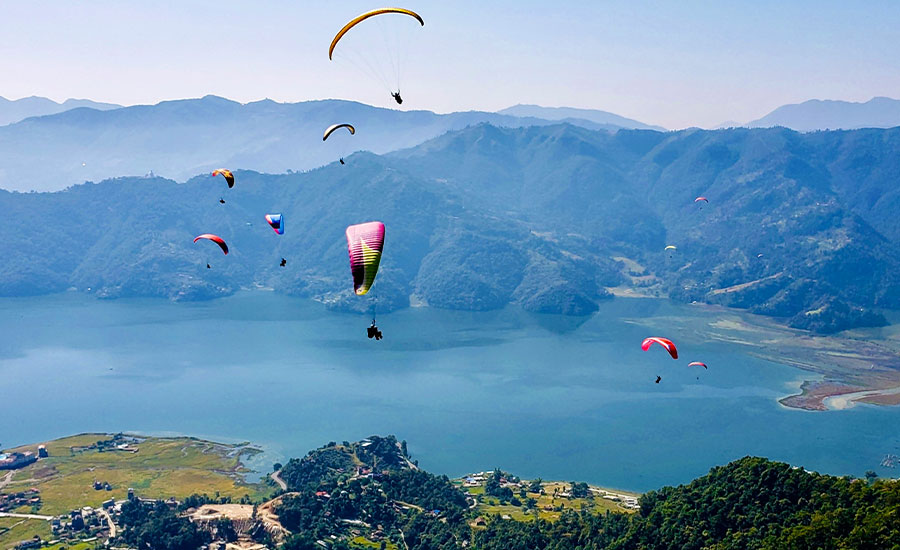
Experience Nepal from a completely different perspective with paragliding in Pokhara, one of the country's most exciting outdoor adventures. Surrounded by green hills, Phewa Lake and the Himalayan skyline, Pokhara provides a spectacular natural setting for a tandem flight above the valley.
A tandem paragliding flight in Pokhara is suitable for first-time flyers as well as travellers looking to add a memorable adventure to their Nepal holiday. You fly together with an experienced professional pilot who manages the paraglider while you enjoy the experience and the scenery below. No previous paragliding experience is required for a standard tandem flight.
After meeting the paragliding team, you will receive a safety briefing and instructions for take-off, flight and landing. Once airborne, the landscape opens beneath you, with views across Pokhara Valley, Phewa Lake, surrounding hills and terraced countryside. When the weather is clear, the Annapurna range and Machhapuchhre (Fishtail) create an impressive Himalayan backdrop.
The duration and character of each flight depend on the selected paragliding program and the weather conditions on the day. Wind, thermal activity, cloud and visibility all influence flying conditions, so departure times may occasionally be adjusted or flights postponed when conditions are unsuitable.
Himalayan Dream Team can arrange your Pokhara paragliding experience with an authorized local paragliding operator and coordinate the necessary arrangements as part of your stay in Pokhara. The activity can easily be combined with sightseeing, a visit to Sarangkot, or a trek in the Annapurna region.
Whether you are visiting Pokhara before a Himalayan trek, relaxing after your adventure or simply looking for an exciting experience during your Nepal holiday, tandem paragliding offers an unforgettable opportunity to see the beauty of Pokhara from the sky.
Please note: Paragliding is weather-dependent and subject to current operating conditions, local regulations and operator availability. Flight duration, take-off arrangements and schedules may change according to conditions on the day.
Please note: Paragliding is weather-dependent and subject to current flying conditions, local regulations and operator availability.
The best time for paragliding in Pokhara is generally from September to April, when weather conditions are typically more favourable for flying and there are better opportunities for clear views of the surrounding hills and Himalayas.
Among these months, autumn (September to November) and spring (March to April) are particularly popular. Winter can also provide excellent visibility and beautiful Himalayan scenery, although mornings are cooler.
| Season | General Conditions | Paragliding Experience |
|---|---|---|
| Spring March–May | Mild to warm weather with generally favourable flying conditions | March and April are particularly popular. Himalayan views can be beautiful, although haze and afternoon cloud may increase later in spring. |
| Summer / Monsoon June–August | Warm, humid and frequently rainy | Rain, low cloud and changing weather can interrupt flying. Paragliding schedules are generally less predictable during the main monsoon period. |
| Autumn September–November | Generally clearer and more stable after the monsoon | One of the most popular periods for paragliding, with good opportunities for Himalayan views and comfortable outdoor conditions. |
| Winter December–February | Cooler and generally drier | Winter can offer excellent visibility and beautiful Himalayan scenery. Early mornings can be cold, so an extra warm layer is recommended. |
Autumn is one of the most popular seasons for paragliding in Pokhara. As the summer monsoon gradually ends, the atmosphere generally becomes clearer and the surrounding hills remain beautifully green.
October and November are especially popular for outdoor activities in Pokhara. On clear days, paragliding can offer impressive views across Pokhara Valley, Phewa Lake and the surrounding hills, with the Annapurna range and Machhapuchhre (Fishtail) forming a spectacular Himalayan backdrop.
Winter can also be an excellent time for paragliding in Pokhara, particularly for travellers interested in clear mountain views and photography.
Days can be pleasant when the sun is out, while mornings are considerably cooler. Wearing a warm layer is recommended, particularly while waiting for your flight or travelling to the take-off area.
Spring brings warmer temperatures and is another popular season for adventure activities in Pokhara.
March and April are particularly popular months for paragliding. The combination of comfortable temperatures and generally favourable conditions makes spring an attractive time to experience Pokhara from the air.
As the season progresses toward May, warmer temperatures, haze and developing clouds can sometimes reduce distant Himalayan visibility.
The summer monsoon brings frequent rainfall, higher humidity and increased cloud cover to Pokhara. The surrounding hills and valleys become beautifully green, but flying conditions are generally less predictable.
Flights may be delayed, rescheduled or cancelled when rain, strong wind, low cloud, poor visibility or other weather conditions make flying unsuitable. Travellers planning to paraglide during the monsoon should therefore keep some flexibility in their Pokhara itinerary.
The best time of day for paragliding depends on the weather, wind and thermal conditions on the day of your flight.
Rather than choosing a flight based only on a fixed clock time, it is best to follow the recommendation of the professional paragliding operator. Flight schedules may be adjusted according to current conditions.
Yes. Paragliding is a weather-dependent adventure activity. Wind direction and strength, rain, cloud, visibility and other atmospheric conditions can all influence whether a flight can operate safely.
Even during the best paragliding season, weather conditions can change from one day to another. For safety reasons, a flight may be delayed, rescheduled or cancelled if conditions are unsuitable.
Travellers who are particularly interested in seeing the Himalayas should consider the clearer months of autumn and winter, as well as favourable days during spring.
When visibility is clear, the flight can provide beautiful views of the Annapurna range and Machhapuchhre (Fishtail) above the Pokhara landscape. However, Himalayan visibility is always dependent on weather and atmospheric conditions and cannot be guaranteed.
For the best overall combination of paragliding conditions, comfortable weather and Himalayan scenery, we generally recommend planning your Pokhara paragliding experience between September and April.
Whatever month you choose, keep some flexibility in your schedule whenever possible. The final decision to operate a flight is always based on the weather and flying conditions on the day.
Your paragliding experience begins with pick-up from your hotel in Pokhara at the agreed time. You will be transferred to the paragliding meeting point, where you will meet the local flying team and complete the necessary preparations.
Before the flight, the paragliding team will provide a short safety briefing and explain the take-off, flight and landing procedures.
For a tandem flight, no previous paragliding experience is required. You will fly together with an experienced professional pilot who controls the paraglider throughout the flight.
After the briefing, continue to the designated take-off area. The exact take-off location may vary according to current paragliding operations, weather conditions and local regulations.
Before launching, your pilot will check the equipment, harness and weather conditions and explain what you need to do during take-off.
When conditions are suitable, you and your pilot will prepare for take-off. After a short run, the paraglider lifts into the air and your flight over the Pokhara landscape begins.
During the flight, enjoy spectacular aerial views across Pokhara Valley, Phewa Lake, surrounding hills and terraced landscapes. On clear days, the Annapurna range and Machhapuchhre (Fishtail) provide a magnificent Himalayan backdrop.
The exact flight duration depends on the type of flight booked and the flying conditions on the day. Wind and thermal activity can influence both the duration and route of the flight.
Your pilot will prepare you for landing and provide simple instructions before approaching the designated landing area.
After landing, the paragliding team will assist you with your equipment and help you complete the activity comfortably.
After completing your paragliding experience, return transportation will be arranged according to your confirmed package.
You can then continue with your day in Pokhara or combine paragliding with other activities such as sightseeing, Phewa Lake, Sarangkot or a relaxing afternoon around Lakeside.
Paragliding is completely dependent on suitable weather and flying conditions. Flight schedules, take-off locations and departure times may change at short notice for safety or operational reasons.
If conditions are unsuitable, the flight may be delayed, rescheduled or cancelled according to the operator's safety decision.
No previous paragliding experience is required when you fly with a professional paragliding pilot. Before take-off, you will receive a safety briefing and simple instructions about what to do during take-off, the flight and landing.
Flight duration depends on the type of flight booked and the weather, wind and thermal conditions on the day. Because paragliding relies on natural flying conditions, the exact time in the air cannot always be guaranteed.
Your complete activity will take longer than the actual flight because it also includes transportation, preparation, safety instructions and take-off arrangements.
Paragliding is an adventure activity and involves inherent risks. Flights should be operated by experienced professional pilots using appropriate equipment and only when weather and flying conditions are considered suitable.
Passengers must follow the pilot's instructions carefully, particularly during take-off and landing. Flights may be delayed or cancelled when conditions are unsuitable.
On a clear day, you can enjoy beautiful aerial views across Pokhara Valley, Phewa Lake, surrounding green hills and terraced landscapes.
When Himalayan visibility is good, the Annapurna range and Machhapuchhre (Fishtail) create an impressive mountain backdrop. Mountain views depend on weather and cannot be guaranteed.
The main favourable period for paragliding in Pokhara is generally from September to April. Autumn, winter and spring can provide good flying opportunities and beautiful Himalayan scenery.
Paragliding is weather-dependent, however, and suitable flying conditions can vary from one day to another.
Wear comfortable clothes suitable for the weather and closed shoes with good grip. A light jacket or windproof layer is useful because it can feel cooler while flying.
During winter, warmer clothing may be necessary. Avoid loose items that could fall or interfere with the equipment during the flight.
Participation depends on the individual traveller as well as the current age, weight and safety requirements of the paragliding operator.
If you are traveling with a child, senior traveller or anyone with mobility concerns, please provide the relevant details before booking so that Himalayan Dream Team can confirm whether the activity is suitable with the operator.
Safety comes first. If wind, rain, cloud, visibility or other flying conditions are unsuitable, the operator may delay, reschedule or cancel the flight.
The available alternatives will depend on the operator's conditions and your travel schedule. We recommend keeping some flexibility in your Pokhara itinerary whenever possible.
Photo and video services may be available depending on the paragliding operator and the package selected.
If you would like photos or videos of your flight, please request this when booking so that we can confirm the available options and any additional cost.
Yes. Paragliding can easily be combined with other experiences around Pokhara, including Phewa Lake, Pokhara sightseeing and Sarangkot, or added before or after a trek in the Annapurna region.
Himalayan Dream Team can also include your paragliding experience as part of a longer private Nepal tour or trekking itinerary.
No reviews yet. Traveled with us on this trip? Be the first to share your experience.
Enjoy the popular trekking and tour packages in Nepal Himalayas. 2026.
© 2011 - 2026 All rights reserved. Himalayan Dream Team