

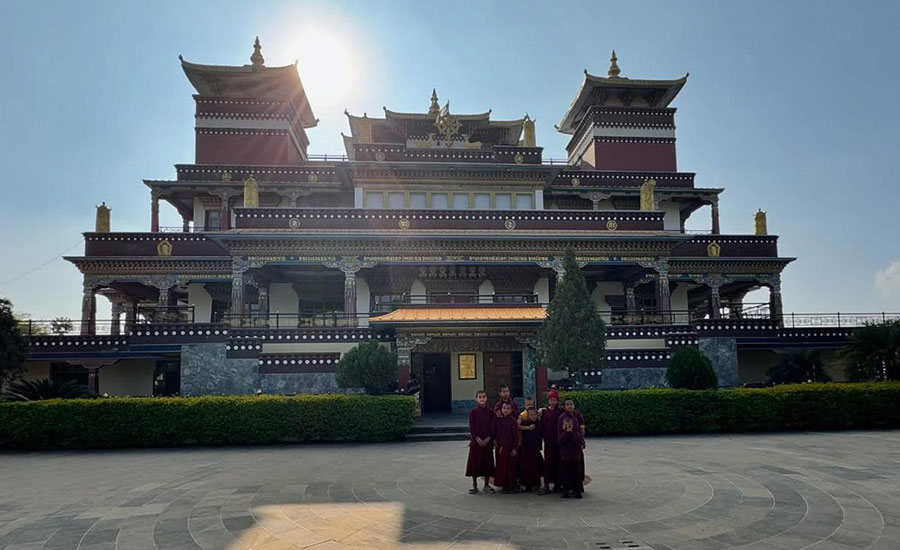
Kopan Monastery Kathmandu – Visitor, Meditation & Retreat Guide

Kopan Monastery Kathmandu is one of Nepal's best-known centres for Tibetan Buddhist study, meditation and spiritual practice. Set on a peaceful hill north of Boudhanath, the monastery offers a calm atmosphere away from the busy streets of central Kathmandu, with gardens, prayer wheels, Buddhist architecture and views across parts of the Kathmandu Valley.
Founded by Lama Thubten Yeshe and Lama Zopa Rinpoche, Kopan became internationally known for introducing Tibetan Buddhist philosophy and meditation to students from Nepal and around the world. Today, people visit for many different reasons. Some come for a peaceful day visit, while others attend structured Buddhist courses, meditation programmes or formal retreats.
Kopan is not simply another sightseeing attraction in Kathmandu. It is an active Buddhist monastery and centre of study and practice. Visitors should therefore approach the monastery respectfully and understand that access to some areas may depend on courses, retreats, prayers and other monastic activities taking place at the time.
This complete guide covers Kopan Monastery opening hours, location, things to do, meditation courses, the November Course, retreats, accommodation, meals, transportation, nearby monasteries, visitor etiquette and the best time to visit.
Kopan Monastery at a Glance
| Information | Details |
|---|---|
| Name | Kopan Monastery |
| Location | Kopan, north of Boudhanath, Kathmandu Valley, Nepal |
| Buddhist Tradition | Tibetan Buddhism – Gelug tradition |
| Founded By | Lama Thubten Yeshe and Lama Zopa Rinpoche |
| Known For | Buddhist philosophy, meditation courses, retreats and the November Course |
| Current Day Visitor Hours | 9:00 AM–5:00 PM |
| Day Visits | Possible during normal visitor periods, subject to monastery programmes |
| Courses | Introductory and advanced Buddhist teachings and meditation programmes |
| Private Retreats | Available for eligible Buddhist practitioners according to monastery guidelines |
| Accommodation | Available for courses, retreats and designated private-stay periods |
| Meals | Vegetarian |
| Best Combined With | Boudhanath Stupa and nearby Buddhist monasteries |
| Best Time to Visit | Year-round; spring and autumn are especially pleasant |
Where Is Kopan Monastery?
Kopan Monastery is situated on a hill on the northern side of Kathmandu, above the Boudhanath area.
Its elevated location is an important part of the experience. Although Kathmandu's urban neighbourhoods are nearby, the monastery grounds provide a noticeably quieter environment with gardens, Buddhist monuments and spaces for study and contemplation.
The monastery is conveniently located for travellers interested in Kathmandu's Buddhist heritage and can easily be combined with a visit to Boudhanath Stupa, one of Nepal's most important Buddhist pilgrimage sites.
A taxi or private vehicle is generally the easiest way to reach Kopan from Thamel or central Kathmandu. Driving time varies considerably depending on traffic, so it is better not to plan your visit around an exact journey time.
Kopan Monastery Opening Hours
According to the monastery's current visitor information, Kopan Monastery is open to day visitors from 9:00 AM to 5:00 PM.
Visitor access can change during major teachings, retreats, ceremonies or other special monastery programmes. If visiting Kopan is an important part of your Kathmandu itinerary, it is sensible to check the monastery's latest visitor information before travelling there.
| Visit Type | Information |
|---|---|
| Day Visitors | 9:00 AM–5:00 PM |
| Individual Visitors | Welcome during normal visitor periods |
| Large Groups / Tourist Buses | Advance arrangements are recommended |
| Private Stay | Available only during designated periods |
| Courses & Retreats | Advance registration according to the individual programme |
Why Visit Kopan Monastery?

Kopan Monastery offers something quite different from Kathmandu's major sightseeing monuments. It is a place where Tibetan Buddhism is actively studied and practised.
Learn About Buddhist Philosophy
Kopan has become internationally known for making Tibetan Buddhist teachings accessible to people from different backgrounds. Courses explore subjects such as compassion, karma, meditation, the nature of mind and the Buddhist path.
Experience a Living Buddhist Monastery
Kopan is home to an active monastic community. Visitors therefore experience a living centre of Buddhist study and practice rather than simply viewing a historic religious building.
Spend Time in a Peaceful Environment
The monastery's hilltop location, gardens and quiet spaces provide a welcome change from the traffic and activity of central Kathmandu.
Explore Tibetan Buddhist Culture
Prayer wheels, stupas, statues, monastery buildings and other religious features introduce visitors to different elements of Tibetan Buddhist culture.
Take Time for Reflection
You do not need to join a long course or retreat to appreciate Kopan. Even a short visit can provide time to walk quietly, sit in the gardens and experience the atmosphere of the monastery.
Activities You Can Do at Kopan Monastery
| No. | Activity |
|---|---|
| 1 | Explore the monastery grounds and peaceful gardens. |
| 2 | Spend quiet time away from central Kathmandu. |
| 3 | Attend an available Buddhist teaching or meditation course. |
| 4 | Learn about Tibetan Buddhist philosophy and monastic life. |
| 5 | Meditate quietly in areas open to visitors. |
| 6 | Enjoy vegetarian food when visitor dining facilities are operating. |
| 7 | Sit in the gardens and enjoy the peaceful surroundings. |
| 8 | Observe permitted aspects of monastic life respectfully. |
| 9 | Explore Buddhist books and learning resources where available. |
| 10 | Visit the monastery's stupas and Buddhist monuments. |
| 11 | Spin prayer wheels respectfully according to Buddhist tradition. |
| 12 | Combine your visit with Boudhanath and other Buddhist sites nearby. |
Not every activity is available every day. Teachings, prayers, courses and visitor access depend on the monastery's current programme.
Courses Available at Kopan Monastery
Kopan Monastery is internationally recognised for its Buddhist courses and meditation programmes.
Courses range from introductions suitable for people beginning to explore Buddhism to more advanced teachings and retreats for experienced practitioners.
Introductory Buddhist Courses
Introductory programmes provide an accessible foundation in Tibetan Buddhist philosophy and meditation.
Subjects may include:
- Basic Buddhist philosophy
- Meditation techniques
- Compassion
- Karma
- The nature of mind
- The Buddhist understanding of suffering and happiness
- Developing positive mental qualities
The exact programme, duration, teachers and prerequisites can change, so anyone planning a course should check the monastery's current course calendar before arranging flights or accommodation.
The Kopan November Course
The Kopan November Course is one of the monastery's most famous programmes and has introduced generations of international students to Mahayana Buddhist philosophy and meditation.
The residential programme traditionally provides an intensive introduction through Buddhist teachings, meditation sessions, discussion and daily practice.
It should be understood as a serious Buddhist study and meditation programme rather than a general wellness holiday.
Exact dates, duration, teachers, registration procedures and accommodation arrangements can change from year to year, so participants should always use the current course information provided by Kopan Monastery.
Kopan Monastery Retreats – Buddhist Practice and Reflection

A retreat at Kopan Monastery offers an opportunity to step away from normal daily routines and devote time to Buddhist study, meditation and practice.
However, it is important to distinguish between a Buddhist course, a private stay and a formal retreat.
A formal retreat at Kopan is not simply a quiet holiday or general mindfulness escape. Private retreat facilities are intended primarily for Buddhist practitioners who meet the monastery's requirements.
Types of Retreats at Kopan Monastery
1. Group Retreats
Kopan offers group retreats and meditation programmes according to its annual calendar.
These provide structured practice under experienced teachers. Some retreats have prerequisites, so applicants should carefully read the individual programme requirements before registering.
2. Private Retreats
Kopan also supports formal private retreats within the Tibetan Buddhist tradition.
Private retreat is intended for practitioners who wish to devote solitary time to recognised Buddhist practices such as Lamrim and other Tibetan Buddhist meditation practices.
The monastery currently has specific eligibility requirements for private retreats, including previous Buddhist study and practice. Preference may also be given to students who have previously attended programmes at Kopan or within the wider FPMT community.
For beginners, attending an introductory course before considering a private retreat is generally the more appropriate path.
Important: Travellers looking only for a general silent holiday, mindfulness break or Vipassana-style retreat should check the monastery's current guidelines carefully. Kopan's formal private retreat facilities are primarily intended for Tibetan Buddhist practice.
Why Choose Kopan Monastery for a Retreat or Buddhist Course?
- Experienced Teachers: Kopan has decades of experience teaching Tibetan Buddhist philosophy and meditation.
- Authentic Monastic Environment: Participants study and practise within an active Buddhist monastery.
- Peaceful Setting: The gardens and hilltop location provide an atmosphere suitable for reflection.
- International Community: Kopan has welcomed Buddhist students from around the world for decades.
- Structured Programmes: Different courses are available according to experience and Buddhist study background.
Accommodation at Kopan Monastery
Kopan offers accommodation primarily for people attending courses and retreats and during specifically designated private-stay periods.
It should not be treated like a normal Kathmandu hotel where travellers can simply arrive and reserve a room at any time.
Private stays are available only during periods announced by the monastery. When no private-stay period is shown in the current programme calendar, accommodation may not be available to ordinary visitors.
Types of Accommodation Available
| Accommodation | General Description |
|---|---|
| Single Rooms | Private room options, with facilities depending on room category |
| Double Rooms | Accommodation for two people depending on availability |
| Higher-Category Rooms | More comfortable private accommodation where available |
| Shared-Bathroom Rooms | Simpler accommodation using shared facilities |
| Dormitory Accommodation | Shared accommodation generally associated with course participation |
Room categories, availability and prices can change, so it is better to check the current accommodation information when registering rather than relying on old published rates.
Important Things to Know About Staying at Kopan
- Kopan is a Buddhist monastery and study centre, not a commercial hotel.
- Private stays are available only during designated periods.
- Course accommodation depends on availability and booking arrangements.
- Your preferred room category may not always be available.
- Dormitory accommodation may be used for some residential programmes.
- Guests are expected to respect monastery rules and programme schedules.
- Modest clothing and appropriate behaviour are required.
Why Stay at Kopan Monastery?
Spiritual Atmosphere
Staying inside the monastery gives participants more time to experience its peaceful environment than a short sightseeing visit allows.
Simple Living
Accommodation supports Buddhist study, meditation and reflection rather than resort-style luxury.
International Community
Residential courses bring together people from different countries who share an interest in Buddhism and meditation.
Convenience During Courses
Staying at the monastery allows participants to follow the daily programme without travelling back and forth from central Kathmandu.
Meals at Kopan Monastery
Kopan provides vegetarian meals for participants in residential programmes and retreats according to the arrangements of each programme.
Meals are generally simple and suitable for the monastery environment, with communal dining forming part of many residential experiences.
| Meal Information | Details |
|---|---|
| Food Style | Vegetarian |
| Residential Courses | Meal arrangements are generally included according to the programme |
| Retreats | Vegetarian meals are provided according to retreat arrangements |
| Dining Style | Primarily communal |
| Special Diets | Check requirements and possibilities in advance |
| Day Visitors | Cafe availability depends on current monastery operations |
Because meal charges and arrangements can change, we recommend checking current information rather than relying on older fixed prices.
How to Reach Kopan Monastery

Kopan Monastery is situated north of Boudhanath and can be reached by taxi, private vehicle, local transport or on foot from the Boudha area.
Kathmandu traffic can change considerably throughout the day, so journey times should always be considered approximate.
Main Ways to Reach Kopan Monastery
1. Taxi or Private Vehicle
For most international visitors, travelling by taxi or private vehicle is the simplest option.
A vehicle can be arranged from Thamel, Boudhanath, Kathmandu Airport or other parts of the Kathmandu Valley.
If you are visiting Kopan as part of an organised Kathmandu cultural tour, private transportation is the easiest way to combine the monastery with Boudhanath and other heritage sites.
2. Walking from Boudhanath
Travellers who enjoy walking can reach the Kopan area from Boudhanath Stupa.
The route passes through local neighbourhoods and gradually climbs towards the monastery hill.
Because Kathmandu's streets and roads continue to change, an up-to-date map or local guidance is more reliable than following old turn-by-turn directions.
3. Via Chabahil and Chuchepati
Visitors approaching from central Kathmandu may travel through the Chabahil and Chuchepati area towards Kopan.
This is a common approach from the eastern side of central Kathmandu and Boudha.
4. Public Transport
Local public transport serves the wider Kopan area.
This is inexpensive but can be less straightforward for first-time international visitors. Some walking may be required depending on the final drop-off point.
5. Motorbike or Bicycle
Experienced riders may reach Kopan by motorbike or bicycle.
Kathmandu traffic can be demanding, so this option is best for visitors who are already comfortable travelling independently in the valley.
Getting to Kopan Monastery from Kathmandu Airport
Visitors arriving at Tribhuvan International Airport can travel to Kopan by taxi or prearranged private vehicle.
Driving time depends heavily on traffic conditions.
Prepaid taxis are available at the airport, while travellers joining a residential Kopan programme should check their registration information for any specific arrival or transport instructions.
Do not assume that airport pickup is automatically provided by the monastery, as services and arrangements can change.
Kopan Monastery Visitor Etiquette
Kopan is an active Buddhist monastery, so respectful behaviour is essential.
| Guideline | Recommended Behaviour |
|---|---|
| Dress | Wear modest clothing suitable for a Buddhist monastery |
| Noise | Keep voices low around prayer, teaching and meditation areas |
| Photography | Ask before photographing monks, ceremonies or monastery interiors |
| Prayer Wheels | Use them respectfully and follow local Buddhist custom |
| Religious Objects | Do not touch statues, offerings or ritual objects unnecessarily |
| Restricted Areas | Respect signs and instructions from monastery staff |
| Courses | Do not disturb participants during teachings, meditation or periods of silence |
Can You Visit Kopan Monastery Without Joining a Course?
Yes. You do not need to register for a residential course simply to visit Kopan Monastery.
Day visitors can explore permitted areas during normal visiting hours, currently listed as 9:00 AM to 5:00 PM.
A normal day visit is ideal for travellers who want to:
- Experience the peaceful monastery grounds
- Learn about Tibetan Buddhist culture
- Walk through the gardens
- See Buddhist architecture and monuments
- Spend quiet time away from central Kathmandu
- Combine Kopan with Boudhanath
How Long Should You Spend at Kopan Monastery?
| Type of Visit | Suggested Time |
|---|---|
| Short Visit | 1–2 hours |
| Relaxed Cultural Visit | 2–3 hours |
| Kopan + Boudhanath | Half day |
| Course | According to the programme schedule |
| Retreat | According to the individual retreat programme |
Other Buddhist Monasteries Near Kopan Monastery
Kopan can be combined with several important Tibetan Buddhist monasteries and pilgrimage sites in and around the Kathmandu Valley.
1. Shechen Monastery

Shechen Monastery is located near Boudhanath and is associated with the Nyingma tradition of Tibetan Buddhism.
Its architecture, murals, monastic community and location close to Boudhanath make it a worthwhile stop for travellers interested in Tibetan Buddhist heritage.
Shechen is particularly convenient to combine with Boudhanath before or after visiting Kopan.
2. Pullahari Monastery

Pullahari Monastery is situated in the hills above the Boudhanath area and is associated with the Kagyu tradition of Tibetan Buddhism.
Its elevated setting and peaceful surroundings provide a very different atmosphere from the busy streets around Boudhanath.
Visitor access and programmes can vary, so check current arrangements if you are travelling specifically to attend a teaching or meditation programme.
3. Thrangu Tashi Yangtse Monastery – Namo Buddha

Thrangu Tashi Yangtse Monastery is located at Namo Buddha outside Kathmandu and belongs to the Karma Kagyu tradition.
Namo Buddha is one of Nepal's important Buddhist pilgrimage sites and is associated with the famous Buddhist story of a compassionate prince who offered his body to a starving tigress and her cubs.
Surrounded by hills and countryside, the monastery offers a peaceful setting for visitors interested in Buddhism, pilgrimage and meditation.
Because Namo Buddha is outside the immediate Kathmandu city area, it is better planned as a separate half-day or full-day excursion rather than described as being directly beside Kopan.
4. White Monastery – Seto Gumba
Seto Gumba, commonly called the White Monastery, is located on the western side of Kathmandu.
Its hilltop setting is known for views across the Kathmandu Valley and its distinctive Buddhist architecture.
Public access has varied over time, so visitors should check current opening arrangements before making a special journey.
5. Ka-Nying Shedrub Ling Monastery
Ka-Nying Shedrub Ling Monastery is located close to Boudhanath and is an important centre of Tibetan Buddhist study and practice.
It is particularly associated with the Nyingma and Kagyu traditions.
This corrects the old version of this article, which described Ka-Nying as belonging to the Gelug tradition.
Its convenient location makes it another worthwhile stop while exploring Boudhanath's Buddhist monasteries.
6. Buddhist Monasteries Around Pharping
Pharping, south of Kathmandu, is one of the valley's important centres of Buddhist pilgrimage and retreat practice.
The area contains numerous Tibetan Buddhist monasteries, retreat centres, caves and sacred sites.
Because Pharping is in a different part of the Kathmandu Valley, it should normally be visited as a separate half-day or full-day Buddhist heritage excursion rather than combined with Kopan in a short visit.
7. Druk Amitabha Mountain – Amitabha Monastery
Druk Amitabha Mountain is situated on the hills overlooking Kathmandu and is associated with the Drukpa Kagyu tradition.
The monastery is known for its dramatic hilltop location and Buddhist community.
As with other active monasteries, public access and programmes can vary, so current visitor information should be checked before travelling.
Kopan Monastery and Boudhanath – A Perfect Half-Day Combination
Kopan and Boudhanath Stupa complement each other extremely well.
Boudhanath is a major public Buddhist pilgrimage site surrounded by monasteries, shops, cafes and devotees performing clockwise circumambulation around the stupa.
Kopan offers a quieter monastic environment focused on Buddhist study, meditation and practice.
| Experience | Kopan Monastery | Boudhanath Stupa |
|---|---|---|
| Main Character | Active monastery and Buddhist study centre | Major Buddhist pilgrimage stupa |
| Atmosphere | Quiet and contemplative | Busy, devotional and atmospheric |
| Best For | Buddhist study, meditation and peaceful surroundings | Pilgrimage culture, heritage and photography |
| Suggested Time | 1–3 hours | 1–2 hours or longer |
For travellers interested in Tibetan Buddhism, combining both places provides a much more complete experience than visiting either site alone.
Best Time to Visit Kopan Monastery
Kopan Monastery can be visited throughout the year, although Kathmandu's seasons create different experiences.
| Season | General Conditions | Visitor Experience |
|---|---|---|
| Spring – March to May | Generally warm with pleasant mornings | Excellent for gardens, views and Kathmandu sightseeing |
| Monsoon – June to August | Warm, humid and rainy | Very green surroundings, but rain may affect walking and views |
| Autumn – September to November | Generally pleasant with clearer conditions | One of the most comfortable periods for visiting Kathmandu |
| Winter – December to February | Cool mornings and evenings | Often quieter; warm layers are recommended |
For an ordinary sightseeing visit, spring and autumn are especially pleasant.
If you are planning to attend a Buddhist course or retreat, however, the monastery's programme calendar should determine your travel dates rather than the weather alone.
Practical Tips for Visiting Kopan Monastery
- Check current visitor access before travelling.
- Current normal day visiting hours are 9:00 AM–5:00 PM.
- Wear modest clothing suitable for a Buddhist monastery.
- Allow extra time for Kathmandu traffic.
- Do not assume that courses or teachings are open to casual visitors.
- Ask before photographing monks, ceremonies or interiors.
- Keep noise to a minimum around prayer and meditation areas.
- Carry water, especially during warmer months.
- Wear comfortable footwear if walking from Boudhanath.
- Check the current programme calendar if you want to stay overnight.
- Large organised groups should arrange their visit in advance.
Frequently Asked Questions About Kopan Monastery
Where is Kopan Monastery?
Kopan Monastery is located on a hill north of Boudhanath in the Kathmandu Valley, Nepal.
What time does Kopan Monastery open?
The monastery's current visitor information lists day visiting hours from 9:00 AM to 5:00 PM. Access may change during special courses, retreats or monastery programmes.
Can tourists visit Kopan Monastery?
Yes. Day visitors are welcome during normal visitor periods as long as they respect the monastery's rules and religious environment.
Do I need to join a meditation course to visit Kopan?
No. You can make a normal day visit without joining a residential course.
Can I meditate at Kopan Monastery?
Kopan is a Buddhist study and meditation centre, but casual visitors should use only areas open to them and should not interrupt organised meditation sessions or teachings.
Can beginners attend courses at Kopan?
Yes. Kopan offers introductory programmes designed to provide a foundation in Tibetan Buddhist philosophy and meditation.
What is the Kopan November Course?
The November Course is Kopan's famous intensive residential introduction to Mahayana Buddhist philosophy and meditation. Exact dates, duration and registration requirements should be checked on the current programme calendar.
Can anyone do a private retreat at Kopan?
No. Formal private retreats have Buddhist-practice requirements and are intended primarily for practitioners with an appropriate background in Tibetan Buddhism.
Can I stay overnight at Kopan Monastery?
Yes, but accommodation is connected with courses, retreats and designated private-stay periods. Kopan should not be treated like a normal hotel with rooms continuously available to tourists.
Does Kopan Monastery provide meals?
Yes. Vegetarian meals are provided according to the arrangements of residential courses, retreats and private stays.
Can I visit Kopan and Boudhanath on the same day?
Yes. Kopan Monastery and Boudhanath make an excellent half-day Buddhist heritage combination.
How long should I spend at Kopan Monastery?
For a normal visit, approximately one to three hours is usually enough. Allow a half day if combining Kopan with Boudhanath.
Can I take photographs at Kopan Monastery?
Photography may be possible in permitted outdoor areas, but always check before photographing monks, religious ceremonies, teachings or monastery interiors.
What should I wear at Kopan Monastery?
Wear comfortable, modest clothing appropriate for a sacred Buddhist environment. Follow any additional dress instructions displayed by the monastery.
What is the best time to visit Kopan Monastery?
Kopan can be visited throughout the year. Spring from March to May and autumn from September to November generally provide comfortable conditions for sightseeing.
Is Kopan Monastery worth visiting?
Yes. It is particularly worthwhile for travellers interested in Tibetan Buddhism, Buddhist philosophy, meditation or simply experiencing a quieter and more contemplative side of Kathmandu.
Conclusion – Is Kopan Monastery Worth Visiting?
Kopan Monastery Kathmandu offers an experience quite different from ordinary sightseeing in Nepal's capital.
For day visitors, it provides peaceful gardens, Buddhist religious spaces and an opportunity to slow down after the noise and movement of central Kathmandu.
For students, Kopan offers something deeper: structured opportunities to explore Tibetan Buddhist philosophy, meditation and Mahayana teachings within an active monastic community.
For experienced Buddhist practitioners, formal retreat opportunities provide an environment for more intensive study and practice, subject to the monastery's current requirements.
The most important thing is to choose the right type of visit. If you simply want to see the monastery, visit during the current day-visiting period. If you want to stay, check the private-stay calendar. If you want to study Buddhism, choose an appropriate course. And if you are considering a formal retreat, read the monastery's eligibility requirements carefully before applying.
Kopan also combines beautifully with Boudhanath Stupa and the wider Buddhist heritage of Kathmandu, making it an excellent addition to a cultural journey through the Kathmandu Valley.
With Himalayan Dream Team Treks & Tours, a visit to Kopan can be included in a private Kathmandu cultural programme together with Boudhanath, Swayambhunath and other important Buddhist and Hindu heritage sites.
Whether you visit for a few peaceful hours or return for a longer period of study, Kopan offers something increasingly valuable in a busy capital city: time and space to slow down, reflect and experience a living Buddhist tradition.