

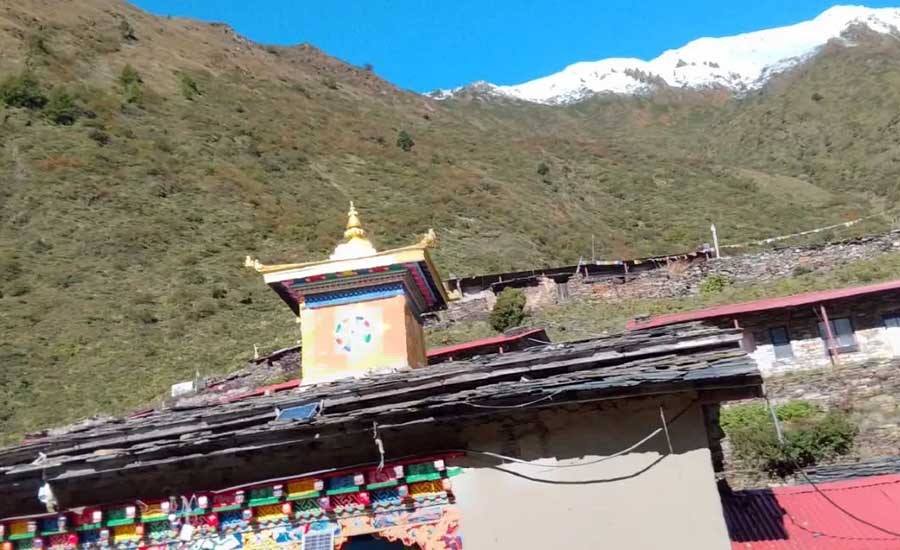
Mu Gompa Monastery, standing at approximately 3,700 metres (12,139 ft) in Upper Tsum Valley, is one of the most remote and culturally significant Buddhist monasteries reached on the Tsum Valley Trek in Nepal.
Located in northern Gorkha, close to the Tibetan border, Mu Gompa sits beyond the villages of Chhule and Nile in an increasingly open Himalayan landscape. There is no road leading directly to the monastery. For trekkers, reaching Mu Gompa means travelling overland from Kathmandu into the Manaslu region and then continuing for several days on foot through the Budhi Gandaki and Tsum valleys.
Mu Gompa is not simply a viewpoint or trekking destination. It is part of the living Buddhist heritage of Tsum Valley, where monasteries, mani walls, chortens, prayer wheels, sacred caves and traditional villages remain closely connected with everyday life.
For many travellers, the hike from Nile (approximately 3,360 m) to Mu Gompa (approximately 3,700 m) is one of the cultural highlights and the principal high point of the standard Tsum Valley Trek.
This complete Mu Gompa guide explains its location, altitude, history, Buddhist importance, how to reach Mu Gompa, the Nile to Mu Gompa trek, weather, best time to visit, accommodation, permits, altitude considerations, photography, monastery etiquette and practical trekking information.
Mu Gompa Monastery at a Glance
| Mu Gompa Fact | Information |
|---|---|
| Name | Mu Gompa / Mu Gumba |
| Location | Upper Tsum Valley, northern Gorkha, Nepal |
| Region | Manaslu / Tsum Valley |
| Approx. Altitude | 3,700 m / 12,139 ft |
| Type | Buddhist monastery |
| Cultural Influence | Tibetan Buddhist |
| Nearest Main Trekking Settlement | Nile / Chhule |
| Nile Altitude | Approx. 3,360 m |
| Nile to Mu Gompa | Generally around 2–3 hours uphill, depending on pace and conditions |
| Access | On foot as part of the Tsum Valley trekking route |
| Best General Seasons | Spring (March–May) and Autumn (September–November) |
| Main Trekking Route | Tsum Valley Trek |
| Permit Area | Restricted trekking region |
| Main Attraction | Buddhist heritage, remote setting and Upper Tsum landscape |
Where Is Mu Gompa?
Mu Gompa is located in the remote upper section of Tsum Valley in northern Gorkha District, Nepal.
Tsum Valley lies within the wider Manaslu region close to Nepal's border with Tibet. The valley branches away from the main Manaslu Circuit near Lokpa and follows a separate route north through villages including Chumling, Chhokang Paro, Chhule and Nile.
Mu Gompa lies beyond these settlements in the increasingly remote upper valley.
There is no direct road to Mu Gompa, which is one of the reasons the monastery retains such a strong sense of isolation.
Travellers normally reach the region by driving from Kathmandu toward Machha Khola and then trekking progressively higher through the valley.
What Is the Altitude of Mu Gompa?
Mu Gompa is situated at approximately 3,700 metres (12,139 feet) above sea level.
It is one of the highest important cultural sites visited on the standard Tsum Valley trekking route.
Himalayan Dream Team's itinerary gains altitude gradually before reaching Mu Gompa:
| Location | Approx. Altitude |
|---|---|
| Machha Khola | 870 m |
| Jagat | 1,350 m |
| Lokpa | 2,240 m |
| Chumling | 2,386 m |
| Chhokang Paro | 3,030 m |
| Nile | 3,360 m |
| Mu Gompa | 3,700 m |
This gradual progression is important because the body needs time to adjust as the trek enters Upper Tsum.
Why Is Mu Gompa Important?
Mu Gompa is important because it represents much more than the highest destination on a trekking itinerary.
The monastery forms part of the Buddhist religious landscape that defines Tsum Valley.
For generations, Buddhism has shaped the valley's sacred places, festivals, monasteries, architecture and community traditions. Mani walls, chortens, prayer wheels and monasteries appear throughout the trekking route.
Mu Gompa's remote location in Upper Tsum gives visitors a particularly strong impression of how closely religion, landscape and everyday Himalayan life remain connected in this region.
Visitors should therefore approach Mu Gompa as a living religious place rather than simply a tourist attraction.
History of Mu Gompa
The precise early history of Mu Gompa is not consistently documented in English-language sources.
Many published accounts date the establishment of the present monastery to the late nineteenth century, often around 1895. At the same time, the wider Tsum Valley has a much older Buddhist history, and religious practice and meditation in this Himalayan region predate the present monastery buildings.
Because written sources differ on some historical details and lineage descriptions, visitors should be cautious about treating every date or story found online as established historical fact.
What is clear is that Mu Gompa has long been associated with Buddhist religious practice in Upper Tsum and remains an important part of the valley's cultural identity.
Mu Gompa and Tibetan Buddhist Culture
Tsum Valley's proximity to Tibet is visible throughout the journey.
Traditional village architecture, Buddhist monuments, religious art, prayer flags, mani walls and monasteries all reflect centuries of cultural and religious connection across the Himalayan borderlands.
At Mu Gompa, this Tibetan Buddhist influence becomes particularly noticeable because of the monastery's isolated location near the northern end of the inhabited valley.
The monastery should be experienced quietly and respectfully. It is a place of prayer, study and religious practice, not a staged cultural attraction.
What Does the Word “Gompa” Mean?
The term gompa is commonly used across Tibetan Buddhist regions of the Himalayas for a monastery, religious complex or place of Buddhist learning and practice.
You may therefore see Mu Gompa written in different ways online, including:
- Mu Gompa
- Mu Gumba
- Mu Monastery
- Mu Gompa Monastery
For international travel searches, Mu Gompa and Mu Gompa Monastery are useful terms because they clearly identify the site.
How Do You Reach Mu Gompa?
Mu Gompa cannot be reached by normal road transportation.
The journey combines a drive from Kathmandu into the Manaslu region followed by several days of trekking.
On Himalayan Dream Team's Tsum Valley itinerary, the approach follows:
| Stage | Route |
|---|---|
| 1 | Kathmandu → Machha Khola by road |
| 2 | Machha Khola → Jagat |
| 3 | Jagat → Lokpa |
| 4 | Lokpa → Chumling |
| 5 | Chumling → Chhokang Paro |
| 6 | Chhokang Paro → Nile |
| 7 | Nile → Mu Gompa |
This gradual journey is one of the attractions of visiting Mu Gompa. Rather than arriving quickly by vehicle, trekkers experience the geographical and cultural transition from Nepal's lower hills into remote Upper Tsum step by step.
Nile to Mu Gompa Trek
The hike from Nile to Mu Gompa is the final approach to the monastery.
Nile lies at approximately 3,360 m and is one of the last permanent settlements before Mu Gompa.
From Nile, the trail continues north through an increasingly open and sparsely inhabited landscape.
The hike generally takes around 2–3 hours to reach Mu Gompa, although walking time varies with acclimatization, fitness, trail conditions, weather and the number of stops made along the way.
| Nile to Mu Gompa Trek | Details |
|---|---|
| Starting Point | Nile |
| Starting Altitude | Approx. 3,360 m |
| Destination | Mu Gompa |
| Mu Gompa Altitude | Approx. 3,700 m |
| Altitude Gain | Approx. 340 m |
| Typical Walking Time Up | Approx. 2–3 hours |
| Trail Character | Gradual high-altitude approach through open Upper Tsum landscape |
| Main Consideration | Altitude, weather and individual walking pace |
What Is the Trail from Nile to Mu Gompa Like?
The character of the landscape changes noticeably above Nile.
Settlements become fewer, vegetation becomes more limited and the valley takes on a broader, higher Himalayan character.
Rather than dense forest trekking, this section feels increasingly open and exposed.
Trekkers should walk at a comfortable pace because the trail rises above 3,500 m before reaching Mu Gompa.
Even though the day's altitude gain is not extreme, walking at 3,700 m can feel noticeably different from trekking at lower elevations.
Himalayan Dream Team's Mu Gompa Trekking Day
On our 16-Day Tsum Valley Trek, Mu Gompa is visited from Nile.
After an early breakfast, we leave Nile and follow the trail north through Upper Tsum toward the monastery.
After reaching Mu Gompa at approximately 3,700 m, there is time to experience the monastery and surrounding landscape before descending through the valley.
Our itinerary then continues back toward Chhokang Paro rather than requiring an overnight stay at Mu Gompa.
This approach allows trekkers to visit the monastery while returning to established lodge accommodation lower in the valley.
Can You Stay Overnight at Mu Gompa?
Some trekking itineraries and local arrangements may allow very basic accommodation in or around the monastery area, but facilities are limited and should not be assumed to operate like a regular trekking lodge.
Accommodation availability can change according to season, local arrangements and monastery circumstances.
Himalayan Dream Team's standard Tsum Valley itinerary therefore treats Mu Gompa as a day visit from Nile before continuing back toward Chhokang Paro.
This also provides greater flexibility regarding accommodation and meals.
What Can You See at Mu Gompa?
The experience of Mu Gompa comes from both the monastery and its setting.
Depending on access and local circumstances, visitors may encounter:
- Buddhist prayer spaces
- Religious statues and images
- Traditional Buddhist scriptures
- Prayer flags
- Chortens
- Mani walls
- Religious artwork
- Monastic buildings
- Open Upper Tsum landscapes
- Views toward the surrounding Himalayan borderlands
Access to individual rooms or religious objects should never be assumed. Visitors should follow the instructions of monks, local residents and their trekking guide.
Is Mu Gompa the Highest Point of the Tsum Valley Trek?
On Himalayan Dream Team's standard Tsum Valley itinerary, Mu Gompa at approximately 3,700 m is the principal high point of the main Upper Tsum route.
However, our itinerary also includes an optional higher excursion from Gumba Lungdang toward Ganesh Himal Base Camp.
That optional hike enters higher and more demanding terrain and depends on weather, trail conditions, fitness and acclimatization.
Therefore, Mu Gompa should not be confused with the absolute highest elevation that can potentially be reached during optional side trips.
Does the Tsum Valley Trek Cross Larkya La?
No. The standard Tsum Valley Trek does not cross Larkya La Pass.
This is an important distinction because online information about Tsum Valley is often mixed with information about the Manaslu Circuit.
The Tsum Valley route branches away from the Manaslu Circuit near Lokpa, travels north to Upper Tsum and Mu Gompa, and then returns through the valley.
Travellers wanting to visit Mu Gompa and later cross Larkya La can instead choose the Manaslu and Tsum Valley Trek, which combines both regions.
Mu Gompa vs Rachen Gompa
Mu Gompa and Rachen Gompa are both important Buddhist sites visited in Tsum Valley, but they are different places.
| Feature | Mu Gompa | Rachen Gompa |
|---|---|---|
| Location | Remote Upper Tsum | Lower than Mu Gompa in the broader upper valley |
| Approx. Altitude | 3,700 m | Approx. 3,200–3,300 m |
| Religious Community | Buddhist monastery | Buddhist nunnery |
| Position on Trek | Beyond Nile toward the northern end of the standard route | Visited before reaching Nile |
| Experience | Remote high-Himalayan monastic setting | Important cultural and religious centre within the inhabited valley |
Visiting both provides a more complete understanding of Tsum Valley's Buddhist heritage than visiting either site alone.
Mu Gompa and Milarepa's Cave
Milarepa's Cave, also known locally as Piren Phu, is another important sacred site encountered on the journey through Tsum Valley.
The cave is traditionally associated with Milarepa, the renowned Tibetan Buddhist yogi and poet.
Mu Gompa and Milarepa's Cave should not be confused as the same site. They are separate religious places encountered during different stages of the trek.
Together with Rachen Gompa, Gumba Lungdang and the numerous smaller Buddhist monuments throughout the valley, they make Tsum Valley particularly interesting for travellers interested in Himalayan Buddhist culture.
Mu Gompa and Gumba Lungdang
After visiting Upper Tsum and Mu Gompa, Himalayan Dream Team's itinerary continues toward Gumba Lungdang.
Gumba Lungdang is a secluded Buddhist nunnery situated beneath the Ganesh Himal.
It offers a different experience from Mu Gompa: Mu Gompa represents the remote northern reaches of Upper Tsum, while Gumba Lungdang lies closer to the dramatic Ganesh Himal landscape.
From Gumba Lungdang, trekkers may make an optional higher hike toward Ganesh Himal Base Camp when weather, trail conditions, acclimatization and fitness allow.
Best Time to Visit Mu Gompa
The generally preferred trekking seasons for Mu Gompa are:
Spring: March to May
Autumn: September to November
These periods normally provide the most practical combination of weather, trail conditions and visibility for trekking in Tsum Valley.
| Season | Months | Mu Gompa Conditions |
|---|---|---|
| Spring | March–May | Increasingly warmer days, spring vegetation and generally favourable trekking conditions |
| Monsoon | June–August | Rainy lower approaches, cloud, muddy trails and possible road disruption |
| Autumn | September–November | Generally dry conditions, excellent visibility and increasingly cold temperatures |
| Winter | December–February | Cold to very cold conditions with greater possibility of snow and ice in Upper Tsum |
Mu Gompa in Spring: March, April & May
Mu Gompa in March
March marks the transition from winter toward spring.
Early March can still be cold around Mu Gompa, with winter conditions lingering at higher elevations. Conditions generally become milder as the month progresses.
Mu Gompa in April
April is one of the strongest months for visiting Mu Gompa.
Days are generally warmer than March, spring conditions are established and mountain visibility can be excellent.
Mu Gompa in May
May is warmer, but cloud development and occasional pre-monsoon showers become increasingly possible as the month progresses.
Mu Gompa in Autumn: September, October & November
Mu Gompa in September
September is the transition from monsoon into autumn.
Early September may still experience residual rain and cloud, while later September generally becomes drier and clearer.
Mu Gompa in October
October is one of the most popular months for trekking to Mu Gompa.
Post-monsoon conditions generally bring good visibility, relatively stable weather and comfortable daytime trekking temperatures.
Nights at 3,700 m are nevertheless cold.
Mu Gompa in November
November can provide excellent mountain visibility and generally dry trekking conditions, but temperatures become progressively colder.
Freezing nighttime temperatures, frost and occasional snow are possible around Mu Gompa, particularly later in the month.
For detailed November planning, read our Manaslu Trek in November guide for broader regional autumn conditions while remembering that the standard Tsum Valley route does not cross Larkya La.
Can You Visit Mu Gompa in Winter?
Visiting Mu Gompa during December, January or February can be possible when local conditions allow, but winter requires considerably stronger preparation.
At approximately 3,700 m, Mu Gompa can experience:
- Very cold nights
- Below-freezing temperatures
- Snow
- Ice
- Cold winds
- Shorter daylight
- More limited services
Winter travellers should not assume that conditions will be the same every year.
Recent snowfall and current trail conditions should always be considered before continuing into Upper Tsum.
Can You Visit Mu Gompa During Monsoon?
June, July and August bring Nepal's summer monsoon.
Mu Gompa itself lies in a high Himalayan environment, but reaching it requires travelling through much wetter lower valleys and mountain roads.
Potential monsoon difficulties include:
- Heavy rainfall at lower elevations
- Muddy trails
- Leeches in warmer vegetation zones
- Cloud and reduced mountain visibility
- Landslides
- Road delays
- Transport disruption
For most visitors, spring and autumn provide more predictable trekking conditions.
Weather at Mu Gompa
Mu Gompa's weather should be understood in relation to its altitude.
At approximately 3,700 m, temperatures are substantially colder than in the lower sections of Tsum Valley.
Even during the main trekking seasons, mornings and nights can be cold.
Strong sunshine during the day can make conditions feel surprisingly warm while walking, but temperatures can fall quickly once the sun disappears behind the mountains.
Weather can also change rapidly in the Himalayas, so trekkers should carry warm and waterproof layers even when the morning sky is clear.
How Cold Is Mu Gompa?
There is no single temperature that accurately describes Mu Gompa throughout the year.
Conditions vary according to:
- Month
- Time of day
- Cloud cover
- Wind
- Snowfall
- Sun exposure
- Individual weather systems
During spring and autumn, sunny daytime walking can feel comfortable, but nights remain cold.
By November and throughout winter, below-freezing nighttime conditions become increasingly possible.
This is why a good layering system and suitable sleeping equipment are important on the Tsum Valley Trek.
Does It Snow at Mu Gompa?
Yes, snow can fall at Mu Gompa.
At around 3,700 m, snowfall is possible during colder weather systems, particularly from late autumn through winter and into early spring.
However, snow conditions vary significantly between years.
It would therefore be inaccurate to promise either guaranteed snow or guaranteed snow-free trails for a particular date.
Trekkers travelling during colder months should prepare for frost, ice and possible snowfall.
Mountain Views from Mu Gompa
Mu Gompa's appeal is strongly connected to its remote Himalayan setting.
The landscape around the monastery opens toward the high terrain near the Nepal–Tibet border, while the wider Tsum Valley trek provides views toward mountain groups including Ganesh Himal, Shringi Himal and Himalchuli when weather conditions are clear.
The exact peaks visible depend on your position, cloud cover and atmospheric conditions.
For many travellers, however, the strongest impression is not one individual mountain but the scale and isolation of the entire Upper Tsum landscape.
Sunrise and Sunset at Mu Gompa
Mu Gompa's high-altitude setting can create beautiful early-morning and late-afternoon light.
However, surrounding mountain ridges affect the time at which direct sunlight actually reaches or leaves the monastery.
Official sunrise and sunset times for Nepal therefore do not necessarily represent the amount of direct sunlight experienced at Mu Gompa.
Trekkers and photographers should also remember that temperatures can drop quickly after the monastery enters shadow.
Photography at Mu Gompa
Mu Gompa is an excellent location for cultural and landscape photography, particularly during clear spring and autumn weather.
Possible subjects include:
- Monastery architecture
- Prayer flags
- Chortens
- Mani walls
- Upper Tsum landscapes
- Traditional villages
- Mountain light
- Monks and religious life, when permission is granted
Always ask before photographing monks, local residents, ceremonies or the interior of religious buildings.
Some sacred objects or rooms may not be appropriate for photography.
Mu Gompa Monastery Etiquette
Mu Gompa is a religious site, so visitors should behave respectfully.
| Do | Avoid |
|---|---|
| Dress respectfully | Entering private rooms without permission |
| Keep your voice low | Interrupting prayers or ceremonies |
| Follow your guide's instructions | Touching religious objects without permission |
| Ask before taking photographs | Photographing people without consent |
| Respect prayer spaces | Using the monastery merely as a photo backdrop |
| Follow local direction around sacred objects | Ignoring signs or instructions from monks |
Altitude and Acclimatization for Mu Gompa
At approximately 3,700 m, Mu Gompa is high enough for altitude to matter.
Himalayan Dream Team's itinerary approaches Upper Tsum progressively, sleeping at Chhokang Paro around 3,030 m and Nile around 3,360 m before visiting Mu Gompa.
This gradual progression helps the body adjust.
Trekkers should still:
- Walk at a comfortable pace
- Stay properly hydrated
- Eat regular meals
- Avoid unnecessary rushing
- Tell the guide about headache, nausea, dizziness or unusual fatigue
- Never hide worsening altitude symptoms
Being fit does not guarantee immunity from altitude-related illness.
How Difficult Is the Trek to Mu Gompa?
The final hike from Nile to Mu Gompa is not technically difficult, but it takes place at high altitude.
The complete journey to Mu Gompa is more demanding because reaching Nile already requires several consecutive trekking days through remote terrain.
| Difficulty Factor | What to Expect |
|---|---|
| Technical Climbing | Not required |
| Altitude | Mu Gompa approx. 3,700 m |
| Daily Walking | Several consecutive trekking days |
| Trail | Mountain paths, stone steps, bridges and uneven terrain |
| Facilities | Basic in remote areas |
| Fitness | Good walking endurance recommended |
| Main Challenges | Remoteness, altitude and multiple trekking days |
Can Beginners Trek to Mu Gompa?
A reasonably fit first-time Himalayan trekker can potentially complete the Tsum Valley Trek with good preparation, an appropriate itinerary and professional guidance.
No technical mountaineering skills are required to reach Mu Gompa.
However, travellers should not underestimate the trek simply because it does not cross a 5,000-metre pass.
Several consecutive walking days, remote trails, simple accommodation and an altitude of approximately 3,700 m still require physical and mental preparation.
Accommodation on the Way to Mu Gompa
Tsum Valley uses simple local teahouses and mountain lodges.
Facilities generally become more basic as the route progresses into Upper Tsum.
Trekkers should expect:
- Simple rooms
- Basic beds
- Shared bathrooms in many places
- Communal dining areas
- Limited heating
- Limited charging facilities
- Hot showers only where available
- Simple meals
Travellers who approach Mu Gompa expecting luxury Himalayan lodges may be disappointed. The attraction of Tsum Valley is its remoteness, culture and landscape rather than sophisticated accommodation.
Food on the Trek to Mu Gompa
Teahouses generally serve straightforward mountain meals.
Depending on location and availability, food may include:
- Dal bhat
- Rice
- Vegetable curry
- Noodles
- Soups
- Potatoes
- Eggs
- Porridge
- Pancakes
- Tea and hot drinks
Food choices naturally become more limited as you travel farther into the remote valley.
What Should You Pack for Mu Gompa?
Your equipment should be appropriate for both the season and a high point of approximately 3,700 m.
Essential Clothing
- Moisture-wicking base layers
- Warm thermal layer
- Fleece or insulating mid-layer
- Warm down jacket
- Waterproof and windproof shell
- Trekking trousers
- Warm hat
- Gloves
- Buff or neck warmer
- Trekking socks
Trekking Equipment
- Well-broken-in trekking boots
- Trekking poles
- Daypack
- Headlamp
- Water bottles
- Water purification method
- Power bank
- Suitable sleeping bag
Sun Protection
- UV-protection sunglasses
- High-SPF sunscreen
- SPF lip balm
- Sun hat
Permits Required to Visit Mu Gompa
Mu Gompa lies within Tsum Valley, which is a restricted trekking area.
Trekkers therefore require the applicable restricted-area and conservation-area trekking documentation.
The current Tsum Valley Restricted Area Permit fee is:
| Season | Restricted Area Permit |
|---|---|
| September–November | USD 40 per person for the first week + USD 7 per person/day thereafter |
| December–August | USD 30 per person for the first week + USD 7 per person/day thereafter |
Permit rules and fees are determined by the Nepal authorities and can change.
Himalayan Dream Team arranges the required trekking permits and documentation for guests travelling on our Tsum Valley program.
Why Is Tsum Valley a Restricted Trekking Area?
Tsum Valley lies in a sensitive northern border region and has long been managed under Nepal's restricted trekking regulations.
The permit system controls access to the region and requires travellers to follow the applicable trekking and guiding procedures.
This controlled access is one factor that helps keep Tsum Valley considerably quieter than many mainstream trekking routes in Nepal.
For a broader explanation of Nepal's restricted trekking regions, see our Restricted Treks in Nepal Guide.
Is Mu Gompa Crowded?
Mu Gompa is not comparable with heavily visited Himalayan destinations such as Everest Base Camp.
Its remote location, restricted-area requirements and longer approach naturally limit visitor numbers.
Spring and autumn attract more trekkers, but the overall experience remains comparatively quiet.
This is one reason Tsum Valley is included among our Less Crowded Treks in Nepal.
Mu Gompa or Manaslu Circuit?
These experiences appeal to somewhat different trekking interests.
| Feature | Mu Gompa / Tsum Valley | Manaslu Circuit |
|---|---|---|
| Main Focus | Culture, monasteries and remote valley | High-altitude circuit and mountain pass |
| Key Destination | Mu Gompa | Larkya La |
| Mu Gompa Visit | Yes | No on standard circuit |
| High Pass | No on standard Tsum route | Yes |
| Cultural Emphasis | Very strong Tibetan Buddhist heritage | Strong mountain and cultural combination |
| Can They Be Combined? | Yes – through the Manaslu and Tsum Valley Trek | |
Why Mu Gompa Is One of the Highlights of Tsum Valley
There is no dramatic summit moment at Mu Gompa and no high mountain pass to cross.
That is precisely what makes the experience different.
Reaching the monastery is about travelling gradually into a remote Himalayan valley and understanding how landscape, religion and traditional village life fit together.
The journey passes through lower river valleys, forest trails, agricultural settlements, Buddhist monuments and increasingly open mountain terrain before reaching the monastery.
Mu Gompa therefore feels like a natural culmination of the cultural journey through Tsum Valley rather than simply another point on a trekking map.
Responsible Travel at Mu Gompa
Remote religious communities are particularly sensitive to the effects of tourism.
Visitors can help by:
- Respecting monastery rules
- Asking before photographing people
- Avoiding loud behaviour
- Not touching sacred objects without permission
- Carrying reusable water bottles
- Reducing plastic waste
- Using local lodges and services
- Respecting local dress and customs
- Following established trekking trails
- Listening to local guides
Frequently Asked Questions About Mu Gompa
Where is Mu Gompa?
Mu Gompa is located in Upper Tsum Valley in northern Gorkha, Nepal, close to the Tibetan border. It is reached on foot beyond the villages of Chhule and Nile.
What is the altitude of Mu Gompa?
Mu Gompa stands at approximately 3,700 metres or 12,139 feet above sea level.
Is Mu Gompa in the Manaslu region?
Yes. Tsum Valley lies within the wider Manaslu region of northern Gorkha.
Is Mu Gompa in Tibet?
No. Mu Gompa is in Nepal, although it lies relatively close to the Tibetan border and the valley has strong Tibetan Buddhist cultural influences.
Can you drive to Mu Gompa?
No. Mu Gompa is reached on foot as part of the Tsum Valley trekking route. The normal road journey ends much farther down the valley before the trekking section begins.
How long does it take to walk from Nile to Mu Gompa?
The uphill walk from Nile to Mu Gompa generally takes around 2–3 hours, depending on walking pace, acclimatization, weather and trail conditions.
How high is Nile Village?
Nile is situated at approximately 3,360 m and is one of the last permanent settlements before Mu Gompa.
How much altitude do you gain from Nile to Mu Gompa?
The approximate altitude gain is around 340 m, from Nile at roughly 3,360 m to Mu Gompa at around 3,700 m.
Is Mu Gompa the highest monastery in Tsum Valley?
Mu Gompa is commonly described as one of the highest and most remote major monasteries in Tsum Valley and is the principal high cultural destination on the standard trekking route.
When was Mu Gompa built?
Many published trekking and regional sources place the establishment of the present monastery in the late nineteenth century, often around 1895. However, published accounts differ on some details, while Buddhist religious activity in the wider Tsum Valley is considerably older.
What religion is Mu Gompa?
Mu Gompa is a Tibetan Buddhist monastery. Published secondary sources differ in their description of its precise lineage, so visitors interested in detailed monastic affiliation should seek information directly from the monastery or knowledgeable local religious authorities.
Can tourists enter Mu Gompa?
Visitors can normally experience the monastery area, but access to individual rooms, prayer halls or ceremonies depends on local circumstances. Always follow the instructions of monks and your trekking guide.
Can I take photographs inside Mu Gompa?
Do not assume photography is permitted everywhere. Ask before photographing monastery interiors, religious objects, monks, local residents or ceremonies.
Can you sleep at Mu Gompa?
Very basic local accommodation may sometimes be possible in or around the monastery area, depending on current arrangements. Himalayan Dream Team's standard itinerary visits Mu Gompa and returns toward established lodge accommodation rather than depending on an overnight stay there.
What is the best month to visit Mu Gompa?
April, October and November are particularly attractive months, although the broader spring period from March to May and autumn period from September to November are generally the main trekking seasons.
Is Mu Gompa open in November?
November is within the main autumn trekking season. Mu Gompa can normally be visited, but later November becomes colder and snow or ice is possible.
Does Mu Gompa get snow?
Yes. Snow can occur at Mu Gompa, particularly during colder weather from late autumn through winter and into early spring.
How cold is Mu Gompa in November?
November becomes increasingly cold at approximately 3,700 m. Freezing or below-freezing nighttime temperatures are possible, particularly later in the month.
Can you visit Mu Gompa in December?
It may be possible when trail and weather conditions allow, but December is colder and winter conditions, snow and ice become more likely.
Do I need a special permit for Mu Gompa?
Yes. Mu Gompa lies within the restricted Tsum Valley trekking region, so the applicable restricted-area and conservation-area permits are required.
Do I need a guide to visit Mu Gompa?
Tsum Valley is a restricted trekking region. The trek should be arranged according to Nepal's current restricted-area regulations through a registered trekking agency with the required licensed trekking support.
Is Mu Gompa part of the Manaslu Circuit Trek?
Not on the standard Manaslu Circuit. Mu Gompa lies on the separate Tsum Valley route. Travellers can combine both through the Manaslu and Tsum Valley Trek.
Does the trek to Mu Gompa cross Larkya La?
No. The standard Tsum Valley Trek to Mu Gompa does not cross Larkya La Pass.
Is Mu Gompa suitable for beginner trekkers?
It can be achievable for fit and properly prepared first-time Himalayan trekkers because technical climbing is not required. However, the trek involves multiple walking days, remote conditions and an altitude of approximately 3,700 m.
Is Mu Gompa worth visiting?
Mu Gompa is particularly meaningful for travellers interested in remote Himalayan landscapes, Tibetan Buddhist culture, traditional villages and quieter trekking routes. Its appeal comes from the complete journey through Tsum Valley rather than from the monastery building alone.
Visit Mu Gompa with Himalayan Dream Team
Our Tsum Valley Trek – 16 Days is designed to explore the valley at a sensible pace while allowing time for its major cultural sites.
The route begins with a drive from Kathmandu to Machha Khola before trekking through Jagat and Lokpa into Tsum Valley.
From there, we continue through Chumling, Chhokang Paro, Nile and Mu Gompa, visiting important Buddhist sites including Rachen Gompa and Milarepa's Cave.
After the Upper Tsum section, the journey continues toward Gumba Lungdang, with an optional higher excursion toward Ganesh Himal Base Camp when weather, trail conditions, fitness and acclimatization allow.
For travellers wanting an extended Himalayan adventure, our Manaslu and Tsum Valley Trek combines Mu Gompa and Tsum Valley with the full Manaslu Circuit and Larkya La crossing.
Travellers interested in peaceful alternatives to Nepal's busiest trekking routes can also explore our guide to Less Crowded Treks in Nepal.
Conclusion: Mu Gompa – The Remote Buddhist Heart of Upper Tsum
Mu Gompa is one of the defining cultural destinations of the Tsum Valley Trek.
At approximately 3,700 m in remote Upper Tsum, reaching the monastery requires several days of travel through changing landscapes, traditional Himalayan settlements and a region where Tibetan Buddhist culture remains deeply connected with everyday life.
The journey itself is as important as the destination.
From the Budhi Gandaki Valley, the trail gradually enters Tsum through Lokpa before climbing through Chumling and Chhokang Paro. Beyond Nile and Chhule, villages become fewer and the landscape opens into the high Himalayan environment surrounding Mu Gompa.
For travellers interested only in reaching the highest possible altitude, there are higher trekking routes in Nepal. But for those interested in Buddhist heritage, remote mountain communities, monasteries, peaceful trails and Himalayan culture, Mu Gompa gives Tsum Valley its distinctive character.
The best general periods for visiting are spring from March to May and autumn from September to November. Regardless of the season, visitors should prepare for cold conditions at altitude, respect monastery customs and remember that Mu Gompa is a living religious place rather than simply a sightseeing stop.
To include Mu Gompa in your Nepal journey, explore our complete Tsum Valley Trek – 16 Days itinerary.