

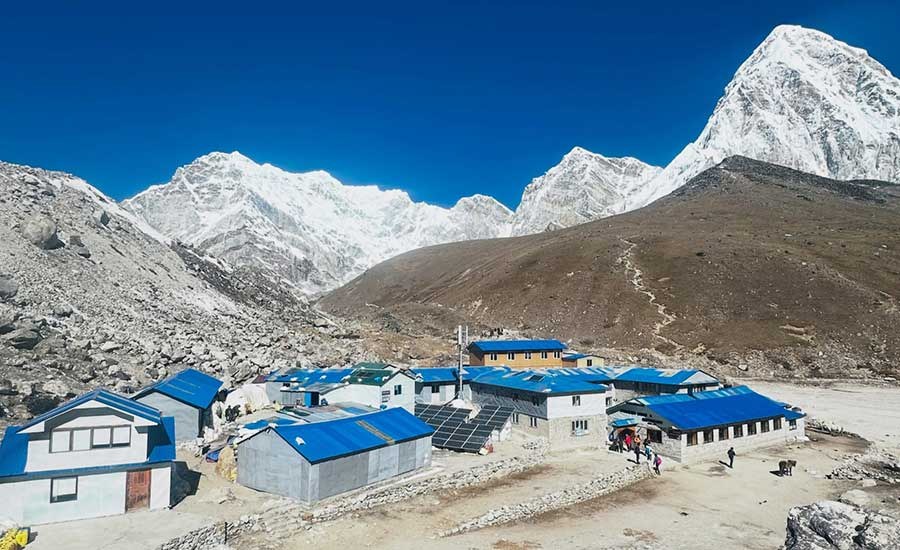
For many trekkers, the walk from Gorak Shep to Everest Base Camp is the most anticipated part of their Himalayan adventure. After days of trekking through the beautiful Khumbu Valley, crossing suspension bridges, visiting Sherpa villages and gradually gaining altitude, the final stretch brings you to the foot of the world's highest mountain.
But how far is Gorak Shep from Everest Base Camp? How long does the walk take, and why can this relatively short distance feel so demanding?
The distance from Gorak Shep to Everest Base Camp is approximately 3.5–5 kilometers (2.2–3.1 miles) one way. Most trekkers need around 2–3 hours to reach Base Camp and a similar amount of time to return, depending on fitness, acclimatization, weather and trail conditions.
The route crosses uneven glacial moraine at an altitude above 5,000 meters, where walking is considerably slower than at lower elevations. Although the net elevation gain is only about 200 meters, the trail involves repeated short ascents and descents over loose rocks and rough terrain.
In this detailed guide, Himalayan Dream Team Treks & Tours explains the distance, hiking time, elevation, trail conditions, difficulty, mountain views, accommodation and important safety considerations for the final journey to Everest Base Camp.
We also explain how this section fits into our 16-day Everest Base Camp Trek, which includes proper acclimatization and a visit to the famous Kala Patthar viewpoint.
Gorak Shep to Everest Base Camp: Quick Facts
| Information | Details |
|---|---|
| Starting Point | Gorak Shep, approximately 5,164 m |
| Destination | Everest Base Camp, approximately 5,364 m |
| One-Way Distance | Approximately 3.5–5 km / 2.2–3.1 miles |
| Round-Trip Distance | Approximately 7–10 km / 4.4–6.2 miles |
| Walking Time to Base Camp | Usually 2–3 hours; longer in difficult conditions |
| Round-Trip Walking Time | Approximately 4–6 hours, excluding extended stops |
| Net Elevation Gain | Approximately 200 m |
| Trail Type | Rocky glacial moraine and uneven mountain paths |
| Difficulty | Challenging because of altitude and terrain |
| Accommodation | Mountain lodges at Gorak Shep |
| Best Trekking Seasons | March–May and September–November |
| Technical Climbing Required | No, on the standard trekking route |
Distances and walking times are approximate. The accessible route can change because of glacier movement, seasonal conditions and local trail adjustments.
How Far Is Gorak Shep from Everest Base Camp?
Gorak Shep is the final settlement on the classic Everest Base Camp trekking route. From this small high-altitude village, trekkers follow the rocky trail towards the Khumbu Glacier and continue to the usual Everest Base Camp trekking destination.
The distance is commonly described as approximately 3.5–5 kilometers one way. Some route measurements are shorter, while others are longer because they follow different GPS tracks or ending points.
Everest Base Camp is not a fixed building or permanently marked road destination. The glacier changes over time, and the position of the trekking marker and expedition camp area can vary.
Gorak Shep to Everest Base Camp Distance in Kilometers and Miles
| Route | Approximate Distance | Walking Time |
|---|---|---|
| Gorak Shep to Everest Base Camp | 3.5–5 km / 2.2–3.1 miles | 2–3 hours or longer |
| Everest Base Camp to Gorak Shep | 3.5–5 km / 2.2–3.1 miles | 2–3 hours |
| Complete Return Hike | 7–10 km / 4.4–6.2 miles | 4–6 hours, plus stops |
Why Does the Distance Vary Between Trekking Guides?
Different trekking companies may report different figures because the trail is not a perfectly fixed route. GPS measurements, the location of the lodge in Gorak Shep, seasonal glacier conditions and the final point reached at Base Camp can all affect the total distance.
For practical planning, it is more useful to allow enough time for a safe return than to focus on an exact number of kilometers.
For a complete breakdown of the journey from Lukla, read our Everest Base Camp Trek Distance Guide.
How Long Does It Take to Walk from Gorak Shep to Everest Base Camp?
Most reasonably acclimatized trekkers take approximately 2–3 hours to walk from Gorak Shep to Everest Base Camp.
The return journey often takes a similar amount of time. Some trekkers walk faster on the way back, but the uneven terrain requires concentration in both directions.
Allow approximately 4–6 hours of walking for the complete return journey, plus additional time for photographs, rest and any necessary changes in the route.
Why Is the Walk So Slow?
At an elevation above 5,000 meters, the reduced oxygen availability makes physical activity more demanding. Even experienced hikers may need to walk slowly and stop frequently.
The rocky trail also includes unstable stones, short climbs and descents, which make it difficult to maintain a regular walking rhythm.
For these reasons, the final few kilometers to Everest Base Camp can feel more demanding than much longer walks at lower altitudes.
Gorak Shep to Everest Base Camp Trail: What to Expect
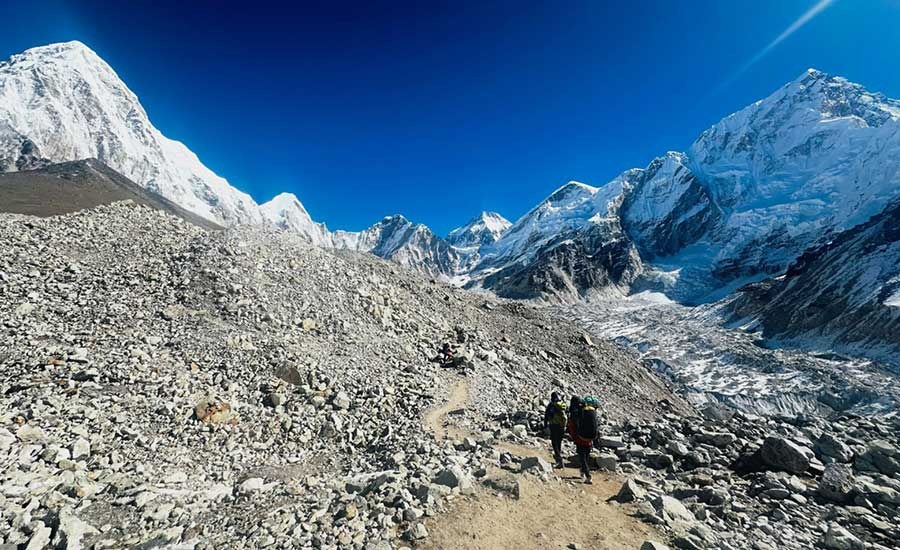
The trail from Gorak Shep towards Everest Base Camp is very different from the green valleys and forest paths encountered earlier in the trek.
There are no forests or traditional farming villages along this final section. Instead, the landscape is dominated by rock, glacial debris, ice formations and enormous Himalayan peaks.
1. Leaving Gorak Shep
The walk begins at Gorak Shep, a small settlement situated on a sandy, relatively flat area surrounded by high mountains.
Most trekkers leave their main luggage at the lodge and carry only essential items such as drinking water, warm clothing, snacks, a camera and personal medication.
2. Following the Khumbu Glacier Moraine
After leaving Gorak Shep, the route follows rocky terrain beside the Khumbu Glacier.
The trail becomes increasingly uneven, with loose stones, boulders and sections that require careful foot placement.
Although the overall elevation gain is modest, the path rises and falls repeatedly.
3. Approaching Everest Base Camp
As trekkers approach Base Camp, the dramatic landscape of the Khumbu Glacier and surrounding peaks becomes more prominent.
During the spring Everest climbing season, expedition tents may be visible in the designated camp area. Outside the climbing season, the area is generally much quieter.
The usual trekking destination is marked by a popular photo location, although the precise position can change.
4. Returning to Gorak Shep
After spending some time at Everest Base Camp, trekkers follow the route back to Gorak Shep.
Most groups return to their lodge for the night before climbing Kala Patthar the following morning, subject to weather, health and trail conditions.
Gorak Shep and Everest Base Camp Altitude Difference
Gorak Shep stands at approximately 5,164 meters, while Everest Base Camp is commonly listed at 5,364 meters above sea level.
The difference in elevation is approximately 200 meters.
| Location | Altitude |
|---|---|
| Gorak Shep | Approx. 5,164 m / 16,942 ft |
| Everest Base Camp | Approx. 5,364 m / 17,598 ft |
| Net Elevation Gain | Approx. 200 m / 656 ft |
However, the route is not a continuous 200-meter uphill climb. There are several short ascents and descents along the glacier moraine, meaning the cumulative elevation gain may be greater.
The main challenge is the high altitude rather than the net elevation difference.
Is Gorak Shep to Everest Base Camp Difficult?
Yes. The walk is challenging, mainly because of the high altitude and rocky terrain.
Although the distance is relatively short, trekking at more than 5,000 meters requires patience, good acclimatization and careful pacing.
Main Challenges
- Reduced oxygen availability at high altitude.
- Loose rocks and uneven glacial moraine.
- Cold temperatures and possible strong winds.
- Snow, ice or slippery sections during certain seasons.
- Fatigue after several consecutive trekking days.
- Limited facilities between Gorak Shep and Everest Base Camp.
Can Beginners Complete This Section?
Physically fit beginners can complete the Everest Base Camp Trek with appropriate preparation and acclimatization, but the final section should not be underestimated.
Travelers should arrive at Gorak Shep after a gradual ascent through the Khumbu, including suitable acclimatization days.
Himalayan Dream Team's 16-day Everest Base Camp Trek includes acclimatization in Namche Bazaar and Dingboche before continuing towards Lobuche and Gorak Shep.
Lobuche to Gorak Shep to Everest Base Camp: The Full Trekking Day
One of the most common questions is whether the walk from Gorak Shep to Base Camp is the entire day's trek.
For many Everest Base Camp itineraries, including Himalayan Dream Team's standard route, it is not.
Trekkers normally begin the day in Lobuche, walk to Gorak Shep, rest at a lodge and then continue to Everest Base Camp before returning to Gorak Shep for the night.
Typical Day 10 Program
| Stage | Activity |
|---|---|
| Morning | Depart Lobuche (approximately 4,910 m) |
| Late Morning | Arrive at Gorak Shep (approximately 5,164 m) |
| Midday | Rest, have a meal and prepare a light daypack |
| Afternoon | Walk to Everest Base Camp (approximately 5,364 m) |
| Later Afternoon | Return to Gorak Shep |
| Evening | Dinner and overnight in a mountain lodge |
The complete Lobuche–Gorak Shep–Everest Base Camp–Gorak Shep day commonly takes approximately 7–8 hours of walking, sometimes longer depending on conditions.
This distinction is important when comparing Everest Base Camp trekking itineraries from different companies.
Where Is Gorak Shep, and Why Is It Important?
Gorak Shep is a small high-altitude settlement in Nepal's Everest region, located at approximately 5,164 meters.
It is the final traditional lodge settlement on the standard trekking route to Everest Base Camp.
Gorak Shep serves as the starting point for two famous excursions: the walk to Everest Base Camp and the climb to Kala Patthar.
Accommodation in Gorak Shep
Accommodation is basic because of the extreme altitude and remote location.
Trekkers usually stay in simple twin-sharing rooms with limited heating and shared facilities.
The dining room is the main gathering area, where trekkers can enjoy warm meals and prepare for the following day's walk.
Is There Electricity or Wi-Fi?
Charging facilities and internet services may be available at some lodges, often for an additional fee. Reliability varies.
Can You Buy Food and Water?
Mountain lodges serve simple meals such as dal bhat, noodles, soups, potatoes, eggs and porridge.
Safe drinking water should be obtained through suitable boiling or purification methods.
Can You Sleep at Everest Base Camp?
Standard trekking itineraries normally return to Gorak Shep for overnight accommodation. Camping at Everest Base Camp is generally associated with authorized expeditions and special arrangements, rather than ordinary teahouse trekking.
Gorak Shep to Everest Base Camp vs Gorak Shep to Kala Patthar
Everest Base Camp and Kala Patthar are two different destinations reached from Gorak Shep.
Everest Base Camp is famous for its location beside the Khumbu Glacier and its connection with Everest mountaineering expeditions.
Kala Patthar is a higher viewpoint offering one of the best close-up panoramas of Mount Everest.
| Feature | Everest Base Camp | Kala Patthar |
|---|---|---|
| Altitude | Approx. 5,364 m | Commonly 5,545 m |
| Distance from Gorak Shep | Approx. 3.5–5 km one way | Approx. 1.5–2 km one way |
| Main Attraction | Base Camp and Khumbu Glacier | Panoramic Mount Everest views |
| Trail | Uneven glacial moraine | Steep rocky ascent |
| Difficulty | Challenging because of terrain and altitude | Challenging because of steepness and altitude |
| Typical Visit | Afternoon from Gorak Shep | Early morning or afternoon, conditions permitting |
Can You See Mount Everest from Everest Base Camp?
The summit of Mount Everest is largely hidden from the usual Base Camp trekking destination by surrounding terrain.
For a clearer view of the summit, Kala Patthar is generally the better choice.
Should You Visit Both?
Yes, when conditions and health permit. Visiting both Everest Base Camp and Kala Patthar provides two very different experiences.
Read our detailed Sunrise from Kala Patthar Guide to learn more about the climb and mountain views.
What Mountains Can You See Along the Trail?
The Gorak Shep to Everest Base Camp trail offers spectacular scenery dominated by the upper Khumbu landscape.
Depending on the viewpoint and weather, trekkers can admire mountains such as Nuptse, Pumori, Lingtren and Khumbutse, together with dramatic glacial formations.
The Khumbu Icefall is one of the most striking features near Base Camp. It is a constantly changing and hazardous section of glacier used by properly equipped Everest climbing expeditions.
Ordinary trekkers should remain on the designated trekking route and must not attempt to enter the Icefall.
Best Time to Trek from Gorak Shep to Everest Base Camp
The best seasons for the Everest Base Camp Trek are generally spring and autumn.
| Season | Months | Conditions |
|---|---|---|
| Spring | March–May | Popular trekking conditions and Everest expedition activity |
| Autumn | September–November | Often clear Himalayan views and popular trekking weather |
| Winter | December–February | Very cold, with possible snow and ice |
| Monsoon | June–August | Less predictable visibility and possible transportation disruption |
What Is Everest Base Camp Like in April and May?
April and May coincide with the main spring Everest climbing season. Expedition tents may be visible in the designated camp area, although access to expedition facilities is restricted.
What Is Everest Base Camp Like in October and November?
Autumn is a popular trekking season, often providing beautiful mountain visibility. The expedition camp area is generally quieter than during the main spring climbing season.
For month-by-month planning, read our Best Time for Everest Base Camp Trek guide.
Altitude Sickness Between Gorak Shep and Everest Base Camp
At more than 5,000 meters, altitude illness is an important concern.
Acute Mountain Sickness can affect trekkers regardless of age, fitness or previous hiking experience.
Common Symptoms
- Headache
- Nausea or loss of appetite
- Dizziness
- Unusual tiredness
- Difficulty sleeping
Trekkers should inform their guide immediately if symptoms develop.
Do not continue ascending with symptoms of altitude illness. Worsening symptoms require descent and medical assessment.
Confusion, loss of coordination or severe breathlessness at rest may indicate life-threatening altitude illness and require emergency assistance and urgent descent when feasible.
How to Reduce Altitude Risk
- Follow a gradual ascent itinerary.
- Include suitable acclimatization days.
- Walk slowly and avoid unnecessary exertion.
- Eat regularly and drink according to your needs.
- Report symptoms early.
- Discuss altitude medication with a qualified healthcare professional.
- Carry insurance covering high-altitude trekking and emergency evacuation.
Our Everest Base Camp Acclimatization Guide explains why proper altitude adaptation is essential.
What Should You Carry from Gorak Shep to Everest Base Camp?
Most trekkers leave their main luggage at the Gorak Shep lodge and carry a light daypack for the Base Camp excursion.
- Warm insulated jacket
- Windproof and waterproof outer layer
- Gloves and warm hat
- Comfortable trekking boots
- Trekking poles
- Drinking water
- Energy snacks
- Sunglasses and sunscreen
- Camera or smartphone
- Headlamp
- Personal medication
- Travel insurance and emergency contact details
Even on a sunny afternoon, temperatures can change quickly and cold winds are common.
Carry a headlamp in case the return walk takes longer than expected, but aim to complete the hike in daylight whenever possible.
Important Safety Tips for the Final Walk to Everest Base Camp
The final trail requires care and attention, especially when trekkers are tired or experiencing the effects of high altitude.
- Follow the route recommended by your experienced guide.
- Do not leave the established trail to explore glacier ice.
- Keep a safe distance from unstable rocks and ice formations.
- Avoid walking close to dangerous crevasses or glacier edges.
- Do not enter restricted expedition areas.
- Walk slowly and use trekking poles where helpful.
- Allow enough daylight for the return journey.
- Turn back if weather or health conditions become unsafe.
- Do not treat reaching Base Camp as more important than personal safety.
Himalayan Dream Team places particular importance on suitable acclimatization, local guide knowledge and realistic daily walking schedules.
Everest Base Camp Trekking Routes That Include Gorak Shep
Gorak Shep is an important destination on several trekking routes in Nepal's Everest region.
1. Classic Everest Base Camp Trek
The classic route begins in Lukla and continues through Phakding, Namche Bazaar, Tengboche, Dingboche and Lobuche before reaching Gorak Shep and Everest Base Camp.
This is the best-known route for travelers who want to visit Everest Base Camp and Kala Patthar while following a carefully planned acclimatization itinerary.
Explore Our Everest Base Camp Trek – 16 Days
2. Everest Base Camp via Gokyo Lakes and Cho La Pass
This more adventurous route combines the beautiful Gokyo Lakes, Gokyo Ri and the challenging Cho La Pass with Everest Base Camp.
Trekkers typically approach the Everest Base Camp route through Dzongla and Lobuche before continuing to Gorak Shep.
This itinerary is suitable for experienced and well-prepared trekkers who want to explore more of the Khumbu region.
3. Everest Three Passes Trek
The Everest Three Passes Trek crosses three high mountain passes: Kongma La, Cho La and Renjo La.
Depending on the chosen route, trekkers can also visit Gorak Shep, Everest Base Camp, Kala Patthar and Gokyo Lakes.
This is a demanding trekking adventure requiring excellent preparation and careful acclimatization.
4. Everest Base Camp with Helicopter Return
Some travelers choose to trek to Everest Base Camp and return from an authorized helicopter pickup location, subject to current aviation regulations, weather and availability.
A helicopter return can reduce the number of walking days, but it does not remove the need for proper acclimatization during the ascent.
5. Other Everest Region Treks
Not every Everest-region trek includes Gorak Shep or Everest Base Camp. Shorter journeys such as the Everest View Trek focus on the lower Khumbu, while Gokyo-only itineraries explore a different valley.
For a wider comparison, read our Everest Trekking Routes, Distances, Hours and Altitudes guide.
Himalayan Dream Team can help travelers choose a suitable Everest trekking route according to available time, fitness, altitude experience and travel interests.
Frequently Asked Questions About Gorak Shep to Everest Base Camp
1. How far is Gorak Shep from Everest Base Camp?
The distance is approximately 3.5–5 kilometers (2.2–3.1 miles) one way, depending on the route and final destination point.
2. How long does it take to walk from Gorak Shep to Everest Base Camp?
Most trekkers take around 2–3 hours each way. Walking time can be longer because of altitude, weather and trail conditions.
3. What is the round-trip distance from Gorak Shep to Everest Base Camp?
The return hike is approximately 7–10 kilometers (4.4–6.2 miles).
4. What is the altitude of Gorak Shep?
Gorak Shep is situated at approximately 5,164 meters (16,942 feet).
5. What is the altitude of Everest Base Camp?
Everest Base Camp is commonly listed at approximately 5,364 meters (17,598 feet).
6. How much elevation do you gain between Gorak Shep and Everest Base Camp?
The net elevation gain is approximately 200 meters, although the trail includes repeated short ascents and descents.
7. Is Gorak Shep to Everest Base Camp difficult?
Yes. The high altitude and rocky glacier moraine make this a challenging walk despite the relatively short distance.
8. Can beginners walk from Gorak Shep to Everest Base Camp?
Fit and properly acclimatized beginners can complete the walk, but they should follow a suitable trekking itinerary and understand the altitude risks.
9. Can you see Mount Everest from Base Camp?
The summit is largely hidden from the usual Base Camp trekking destination. Kala Patthar offers a clearer view of Everest.
10. How far is Kala Patthar from Gorak Shep?
The standard ascent is approximately 1.5–2 kilometers one way, depending on the chosen viewpoint.
11. Is Kala Patthar harder than Everest Base Camp?
Kala Patthar is a shorter but steeper climb to a higher elevation. Everest Base Camp involves a longer walk over uneven glacial terrain.
12. Can you visit Everest Base Camp and Kala Patthar on the same day?
Some trekkers attempt both, but this can be extremely demanding at high altitude. Many itineraries visit Everest Base Camp one day and Kala Patthar the following morning.
13. Can you sleep at Everest Base Camp?
Ordinary teahouse trekkers normally sleep at Gorak Shep. Camping at Base Camp is generally associated with authorized expeditions and special arrangements.
14. Are there toilets or restaurants between Gorak Shep and Base Camp?
There are no dependable permanent food or toilet facilities along the final trekking section. Carry essential supplies from Gorak Shep.
15. Is there mobile network coverage?
Coverage may be available in parts of the upper Khumbu, but it is unreliable and should not be depended upon for emergencies.
16. What is the best time to visit Everest Base Camp?
March to May and September to November are generally the most popular trekking seasons.
17. Is Everest Base Camp crowded?
The route can be busy during peak trekking months. The expedition camp area is especially active during the spring climbing season.
18. Can you walk on the Khumbu Glacier?
The standard route crosses or follows glacial moraine and designated terrain near the glacier. Trekkers should not explore glacier ice, crevasses or the Khumbu Icefall independently.
19. Do you need a guide for this section?
Current guide requirements should be confirmed for the itinerary. An experienced local guide is strongly recommended because of the altitude, changing terrain and potential safety risks.
20. Is the walk from Gorak Shep to Everest Base Camp worth it?
Yes. Reaching Everest Base Camp is a memorable achievement and offers an extraordinary experience of the Khumbu Glacier and the high Himalayan environment.
Final Thoughts: The Last Walk to Everest Base Camp
The journey from Gorak Shep to Everest Base Camp may be only a few kilometers, but it is one of the most memorable sections of the entire Everest Base Camp Trek.
Walking beside the Khumbu Glacier, surrounded by towering Himalayan peaks and the dramatic landscape of the upper Khumbu, is a remarkable experience.
Although the distance is approximately 3.5–5 kilometers one way, the high altitude and rocky terrain make the final approach challenging.
With suitable preparation, careful acclimatization and experienced local guidance, reaching Everest Base Camp can become one of the most rewarding moments of your Nepal trekking adventure.
Plan Your Everest Base Camp Trek with Himalayan Dream Team
Are you planning to trek to Everest Base Camp and wondering how to prepare for the final walk from Gorak Shep?
At Himalayan Dream Team Treks & Tours Pvt. Ltd., we organize carefully planned Everest-region trekking holidays with experienced local guides, suitable acclimatization, mountain lodge accommodation and personal support throughout the journey.
Our 16-day Everest Base Camp Trek includes the journey to Gorak Shep, Everest Base Camp and Kala Patthar, together with acclimatization days in Namche Bazaar and Dingboche.
We can also customize Everest trekking itineraries to include Gokyo Lakes, Cho La Pass, the Everest Three Passes route or other destinations in the Khumbu region.
Himalayan Dream Team Treks & Tours Pvt. Ltd.
Nepal-Based Trekking and Tour Operator
www.himalayandream.team
Together is Our Favourite Place to Be.