

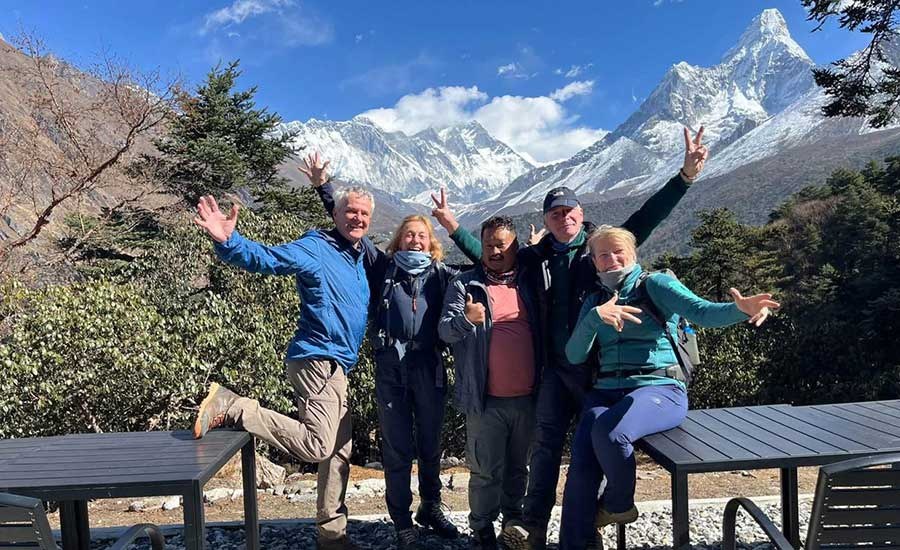
Can you get altitude sickness on the Everest Base Camp Trek? Yes. Altitude sickness is one of the most important health risks on the journey to Everest Base Camp (5,364 m). It can affect anyone, including young, fit and experienced trekkers. The risk increases when you ascend too quickly, sleep at progressively higher elevations without sufficient acclimatization, or continue climbing despite symptoms.
The Everest Base Camp Trek takes you from Lukla (approximately 2,840 m) through Namche Bazaar (3,440 m), Tengboche (3,860 m), Dingboche (4,410 m), Lobuche (4,910 m) and Gorak Shep (5,164 m). Many itineraries also include Kala Patthar (5,545 m), the highest viewpoint on the classic route.
As you gain altitude, atmospheric pressure decreases, meaning less oxygen is available with every breath. Your body needs time to adapt to these conditions. Without adequate acclimatization, you may develop acute mountain sickness (AMS) or, in severe cases, life-threatening high-altitude cerebral edema (HACE) or high-altitude pulmonary edema (HAPE).
Fortunately, understanding the warning signs, ascending gradually and making sensible decisions can significantly reduce the risk of serious altitude illness.
At Himalayan Dream Team, we believe that reaching Everest Base Camp should never be more important than a trekker's health. Our 16-day Everest Base Camp Trek includes acclimatization days in Namche Bazaar and Dingboche, with experienced local guides supporting trekkers throughout the journey.
This detailed guide explains the symptoms, prevention, acclimatization, medication, emergency treatment and practical safety decisions that every Everest Base Camp trekker should understand before traveling to Nepal.
Important medical information: This article is educational and does not replace professional medical advice, diagnosis or treatment. Suspected severe altitude illness is a medical emergency. Stop ascending, arrange urgent descent and seek medical assistance immediately. Do not delay descent while waiting for medication, oxygen or helicopter rescue.
Everest Base Camp Altitude Sickness – Quick Facts
| Question | Essential Information |
|---|---|
| Everest Base Camp elevation | 5,364 m / 17,598 ft |
| Highest point on HDT's classic trek | Kala Patthar – 5,545 m / 18,192 ft |
| Highest overnight location | Gorak Shep – approximately 5,164 m |
| When can altitude sickness occur? | Commonly above approximately 2,500 m, particularly after rapid ascent |
| Common AMS symptoms | Headache, nausea, dizziness, fatigue and reduced appetite |
| Serious warning signs | Confusion, poor coordination, breathlessness at rest, severe weakness or worsening breathing |
| Main prevention strategy | Gradual ascent, suitable acclimatization and avoiding further ascent with symptoms |
| Recommended sleeping-altitude gain | Generally no more than 500 m per night above 3,000 m, with additional acclimatization nights |
| Key acclimatization locations | Namche Bazaar and Dingboche |
| Can fit people get altitude sickness? | Yes. Physical fitness does not provide immunity |
| Does Diamox guarantee prevention? | No. It can reduce risk when appropriately prescribed but does not replace gradual ascent |
| Best action for severe altitude illness | Urgent descent, medical assistance and oxygen when available |
What Is Altitude Sickness on the Everest Base Camp Trek?
Altitude sickness refers to a group of illnesses caused by exposure to reduced oxygen availability at high elevations.
As you ascend into the Himalayas, atmospheric pressure decreases. Although the percentage of oxygen in the air remains approximately the same, the lower pressure means less oxygen reaches your lungs and bloodstream with each breath.
Your body responds by increasing breathing and making other physiological adjustments. This process is called acclimatization.
However, acclimatization takes time. If your sleeping altitude increases faster than your body can adapt, altitude illness may develop.
Why Is Everest Base Camp a High-Altitude Trek?
The standard Everest Base Camp route begins with a mountain flight to Lukla at approximately 2,840 m.
Trekkers then descend to Phakding before climbing to Namche Bazaar and continuing towards villages above 4,000 m.
By the time you reach Gorak Shep, you are sleeping above 5,000 m, where oxygen availability is substantially lower than at sea level.
Even simple activities such as walking uphill, climbing stairs or carrying a daypack can feel unusually demanding.
The greatest concern is not simply how high you hike during the day. Your sleeping altitude, rate of ascent, individual susceptibility and symptoms are especially important.
How Common Is Altitude Sickness on the Everest Base Camp Trek?
Altitude sickness is a genuine concern on the Everest Base Camp route, even for trekkers following established itineraries.
The CDC Yellow Book notes that on some standard Everest Base Camp acclimatization schedules, the prevalence of altitude illness can approach 30% at higher elevations.
This is not a fixed risk for every trekker. Actual rates vary according to the itinerary, ascent profile, previous altitude exposure, individual susceptibility and how altitude illness is defined.
Some people experience only mild symptoms, while others need to remain at the same altitude, descend or end their trek.
The important lesson is that altitude sickness is neither rare enough to ignore nor inevitable for everyone.
Does Everyone Get Altitude Sickness at Everest Base Camp?
No. Many trekkers complete the journey without clinically significant altitude illness.
However, no one can reliably predict their personal response to altitude based only on age, fitness or previous hiking experience.
A person who completed one high-altitude trek without problems may still experience symptoms on another journey.
Three Types of Altitude Illness: AMS, HACE and HAPE
Understanding the difference between mild altitude sickness and severe altitude illness is essential for making safe decisions.
| Condition | Main Symptoms | Urgency |
|---|---|---|
| Acute Mountain Sickness (AMS) | Headache with symptoms such as nausea, dizziness, fatigue or reduced appetite after ascent | Stop ascending and assess. Descend if symptoms worsen or fail to improve. |
| High-Altitude Cerebral Edema (HACE) | Confusion, loss of coordination, unusual drowsiness, altered consciousness | Life-threatening emergency. Urgent descent and medical treatment. |
| High-Altitude Pulmonary Edema (HAPE) | Increasing breathlessness, reduced exercise capacity, cough, breathlessness at rest | Life-threatening emergency. Urgent descent, oxygen and medical treatment. |
1. Acute Mountain Sickness (AMS)
AMS is the most common form of altitude illness encountered by trekkers.
It often develops within several hours after reaching a higher sleeping altitude, although the timing can vary.
Typical symptoms include headache, nausea, dizziness, tiredness and reduced appetite.
Mild AMS may improve when the person stops ascending and allows more time for acclimatization.
However, symptoms should never be dismissed or concealed. Continuing uphill with AMS can lead to worsening illness.
2. High-Altitude Cerebral Edema (HACE)
HACE is a severe neurological form of altitude illness involving brain dysfunction.
Warning signs include confusion, difficulty walking in a straight line, loss of coordination, unusual behavior and reduced consciousness.
A person with suspected HACE may be unable to make safe decisions or walk without assistance.
HACE is a medical emergency. Immediate descent and urgent medical treatment are necessary. Supplemental oxygen and clinician-directed medication may be used while evacuation is arranged.
3. High-Altitude Pulmonary Edema (HAPE)
HAPE occurs when fluid accumulates in the lungs at high altitude.
It may develop with or without the typical headache of AMS.
Early signs can include unusual breathlessness during activity, a marked reduction in walking performance and cough.
As the condition worsens, the person may become breathless while resting, have difficulty lying flat or develop severe respiratory distress.
HAPE is also a medical emergency. Urgent descent, oxygen when available and medical care are essential.
Altitude Sickness Symptoms: What Every Everest Trekker Should Recognize
One of the most important safety habits during the Everest Base Camp Trek is recognizing changes in how you feel after gaining altitude.
Early Symptoms of AMS
- New headache after ascending to a higher elevation.
- Nausea or an unsettled stomach.
- Loss of appetite.
- Dizziness or light-headedness.
- Unusual fatigue or weakness.
- Difficulty sleeping, although poor sleep alone does not diagnose AMS.
These symptoms can overlap with dehydration, exhaustion, infection, migraine and other medical conditions.
Do not automatically assume every headache is caused by altitude. Equally, do not dismiss a new headache after ascent as simple dehydration without assessing the other symptoms.
Emergency Warning Signs
The following signs require urgent attention:
- Confusion or unusual behavior.
- Difficulty walking normally or maintaining balance.
- Severe drowsiness or reduced consciousness.
- Breathlessness while resting.
- Rapidly worsening breathing difficulty.
- Severe weakness or inability to continue walking normally.
- Persistent cough accompanied by significant breathlessness or declining physical performance.
Do not continue ascending with these symptoms. Arrange urgent descent and medical assistance. Do not leave an affected trekker alone.
Altitude Sickness Decision Table
| Situation | What to Do |
|---|---|
| No symptoms | Continue only according to a sensible ascent schedule, with regular monitoring. |
| Mild headache or nausea after ascent | Stop ascending, tell your guide and assess for AMS or other illness. Remain at the current altitude while being monitored. |
| Symptoms are worsening or not improving | Do not ascend. Arrange descent and medical assessment. |
| Confusion, poor coordination or breathlessness at rest | Medical emergency: urgent descent, oxygen if available and immediate medical assistance. |
Everest Base Camp Trek Altitude and Acclimatization Table
The following table shows the main locations on Himalayan Dream Team's classic Everest Base Camp route.
Elevations are approximate and can vary slightly between maps, lodges and GPS measurements.
| Location | Elevation | Altitude Consideration |
|---|---|---|
| Kathmandu | 1,335 m | Arrival and trekking preparation |
| Lukla | 2,840 m | Rapid altitude exposure after the mountain flight |
| Phakding | 2,610 m | Lower sleeping altitude after Lukla |
| Namche Bazaar | 3,440 m | Important acclimatization stop; normally two nights |
| Everest View Hotel area | Approximately 3,880 m | Optional acclimatization hike; return to Namche to sleep |
| Tengboche | 3,860 m | Continue gradual ascent and monitor symptoms |
| Dingboche | 4,410 m | Second important acclimatization stop; normally two nights |
| Lobuche | 4,910 m | High sleeping altitude; monitor closely |
| Gorak Shep | 5,164 m | Highest overnight location on the classic itinerary |
| Everest Base Camp | 5,364 m | High-altitude day excursion from Gorak Shep |
| Kala Patthar | 5,545 m | Highest point on the classic trek; optional according to conditions |
| Pheriche | 4,240 m | Lower overnight location on the return journey |
Why Is Sleeping Altitude More Important Than the Highest Point Reached?
During an acclimatization hike, you may climb to a higher viewpoint and return to sleep at a lower elevation.
This is commonly described as climb high, sleep low.
For example, trekkers staying in Namche Bazaar may walk towards the Everest View Hotel area and return to Namche for the night.
However, hiking high is not necessary when someone is already experiencing AMS symptoms. A symptomatic trekker should not undertake an optional ascent simply to follow an acclimatization routine.
Are All Elevation Gains on the EBC Route Within 500 Metres?
No. Some standard itinerary stages involve greater sleeping-altitude gains.
For example, Phakding to Namche Bazaar increases sleeping altitude by approximately 830 m, although Phakding is below 3,000 m. Tengboche to Dingboche involves approximately 550 m, and Dingboche to Lobuche approximately 500 m.
These stages show why acclimatization nights, individual assessment and itinerary flexibility matter.
The commonly recommended limit of approximately 500 m per night above 3,000 m is a risk-reduction guideline, not a guarantee of safety or a rule that every established trail automatically follows.
Where Is Altitude Sickness Most Likely on the Everest Base Camp Route?
Lukla to Namche Bazaar
The journey begins with a flight to Lukla, followed by an overnight stay in Phakding and a substantial climb to Namche Bazaar.
Namche is often the first place where trekkers become aware of altitude-related symptoms.
Spending two nights here helps provide time for adaptation before continuing higher.
Namche Bazaar to Tengboche
After acclimatizing in Namche, the route continues through forests and mountain settlements towards Tengboche.
Although many trekkers feel stronger after their Namche stay, the body is still adjusting to increasing altitude.
Continue at a comfortable pace and report any new symptoms.
Tengboche to Dingboche
Dingboche is situated above 4,400 m, where reduced oxygen availability becomes increasingly noticeable.
Some trekkers experience headaches, reduced appetite, fatigue or disturbed sleep here.
Himalayan Dream Team's standard itinerary includes an additional night in Dingboche for acclimatization.
Dingboche to Lobuche
The route climbs towards Thukla and the memorial area before continuing to Lobuche.
At approximately 4,910 m, Lobuche is a significant high-altitude overnight stop.
Symptoms that begin or worsen here should be taken seriously. Continuing to Gorak Shep and Everest Base Camp with AMS is unsafe.
Lobuche to Gorak Shep and Everest Base Camp
The final approach crosses rugged glacial moraine at elevations above 5,000 m.
Even a relatively short walk can feel physically demanding because of the thin air and uneven terrain.
Gorak Shep is approximately 5,164 m, while Everest Base Camp is 5,364 m.
Trekkers normally return to Gorak Shep after visiting Base Camp.
For detailed walking distances and trail conditions, see our Gorak Shep to Everest Base Camp Distance Guide.
Gorak Shep to Kala Patthar
Kala Patthar (5,545 m) is the highest point on Himalayan Dream Team's classic Everest Base Camp Trek.
The climb is steep and demanding, particularly in cold morning conditions.
Trekkers who are unwell, poorly acclimatized or experiencing altitude symptoms should not attempt the viewpoint simply to complete the itinerary.
Read our Kala Patthar Sunrise Guide for information about the viewpoint and mountain scenery.
How to Reduce the Risk of Altitude Sickness on Everest Base Camp
No prevention strategy can completely eliminate altitude sickness. However, the following measures can reduce the risk and help trekkers recognize problems early.
1. Ascend Gradually
Gradual ascent is the most important preventive measure.
Once above approximately 3,000 m, established medical guidance generally recommends increasing sleeping altitude by no more than about 500 m per night and including an extra acclimatization night for every additional 1,000 m of sleeping-altitude gain.
Some established Everest trekking stages exceed these recommendations, so additional nights may be appropriate for certain travelers.
2. Include Acclimatization Days
Do not remove acclimatization days simply to shorten the trek.
Namche Bazaar and Dingboche are important locations for spending additional nights before continuing higher.
Some trekkers may benefit from an even slower itinerary.
3. Never Ascend Higher with AMS Symptoms
If you develop symptoms consistent with acute mountain sickness, stop ascending.
Inform your guide and arrange an appropriate assessment.
If symptoms worsen or fail to improve, descend.
Do not continue uphill simply because the next lodge has already been booked or the group wants to reach Base Camp.
4. Maintain a Comfortable Walking Pace
Walk at a pace that allows comfortable breathing and regular breaks.
Rushing uphill increases physical strain, although walking slowly by itself does not prevent altitude sickness if the sleeping-altitude gain remains too rapid.
5. Drink According to Your Needs
Drink enough fluids to replace normal losses from walking, breathing and dry mountain air.
However, forcing excessive water intake does not prevent AMS and can cause dangerous low blood sodium.
Use thirst, activity level, urine output and individual medical advice to guide fluid intake.
6. Eat Regular Meals
Maintain adequate food intake, even when your appetite decreases at altitude.
Carbohydrate-rich meals can be useful for sustaining energy during trekking.
However, food alone cannot prevent altitude sickness.
7. Avoid Alcohol During Acclimatization
Avoid alcohol during the early high-altitude adjustment period and when experiencing symptoms.
Alcohol can interfere with judgment, sleep and hydration.
8. Be Careful with Sleeping Medication
Avoid self-medicating with sedatives or sleeping pills that may suppress breathing or impair alertness.
If you regularly use sleep medication, discuss its suitability for high-altitude travel with your doctor before departure.
9. Consider Preventive Medication with a Doctor
Acetazolamide, commonly known as Diamox, can reduce the likelihood of AMS and support acclimatization in selected travelers.
It should be considered according to individual risk, medical history and professional advice.
10. Report Symptoms Early
Tell your guide immediately if you develop headache, nausea, dizziness, unusual fatigue, breathing difficulties or other concerning symptoms.
Early reporting allows the itinerary to be adjusted before symptoms become severe.
Acclimatization at Namche Bazaar and Dingboche
Acclimatization is the process by which the body gradually adapts to lower oxygen availability at higher elevations.
Himalayan Dream Team's classic Everest Base Camp itinerary includes dedicated acclimatization days at Namche Bazaar and Dingboche.
Namche Bazaar Acclimatization – 3,440 m
Namche Bazaar is the first major acclimatization stop on the standard route.
Trekkers usually spend two nights here before continuing towards Tengboche.
When feeling well, an optional walk towards the Everest View Hotel area (approximately 3,880 m) provides an opportunity to gain elevation during the day and return to sleep in Namche.
Other activities may include exploring the village and learning about local Sherpa culture.
However, acclimatization days should not become exhausting sightseeing days. Trekkers with symptoms should avoid additional ascent.
Dingboche Acclimatization – 4,410 m
Dingboche is the second major acclimatization stop.
Surrounded by Ama Dablam, Lhotse, Island Peak and other Himalayan peaks, the village is an important location for preparing for the higher sections of the trek.
Well-acclimatized trekkers may undertake a suitable hike towards Nangkartshang Hill or another nearby viewpoint, returning to Dingboche for the night.
The height and duration of the excursion should depend on weather, individual condition and guide assessment.
Reaching the top of an acclimatization viewpoint is not necessary for a successful acclimatization day.
Can You Skip the Acclimatization Days?
We strongly discourage removing the standard acclimatization days simply to save time.
A shorter itinerary with rapid sleeping-altitude gains can increase the likelihood of altitude illness and may reduce the chance of completing the trek.
Even with planned acclimatization days, extra nights may sometimes be needed.
For a more detailed explanation, read our Everest Base Camp Acclimatization Guide.
Diamox and Other Medications for Altitude Sickness
Medication can play an important role in preventing or treating altitude illness, but it must be used appropriately.
Trekkers should discuss high-altitude medication with a qualified healthcare professional before traveling, particularly if they have medical conditions or take regular medication.
Acetazolamide (Diamox)
Acetazolamide helps the body acclimatize by stimulating ventilation and improving oxygenation, especially during sleep.
It is used for prevention and sometimes treatment of acute mountain sickness.
According to the CDC Yellow Book, a commonly recommended adult preventive regimen is 125 mg every 12 hours, beginning the day before ascent and continuing during the initial high-altitude period or longer while ascending, according to medical advice.
This information is provided for education, not as an individual prescription. Appropriate dosing, duration and suitability must be determined by a clinician.
Possible Side Effects of Diamox
- Tingling in fingers, toes or around the mouth.
- Increased urination.
- Changes in the taste of carbonated drinks.
- Occasional nausea or other side effects.
People with certain kidney or liver conditions, relevant allergies, electrolyte disorders or medication interactions require particular medical assessment.
Diamox is not a substitute for acclimatization and does not make it safe to continue ascending with worsening symptoms.
Dexamethasone
Dexamethasone is a corticosteroid used in selected cases of altitude illness, particularly when rapid treatment is required.
It can relieve symptoms but does not produce the same acclimatization effect as acetazolamide.
It may be used for serious altitude illness under appropriate medical guidance.
Trekkers should not use dexamethasone to conceal symptoms and continue climbing.
Medication for HAPE
Specific medications may be used for high-altitude pulmonary edema under medical direction.
However, the priorities remain urgent descent, supplemental oxygen when available and professional medical treatment.
Should Every Everest Base Camp Trekker Take Diamox?
No. Preventive medication depends on the individual's altitude illness history, ascent schedule, health and risk assessment.
Some trekkers benefit from acetazolamide, while others may not require it.
Discuss the decision with a travel medicine specialist before the trek rather than relying on advice from other travelers.
What to Do If Altitude Sickness Develops During the Trek
The correct response depends on the symptoms and their severity.
If You Develop Mild AMS Symptoms
- Stop ascending and inform your guide immediately.
- Assess the symptoms and consider other possible causes.
- Remain at the same sleeping altitude while symptoms are monitored, if the condition is mild and stable.
- Rest, eat and drink appropriately.
- Seek medical advice about suitable treatment.
- Descend if symptoms worsen or do not improve.
Do not continue to a higher sleeping altitude while AMS symptoms persist.
If Symptoms Become Severe
Confusion, poor coordination, severe weakness, breathlessness at rest or rapidly worsening symptoms require emergency action.
Arrange immediate descent and medical assistance.
Supplemental oxygen and appropriate emergency medication may be used if available, but they must not delay evacuation to a lower elevation.
A person with severe altitude illness should not be left alone or expected to descend without appropriate assistance.
Can You Continue Trekking After Recovering from AMS?
Further ascent should only be considered after symptoms have fully resolved and the trekker has been appropriately reassessed.
If severe altitude illness occurred, further ascent should not be attempted without specialist medical guidance.
Completing the itinerary is never more important than recovering safely.
Emergency Descent, Oxygen and Helicopter Evacuation
The Everest region is remote, and access to medical treatment becomes more limited at higher elevations.
Understanding emergency procedures before departure is therefore essential.
Why Descent Is the Most Important Treatment
Descending to a lower altitude increases the oxygen available to the body.
For AMS, a descent of approximately 300 m or more may produce significant improvement, although the necessary descent varies with the person's condition.
For suspected HACE or HAPE, urgent descent is essential and a greater descent may be needed.
Supplemental Oxygen
Medical oxygen can help stabilize a person with altitude illness while descent or evacuation is arranged.
However, small disposable oxygen cans sold to tourists contain limited oxygen and are not a reliable treatment for serious altitude illness.
Portable Hyperbaric Chambers
Some organized mountain operations use portable hyperbaric chambers to temporarily simulate descent when immediate evacuation is impossible.
These devices are emergency measures and do not replace actual descent or medical care.
Helicopter Evacuation in the Everest Region
Helicopters may be used for emergency evacuation when weather, visibility, landing conditions, aircraft performance and operational permissions allow.
However, helicopter rescue is not guaranteed.
Flights may be delayed or impossible because of cloud, wind, darkness, snowfall or high-altitude operating limitations.
Trekkers must not wait for a helicopter when safe descent is possible and urgent descent is medically necessary.
Medical Facilities Along the Everest Route
Medical support may be available in places such as Namche Bazaar and Pheriche, depending on the season, staffing and current operations.
The Himalayan Rescue Association is known for providing seasonal medical services and altitude-related education in the Everest region.
Travelers should not assume that every mountain village has a staffed clinic, advanced equipment or continuous emergency services.
Before trekking, confirm available medical contacts, evacuation arrangements and insurance procedures with your trekking organizer.
Travel Insurance for Altitude Sickness
Your insurance policy should specifically cover:
- High-altitude trekking at the elevations on your itinerary, including above 5,000 m.
- Emergency medical treatment.
- Helicopter rescue and evacuation, subject to policy terms.
- Hospitalization and medical transport.
- Trip interruption or early termination where covered.
Check exclusions, altitude limits, authorization requirements and emergency contact procedures before departure.
Who Is Most at Risk of Altitude Sickness?
Altitude sickness can affect anyone, but some circumstances increase the likelihood of illness.
Important Risk Factors
- Rapid ascent to higher sleeping elevations.
- Insufficient acclimatization time.
- Previous history of AMS, HACE or HAPE.
- Starting a high-altitude trek without recent acclimatization.
- Continuing to ascend despite symptoms.
- Individual susceptibility to altitude illness.
Previous severe altitude illness is particularly important and should be discussed with a travel medicine specialist.
Can Young and Fit Trekkers Get Altitude Sickness?
Yes. Strong cardiovascular fitness does not prevent AMS, HACE or HAPE.
In fact, very fit trekkers sometimes ascend too quickly because they feel physically capable of walking faster than their bodies can acclimatize.
Are Older Trekkers More Likely to Get Altitude Sickness?
Age alone is not a reliable predictor of AMS risk.
Older travelers should consider their overall health, mobility, medical conditions and ability to complete the itinerary, rather than assuming that age automatically makes altitude illness inevitable.
Can People with Medical Conditions Trek to Everest Base Camp?
Some travelers with well-managed medical conditions may be able to trek at altitude, but suitability requires individualized medical advice.
People with heart disease, significant lung conditions, sleep-related breathing disorders, previous severe altitude illness or other relevant health concerns should seek specialist assessment before booking.
Do not stop or change prescribed medication without consulting your healthcare professional.
Fitness, Hydration, Food and Sleep at High Altitude
Does Better Fitness Prevent AMS?
No. Fitness helps you manage the physical demands of trekking but does not make you immune to altitude illness.
Cardiovascular training, hill walking and strength exercises are useful preparation, but the ascent schedule remains essential.
Read our Everest Base Camp Preparation Guide for practical training and equipment advice.
How Much Water Should You Drink?
Fluid requirements vary according to temperature, exertion, sweating, diet and individual health.
Drink regularly and replace fluids lost during trekking, but avoid forcing excessive amounts of water.
Overhydration can cause hyponatremia, a potentially serious condition whose symptoms may resemble altitude illness.
What Should You Eat?
Regular, nutritious meals help maintain energy during consecutive trekking days.
Common teahouse foods include dal bhat, rice, potatoes, soup, noodles, porridge and other carbohydrate-rich dishes.
Food safety and adequate calorie intake are important, but no particular food prevents altitude sickness.
Why Is Sleeping Difficult at High Altitude?
Many trekkers experience lighter sleep or changes in breathing patterns at altitude.
Periodic breathing can occur during sleep as the body responds to lower oxygen availability.
However, sleep disturbance alone does not establish an AMS diagnosis.
If sleep problems are accompanied by headache, nausea, unusual fatigue or other symptoms, inform your guide and consider medical assessment.
Should You Use a Pulse Oximeter?
A pulse oximeter measures peripheral oxygen saturation and can provide supplementary information.
However, oxygen saturation normally decreases with altitude, and readings vary with temperature, circulation, movement and device quality.
A single reading cannot reliably diagnose or exclude AMS.
Do not use a seemingly acceptable oxygen saturation reading as a reason to ignore confusion, severe breathlessness or other warning signs.
Does an Everest Base Camp Helicopter Return Reduce Altitude Sickness Risk?
Some travelers choose an Everest Base Camp Trek with Helicopter Return because it reduces the number of days required to return from the high Khumbu.
Himalayan Dream Team offers a 10-day Everest Base Camp Trek with Helicopter Return.
This itinerary follows the classic trekking route through Namche Bazaar and Dingboche, includes two acclimatization days and visits Everest Base Camp and Kala Patthar before the planned helicopter return from Gorak Shep.
Does a Helicopter Return Make the Ascent Safer?
Not automatically.
The helicopter return shortens the descent portion of the itinerary, but trekkers still need to ascend to the same high elevations.
It does not remove the risk of AMS, HACE or HAPE during the ascent.
Helicopter services are also weather-dependent and cannot be relied upon as an immediate medical rescue option.
The decision between a traditional trekking return and a helicopter return should be based on available time, personal preferences, medical suitability and operational considerations.
Everest Base Camp Altitude Sickness Preparation Checklist
Before departing for Everest Base Camp, review the following points with your trekking organizer and healthcare professional.
| Preparation | What to Confirm |
|---|---|
| Medical consultation | Discuss altitude exposure, personal health conditions and relevant medication. |
| Itinerary | Include acclimatization days and allow flexibility for additional nights. |
| Medication | Discuss whether acetazolamide or other emergency medication is appropriate. |
| Travel insurance | Confirm high-altitude trekking and emergency evacuation coverage. |
| Guide communication | Understand how to report symptoms and who makes emergency decisions. |
| Medical information | Carry details of allergies, medical conditions and regular medication. |
| Emergency contacts | Keep insurance assistance and local emergency contacts accessible. |
| Hydration and nutrition | Plan regular meals and appropriate fluid intake. |
| Fitness preparation | Train for repeated hiking days while understanding that fitness does not prevent AMS. |
| Flexibility | Accept that descent, rest or cancellation may be necessary for safety. |
Frequently Asked Questions About Everest Base Camp Altitude Sickness
1. Is altitude sickness common on the Everest Base Camp Trek?
Yes. Altitude illness is a significant risk on the EBC route. Medical guidance notes that prevalence can approach 30% at higher elevations on some standard acclimatization schedules, although individual risk varies.
2. At what altitude does altitude sickness usually begin?
AMS can occur above approximately 2,500 m, particularly after rapid ascent. Some people develop symptoms at lower or higher elevations depending on individual susceptibility and exposure.
3. Can you get altitude sickness in Namche Bazaar?
Yes. Namche Bazaar is approximately 3,440 m above sea level, and symptoms may develop after the climb from Phakding.
4. Can you get altitude sickness in Dingboche?
Yes. Dingboche is approximately 4,410 m, making acclimatization and symptom monitoring particularly important.
5. What are the first signs of altitude sickness?
A new headache after ascent, together with symptoms such as nausea, dizziness, fatigue or loss of appetite, may indicate AMS.
6. How quickly can altitude sickness develop?
Symptoms often develop within several hours after ascent, commonly during the first night at a higher elevation, although timing varies.
7. Can altitude sickness happen even if I am very fit?
Yes. Fitness does not prevent altitude illness. A gradual ascent remains important for everyone.
8. Does drinking more water prevent altitude sickness?
No. Adequate hydration supports general health, but excessive water intake does not prevent AMS and may be harmful.
9. Is Diamox necessary for Everest Base Camp?
Not for everyone. Acetazolamide may be appropriate for some trekkers depending on their risk factors and ascent schedule. Discuss it with a qualified healthcare professional.
10. Can I take Diamox without seeing a doctor?
We recommend medical consultation before using acetazolamide, especially if you have medical conditions, allergies or take other medication.
11. Can Diamox completely prevent altitude sickness?
No. It can reduce risk and assist acclimatization but cannot guarantee protection against AMS, HACE or HAPE.
12. Should I continue trekking if I have a headache?
Do not ascend higher if the headache may be part of AMS. Stop, inform your guide, assess for other symptoms and seek appropriate medical advice.
13. What should I do if my altitude sickness symptoms get worse?
Stop ascending and arrange descent and medical assessment. Severe neurological or respiratory symptoms require emergency action.
14. Can I sleep at Gorak Shep with mild AMS?
Do not continue to Gorak Shep with existing AMS symptoms. If symptoms begin at Gorak Shep, remain under close assessment and arrange descent if they worsen or fail to improve.
15. Is Kala Patthar more dangerous than Everest Base Camp?
Kala Patthar is higher and involves a steep ascent, but individual risk depends on acclimatization, symptoms, weather and physical condition. Neither destination should be attempted while experiencing altitude illness.
16. What is the difference between AMS and HACE?
AMS commonly causes headache and other symptoms such as nausea or fatigue. HACE involves serious neurological dysfunction, including confusion and loss of coordination, and is a medical emergency.
17. What are the symptoms of HAPE?
HAPE may cause increasing breathlessness, reduced exercise capacity and cough. Breathlessness at rest or severe respiratory distress is an emergency.
18. Can altitude sickness be fatal?
Yes. Severe altitude illness, particularly HACE and HAPE, can be fatal without prompt treatment and descent.
19. Is oxygen available along the Everest Base Camp route?
Medical oxygen may be available through some clinics or organized emergency arrangements, but availability cannot be guaranteed in every village or at all times.
20. Does a pulse oximeter detect altitude sickness?
Not reliably on its own. Oxygen saturation readings are supplementary information and must be interpreted alongside symptoms and clinical assessment.
21. Can I prevent altitude sickness by walking very slowly?
A comfortable pace reduces exertion, but walking slowly does not replace gradual sleeping-altitude gain or acclimatization nights.
22. How many acclimatization days are needed for Everest Base Camp?
Many standard itineraries include at least two dedicated acclimatization days, commonly at Namche Bazaar and Dingboche. Some trekkers require additional time.
23. Can I trek to Everest Base Camp without acclimatization days?
Skipping acclimatization days increases risk and is not recommended simply to shorten the itinerary.
24. Does helicopter return prevent altitude sickness?
No. A helicopter return reduces the number of return walking days but does not remove altitude exposure during the ascent.
25. Does travel insurance cover altitude sickness evacuation?
Coverage depends on the policy. Confirm that your insurance explicitly includes high-altitude trekking, medical treatment and emergency evacuation at the elevations on your itinerary.
26. Can children or older travelers get altitude sickness?
Yes. Altitude illness can affect people of different ages. Suitability for the trek depends on individual health, acclimatization and medical assessment.
27. Can I continue after recovering from mild AMS?
Further ascent may be considered only after complete symptom resolution and appropriate reassessment. Persistent or worsening symptoms require descent.
28. What happens if someone in my trekking group develops AMS?
The affected trekker should stop ascending and be assessed. The guide and trekking organizer should arrange suitable rest, medical advice or descent without pressuring the person to continue.
29. Is Everest Base Camp safe for first-time Himalayan trekkers?
Some well-prepared first-time trekkers can complete EBC with appropriate acclimatization and support, but high altitude presents real risks regardless of previous experience.
30. What is the most important rule for preventing serious altitude illness?
Ascend gradually, report symptoms immediately and never continue to a higher sleeping altitude with AMS symptoms. Severe symptoms require urgent descent and medical assistance.
Related Everest Base Camp Treks and Safety Guides
For further information about trekking in the Everest region, explore these Himalayan Dream Team itineraries and travel guides.
Everest Trekking Packages
- Everest Base Camp Trek – 16 Days – classic route with acclimatization days at Namche Bazaar and Dingboche.
- Everest Base Camp Trek with Helicopter Return – 10 Days – walk to Base Camp and return by helicopter, subject to operating conditions.
Everest Safety and Preparation Guides
- Acclimatization for Everest Base Camp Trek – acclimatization days, altitude progression and itinerary planning.
- Altitude Sickness in Nepal – general altitude illness information for Himalayan trekking.
- Everest Base Camp Preparation Guide – fitness, training, packing and travel preparation.
- 30 Everest Base Camp Trekking Tips – practical advice about accommodation, food, equipment, guides and altitude.
- Everest Base Camp Trek Difficulty – trail conditions, walking hours, fitness and altitude challenges.
- Gorak Shep to Everest Base Camp Distance – the final trekking section above 5,000 m.
- Sunrise from Kala Patthar – the famous Everest viewpoint and its mountain scenery.
Medical Sources and Further Reading
For authoritative information about high-altitude illness, prevention and treatment, consult:
Medical recommendations may be updated. Travelers should obtain personalized advice from a qualified healthcare professional before departure.
Final Thoughts: Understanding Altitude Sickness Is Essential for Everest Base Camp
The Everest Base Camp Trek is one of the world's most remarkable mountain journeys, but the high altitude deserves serious preparation and respect.
From Namche Bazaar and Dingboche to Lobuche, Gorak Shep and Everest Base Camp, the increasing elevation places demands on the body that cannot be overcome by fitness or determination alone.
Understanding the early symptoms of AMS, recognizing the emergency warning signs of HACE and HAPE, and following a suitable acclimatization schedule can help trekkers make safer decisions.
Above all, remember that reaching Everest Base Camp is optional. Protecting your health is not.
A successful Himalayan journey is not measured only by reaching a destination, but also by making responsible decisions throughout the trek.
Plan Your Everest Base Camp Trek with Himalayan Dream Team
Himalayan Dream Team Treks & Tours Pvt. Ltd. is a Kathmandu-based trekking company organizing guided Everest Base Camp journeys with experienced local trekking staff.
Our classic 16-day itinerary includes two important acclimatization days, mountain lodge accommodation, licensed English-speaking guides, porter support and the required trekking arrangements as specified in the package.
We also offer a 10-day Everest Base Camp Trek with Helicopter Return for travelers who prefer a shorter return journey while retaining the planned acclimatization days on the ascent.
Our team can discuss your trekking experience, available time, preferred itinerary and any additional acclimatization days you may wish to include. Medical suitability and medication decisions should be discussed with your healthcare professional.
Explore our Everest Base Camp Trek – 16 Days or Everest Base Camp Trek with Helicopter Return and contact Himalayan Dream Team to plan your Himalayan adventure.
Himalayan Dream Team Treks & Tours Pvt. Ltd.
Kathmandu, Nepal
www.himalayandream.team