

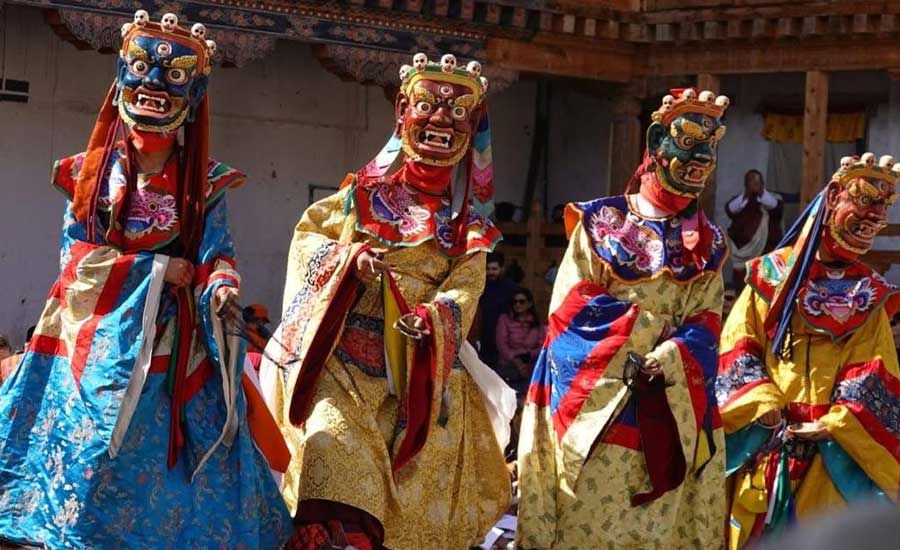
Festivals in Bhutan offer one of the most memorable ways to experience the country's Buddhist traditions, sacred dances, traditional clothing, monasteries and community life. From the famous Paro Tshechu and Thimphu Tshechu to smaller celebrations in Bumthang, Gangtey and remote Himalayan communities, Bhutan's festival calendar gives travellers an extraordinary opportunity to experience living culture rather than simply visit historic monuments.
Many of Bhutan's best-known religious festivals are called Tshechus. These celebrations are held in honour of Guru Rinpoche, also known as Padmasambhava, who played a central role in bringing Buddhism to Bhutan and the Himalayan region.
During a Tshechu, monks and trained performers present sacred Cham mask dances, communities gather in their finest traditional clothing, prayers and blessings take place, and in some festivals enormous sacred thongdrel images are displayed.
However, Bhutan's festival calendar goes beyond Tshechus. Travellers can also experience events celebrating highland communities, mountain conservation, local traditions, agriculture and wildlife.
This complete guide to the major festivals in Bhutan explains the most important festivals, their timing, the current 2027 travel calendar, how to choose the right festival, weather by festival season, what to wear, festival etiquette, photography, accommodation, booking advice and how to combine a Bhutan festival with trekking or a journey through Nepal.
For broader destination planning, start with our Bhutan Tour Guide or explore all our Bhutan Tours.
What Are Bhutan's Famous Festivals?
Bhutan has numerous religious and cultural festivals throughout the year. The most famous are the Tshechus, which are celebrated in different districts, monasteries and communities according to the Bhutanese lunar calendar.
The word Tshechu refers to the tenth day of a lunar month. Many Tshechus commemorate events associated with Guru Rinpoche.
Although visitors often describe these events simply as "Bhutan festivals," their importance goes far beyond entertainment. They are religious and social occasions when communities come together to receive blessings, watch sacred dances, meet friends and relatives, and maintain traditions that have been passed through generations.
For travellers, attending a festival provides an opportunity to experience Bhutanese culture in a very different way from ordinary sightseeing.
Why Are Festivals So Important in Bhutan?
Bhutan's festivals bring together religion, community, history, art and social life.
For local people, attending a Tshechu can be an important spiritual occasion. Families often wear their finest traditional dress, travel from surrounding villages and spend much of the day at the festival grounds.
Sacred mask dances are performed according to established traditions. Many dances communicate Buddhist teachings through symbolic costumes, masks, movements and characters.
For travellers, the value of attending a festival lies not only in seeing colourful dances but in observing how Bhutan's spiritual traditions remain part of everyday community life.
Major Festivals in Bhutan at a Glance
| Festival | Main Location | Usual Season | Best For |
|---|---|---|---|
| Paro Tshechu | Paro | Spring | First-time visitors, Tiger's Nest and major Tshechu experience |
| Thimphu Tshechu | Thimphu | Autumn | Large festival atmosphere and classic Bhutan tour |
| Punakha Drubchen & Tshechu | Punakha | Late winter / spring | History, culture and Punakha Valley |
| Wangdue Tshechu | Wangdue Phodrang | Autumn | Regional culture and western Bhutan itineraries |
| Gangtey Tshechu | Gangtey / Phobjikha | Autumn | Quieter festival atmosphere and beautiful valley scenery |
| Jambay Lhakhang Drup | Bumthang | Autumn | Ancient temple traditions and Bumthang culture |
| Thangbi Mewang | Bumthang | Autumn | Traditional Bumthang festival experience |
| Tamshing Phala Chhoepa | Bumthang | Autumn | Religious traditions and central Bhutan |
| Black-Necked Crane Festival | Phobjikha Valley | November | Wildlife, conservation and local culture |
| Royal Highland Festival | Laya, Gasa | October | Highland culture and adventurous travellers |
| Jhomolhari Mountain Festival | Jhomolhari region | Autumn | Mountain culture, conservation and trekking |
Bhutan Festival Calendar 2027
Bhutanese religious festivals follow the traditional lunar calendar, which means their dates change on the Gregorian calendar every year.
Travellers should therefore never assume that a festival will take place on exactly the same dates, or even necessarily in the same Gregorian month, every year.
The following table highlights some of the most useful 2027 Bhutan festival dates for international travellers. Dates published in advance may remain tentative and should always be reconfirmed before booking non-refundable international flights.
| Festival | Location | 2027 Timing | Why Consider It |
|---|---|---|---|
| Wangdue Tshechu | Wangdue Phodrang | 8–10 October 2027 | Regional Tshechu easily combined with Punakha |
| Thimphu Tshechu | Thimphu | 10–12 October 2027 | One of Bhutan's largest and best-known festivals |
| Tamshing Phala Chhoepa | Bumthang | 10–12 October 2027 | Religious traditions in Bhutan's spiritual heartland |
| Gangtey Tshechu | Gangtey Gonpa | 13–15 October 2027 | Festival combined with Phobjikha Valley |
| Jhomolhari Mountain Festival | Jhomolhari region | 14–15 October 2027 | Mountain communities, nature and conservation |
| Thangbi Mewang | Bumthang | 15–16 October 2027 | Distinctive traditional festival in Bumthang |
| Royal Highland Festival | Laya, Gasa | 23–24 October | Highland culture in one of Bhutan's most remote settings |
| Black-Necked Crane Festival | Phobjikha Valley | 11 November | Wildlife conservation and community culture |
Important: Bhutanese religious festival dates are based on the traditional lunar calendar. Dates announced well in advance may be tentative. Always reconfirm the final dates before purchasing non-refundable flights or designing an itinerary specifically around a festival.
Which Is the Best Festival in Bhutan?
There is no single "best" Bhutan festival for every traveller. The right choice depends on your travel month, preferred region, available time and whether you prefer a large celebration or a smaller regional experience.
| If You Want... | Festival to Consider |
|---|---|
| One of Bhutan's biggest festival experiences | Thimphu Tshechu |
| Festival + Tiger's Nest + Paro Valley | Paro Tshechu |
| Festival + Punakha Dzong + warmer valley | Punakha Tshechu |
| A quieter festival + beautiful rural valley | Gangtey Tshechu |
| Ancient temples and spiritual traditions | Bumthang festivals |
| Mountain communities + trekking | Jhomolhari Mountain Festival |
| Remote Himalayan highland culture | Royal Highland Festival |
| Wildlife + conservation + community culture | Black-Necked Crane Festival |
Paro Tshechu
Paro Tshechu is one of Bhutan's best-known spring festivals and an excellent choice for first-time visitors.
The festival is held in Paro and normally extends over several days of religious ceremonies and sacred Cham dances.
One reason Paro Tshechu works particularly well for international travellers is its location. Paro is Bhutan's main international gateway and is also home to the country's most famous landmark, Paro Taktsang or Tiger's Nest Monastery.
A well-designed Paro festival journey can therefore combine the Tshechu with Tiger's Nest, Paro's cultural sites, Thimphu and Punakha.
Spring also brings pleasant travel conditions and flowering landscapes, making Paro Tshechu one of the strongest options for travellers interested in both culture and nature.
Thimphu Tshechu
Thimphu Tshechu is one of Bhutan's largest and most celebrated religious festivals.
Held in the capital, the festival attracts large numbers of Bhutanese families from Thimphu and surrounding regions. People arrive dressed in their finest traditional gho and kira, creating an impressive atmosphere around the festival grounds.
Sacred Cham dances, Buddhist rituals, blessings and community gatherings take place during the celebration.
For international visitors, Thimphu Tshechu is particularly convenient because it can easily be incorporated into a classic western Bhutan itinerary covering Paro, Thimphu, Punakha and Tiger's Nest.
Travellers planning for 2027 can explore our Thimphu Tshechu Festival Tour.
Punakha Drubchen and Punakha Tshechu
Punakha's festival season is especially interesting because of the historical character of the Punakha Drubchen and the religious celebrations of the Punakha Tshechu.
Punakha was once Bhutan's capital and remains one of the country's most historically important valleys. The spectacular Punakha Dzong, standing between the Pho Chu and Mo Chu rivers, provides an extraordinary setting for cultural exploration.
The Punakha Drubchen is particularly known for historical re-enactments connected with Bhutan's past, while the Tshechu features traditional religious dances and ceremonies.
Because Punakha lies at a lower elevation than Thimphu and Paro, the valley also has a noticeably warmer climate.
Wangdue Tshechu
Wangdue Tshechu provides an opportunity to experience an important regional celebration while travelling through western Bhutan.
Wangdue is easily combined with nearby Punakha, making the festival practical for travellers who want to add a cultural event without designing their entire holiday around one festival.
In 2027, the current tentative dates are 8–10 October, making it potentially possible to combine Wangdue with other October festivals when the itinerary is carefully planned.
Gangtey Tshechu
Gangtey Tshechu takes place at Gangtey Gonpa overlooking the beautiful Phobjikha Valley.
Compared with the large urban atmosphere of Thimphu Tshechu, Gangtey can provide a more rural festival experience.
The location is a major part of its appeal. Phobjikha is a broad glacial valley surrounded by forested mountains and traditional villages.
In 2027, Gangtey Tshechu is tentatively scheduled for 13–15 October.
See our Bhutan with Gangtey Festival Tour for a journey combining this cultural celebration with the surrounding valley.
Major Festivals in Bumthang
Bumthang is often described as the spiritual heartland of Bhutan. Its valleys contain ancient temples, monasteries and sites associated with important Buddhist teachers and legends.
For travellers who are especially interested in religious traditions, Bumthang's festivals can provide some of the country's most memorable cultural experiences.
Jambay Lhakhang Drup
Jambay Lhakhang Drup is one of Bumthang's most famous traditional festivals.
It takes place at Jambay Lhakhang, one of Bhutan's ancient temples, and is known for distinctive religious ceremonies and traditional dances.
The festival is particularly attractive for travellers who want to go beyond western Bhutan and spend time exploring the temples, villages and valleys of central Bhutan.
Thangbi Mewang
Thangbi Mewang is held at Thangbi Lhakhang in Bumthang and is another distinctive regional festival.
The celebration is known for its strong local character and religious traditions.
The current tentative dates for 2027 are 15–16 October, making October particularly interesting for travellers planning a deeper cultural journey through Bhutan.
Tamshing Phala Chhoepa
Tamshing Phala Chhoepa is associated with Tamshing Lhakhang in Bumthang and provides another opportunity to experience the region's living Buddhist traditions.
In 2027, the current tentative dates are 10–12 October.
Travellers interested in exploring this region on foot can also consider our Bumthang Cultural Trek.
Black-Necked Crane Festival
The Black-Necked Crane Festival is different from a traditional Tshechu.
Held in the Phobjikha region on 11 November, the festival celebrates the arrival and conservation of the endangered black-necked cranes that migrate to the valley for winter.
The event combines environmental awareness, local culture, songs, dances and community participation.
For travellers interested in wildlife, conservation and rural Bhutan, this can be one of the most interesting festivals in the country.
November also provides better timing than September or early October for travellers specifically hoping to see black-necked cranes in Phobjikha.
Royal Highland Festival
The Royal Highland Festival is held annually in Laya, Gasa, on 23–24 October.
Unlike the large Dzong-based Tshechus, this festival focuses on Bhutan's highland communities, their traditions, livelihoods and relationship with the Himalayan environment.
Visitors can experience traditional performances, highland culture and activities involving animals such as yaks, horses and mastiffs.
Laya lies at approximately 4,000 metres, so attending the Royal Highland Festival requires considerably more planning than visiting a festival in Paro or Thimphu.
The journey is best suited to active travellers who have enough time for proper acclimatization and who genuinely want to experience Bhutan's remote highland culture.
Jhomolhari Mountain Festival
The Jhomolhari Mountain Festival celebrates mountain communities, local culture and conservation in the Jomolhari region.
It provides a very different experience from Bhutan's large urban Tshechus and can be especially appealing to trekkers and travellers interested in the relationship between local communities and the Himalayan environment.
The current tentative dates for 2027 are 14–15 October.
Travellers interested in exploring this mountain region more deeply can consider our Jomolhari Trek Bhutan.
Best Time to Visit Bhutan for Festivals
There is no single festival month because celebrations take place throughout the year. However, spring and autumn are particularly attractive because they combine important festivals with some of Bhutan's most favourable travel conditions.
| Season | General Conditions | Festival Experience |
|---|---|---|
| Spring | Pleasant weather, flowering landscapes and good trekking conditions | Excellent for major events such as Paro Tshechu and other spring celebrations |
| Summer | Green landscapes with monsoon rainfall | Regional festivals may offer quieter experiences |
| Autumn | Clearer weather, excellent trekking and Himalayan views | One of the strongest periods for major Tshechus and cultural festivals |
| Winter | Cooler and generally drier, with cold high-altitude conditions | Interesting regional festivals and fewer visitors in many areas |
For a complete seasonal comparison, see our Best Time to Visit Bhutan.
Spring Festivals vs Autumn Festivals in Bhutan
| Factor | Spring Festivals | Autumn Festivals |
|---|---|---|
| Landscape | Fresh spring vegetation and flowering plants | Post-monsoon landscapes and autumn scenery |
| Weather | Generally pleasant | Generally excellent for cultural touring and trekking |
| Famous Festival | Paro Tshechu | Thimphu Tshechu |
| Trekking | Excellent | Excellent |
| Mountain Views | Good opportunities | Often excellent after the monsoon |
| Best For | Flowers + culture + trekking | Festivals + Himalayan scenery + trekking |
October: One of Bhutan's Best Festival Months
For 2027 specifically, October is an outstanding month for festival travel in Bhutan.
The current calendar places several important events within a relatively short period, including Thimphu Tshechu, Gangtey Tshechu, Jhomolhari Mountain Festival, Thangbi Mewang and the Royal Highland Festival.
October is also one of Bhutan's strongest months for autumn travel, trekking and Himalayan scenery.
Travellers considering this period should read our detailed Bhutan in October: Weather, Festivals, Trekking & Travel Guide.
Can You Attend More Than One Festival on One Bhutan Trip?
Yes, sometimes. Because different festivals can take place close together, it may be possible to combine two or more events.
For example, the current 2027 calendar creates opportunities to combine Thimphu Tshechu and Gangtey Tshechu.
However, we do not recommend designing an itinerary simply to collect as many festivals as possible.
Bhutan's mountain roads require time, and the journey between destinations is part of the experience. A better itinerary combines one or two festivals with important cultural sites, landscapes, village experiences and sufficient time to understand each region.
Suggested Bhutan Festival Tour Duration
| Trip Length | What You Can Comfortably Include |
|---|---|
| 5–6 Days | One festival + Paro + Thimphu |
| 7–8 Days | One major festival + Paro + Thimphu + Punakha + Tiger's Nest |
| 9–11 Days | Festival + Paro + Thimphu + Punakha + Phobjikha |
| 12–14 Days | Multiple regions, selected festivals and Bumthang |
| 14+ Days | Festival + deeper cultural journey, trekking or remote highland experience |
Suggested 8-Day Bhutan Festival Itinerary
| Day | Journey | Main Experience |
|---|---|---|
| Day 1 | Arrive Paro – Thimphu | Arrival and introduction to Bhutan |
| Day 2 | Thimphu | Festival and cultural sightseeing |
| Day 3 | Thimphu | Festival / city highlights |
| Day 4 | Thimphu – Punakha | Dochula Pass and Punakha Valley |
| Day 5 | Punakha | Punakha Dzong and village experiences |
| Day 6 | Punakha – Paro | Scenic journey to Paro |
| Day 7 | Paro | Tiger's Nest Monastery hike |
| Day 8 | Paro | International departure |
The exact itinerary should always be adjusted around the confirmed festival schedule rather than forcing a festival into a fixed tour program.
Combine a Bhutan Festival with Trekking
Spring and autumn are both important trekking seasons, which makes it possible to combine cultural festivals with a Himalayan trek.
Depending on your fitness, time and interests, possibilities include:
- Jomolhari Trek – a classic high-altitude journey
- Samtengang Trek – a lower-altitude cultural trekking option
- Bumthang Cultural Trek – walking combined with Bhutan's spiritual heartland
The festival is best placed before or after the trek according to festival dates, route logistics and acclimatization requirements.
Festival Etiquette in Bhutan
Bhutan's festivals are religious and community events. Visitors are welcome, but respectful behaviour is essential.
- Dress modestly and neatly.
- Follow your guide's instructions.
- Respect designated seating and restricted areas.
- Do not walk across ceremonial spaces.
- Never interrupt a sacred dance for a photograph.
- Do not touch masks, religious objects or costumes.
- Ask permission before taking close portraits of local people.
- Observe all photography restrictions inside monasteries and temples.
- Avoid standing directly in front of local spectators for long periods.
- Remember that the festival is primarily a religious and community occasion.
What to Wear to a Bhutan Festival
International visitors are not expected to wear Bhutanese national dress, but clothing should be respectful.
We recommend:
- Long trousers or a modest long skirt
- Shirt or top covering the shoulders
- Comfortable walking shoes
- Warm layer for cool mornings and evenings
- Sun hat when appropriate
- Light rain protection depending on the season
Avoid very short shorts, revealing tops and clothing that would be inappropriate in a religious setting.
Photography at Bhutan Festivals
Bhutan festivals can be extraordinary for photography, with colourful masks, traditional dress, architecture and community gatherings.
However, a good photograph should never come at the expense of respect.
- Follow local photography rules.
- Never use flash where it is prohibited.
- Do not enter restricted areas for a better angle.
- Avoid blocking local spectators.
- Ask before taking close-up portraits.
- Be particularly careful around monks and religious ceremonies.
- Photography may be restricted inside temples and sacred spaces.
Are Bhutan Festivals Crowded?
The largest festivals, particularly Paro and Thimphu Tshechus, can attract large crowds.
This is part of the atmosphere, but travellers who prefer smaller gatherings may enjoy regional festivals such as Gangtey or celebrations in Bumthang.
Arriving early can help you find a good viewing position and experience the festival as local families begin gathering.
How Early Should You Book a Bhutan Festival Tour?
We recommend planning early for major festivals, particularly Paro Tshechu and Thimphu Tshechu.
Accommodation and flights can become limited because festival periods often overlap with Bhutan's popular spring and autumn travel seasons.
Early planning is particularly important if you:
- Have fixed international flight dates
- Want a particular hotel
- Are travelling as a private group
- Want to combine two festivals
- Plan to add a trek
- Want premium or luxury accommodation
Accommodation During Bhutan Festivals
Hotel demand increases during major festivals, especially in Paro and Thimphu.
Travellers seeking specific boutique or luxury properties should book particularly early.
For a premium journey, see our Bhutan in Top Hotels.
Bhutan Visa and Sustainable Development Fee
Most international travellers need the appropriate Bhutan visa before arrival, while entry arrangements differ for certain nationalities.
Bhutan also applies a Sustainable Development Fee (SDF).
The visa and SDF are separate from normal tour expenses such as accommodation, meals, transportation, guiding and flights.
Because entry regulations and fees can change, travellers should confirm current requirements for their nationality and travel dates.
Read our Bhutan Visa Guide for more detailed planning information.
How Much Does a Bhutan Festival Tour Cost?
The cost of a Bhutan festival tour depends on several factors rather than the festival alone.
Your total journey can include:
- International flights
- Bhutan visa fee where applicable
- Sustainable Development Fee
- Hotel accommodation
- Guide
- Private vehicle and driver
- Meals
- Entrance fees
- Festival itinerary arrangements
- Trekking services where applicable
- Travel insurance
- Personal expenses
Hotel category, number of travellers, journey length and additional activities all affect the final cost.
Combine Nepal and a Bhutan Festival
Bhutan festival journeys combine particularly well with Nepal.
Kathmandu provides convenient air access to Paro, allowing travellers to experience Nepal's UNESCO World Heritage Sites, trekking regions or wildlife before continuing to Bhutan.
Spring and autumn are especially attractive because both countries offer excellent travel opportunities during these periods.
Our Best of Nepal and Bhutan Tour provides a starting point for combining the two Himalayan destinations.
For transport, visa and practical information, read our Nepal to Bhutan Travel Guide.
Travellers looking for a more exclusive journey can also explore our Exclusive Bhutan with Nepal Stopover.
Major Bhutan Festival or Small Regional Festival?
Both experiences have advantages.
| Major Festival | Regional Festival |
|---|---|
| Larger crowds and impressive atmosphere | Often more intimate atmosphere |
| Easy to include in classic itineraries | May require travelling deeper into Bhutan |
| Greater hotel demand | Often fewer international visitors |
| Ideal for first-time festival visitors | Excellent for repeat visitors and cultural travellers |
| Examples: Paro and Thimphu | Examples: Gangtey and Bumthang celebrations |
If this is your first journey to Bhutan, Paro or Thimphu Tshechu can be excellent choices. If you have more time or prefer smaller cultural experiences, Gangtey or Bumthang may suit you better.
Frequently Asked Questions About Bhutan Festivals
What is the most famous festival in Bhutan?
Paro Tshechu and Thimphu Tshechu are among Bhutan's most famous festivals. Both attract large local gatherings and are convenient to combine with Bhutan's main cultural highlights.
What is a Tshechu?
A Tshechu is a traditional Bhutanese Buddhist festival associated with Guru Rinpoche. Tshechus include sacred Cham dances, religious ceremonies, blessings and community gatherings.
Which Bhutan festival is best for first-time visitors?
Paro Tshechu and Thimphu Tshechu are excellent choices because both can easily be combined with Bhutan's classic cultural route and Tiger's Nest Monastery.
When is the best time to visit Bhutan for festivals?
Spring and autumn are particularly attractive because important festivals coincide with generally favourable sightseeing and trekking conditions.
Which month has the most festivals in Bhutan?
This changes every year because festival dates follow the Bhutanese lunar calendar. For 2027, October is particularly strong, with several important festivals and cultural events scheduled during the month.
When is Thimphu Tshechu in 2027?
The current tentative dates for Thimphu Tshechu 2027 are 10–12 October.
When is Gangtey Tshechu in 2027?
The current tentative dates for Gangtey Tshechu 2027 are 13–15 October.
Can I attend Thimphu and Gangtey Tshechu on the same trip?
Yes. The current 2027 schedule makes this potentially possible because Thimphu Tshechu ends immediately before Gangtey Tshechu begins. The itinerary should be carefully designed around driving times and confirmed festival dates.
Are Bhutan festival dates the same every year?
No. Religious festival dates follow the traditional lunar calendar and therefore change on the Gregorian calendar from year to year.
Are Bhutan festivals organised for tourists?
No. Traditional Tshechus are religious and community celebrations attended primarily by Bhutanese people. International visitors are welcome, but should observe the events respectfully.
Can tourists take photographs during a Bhutan festival?
Photography is often possible in outdoor festival areas, but restrictions can apply during particular ceremonies and inside religious buildings. Always follow your guide's instructions and posted rules.
What should I wear to a Bhutan festival?
Wear neat, modest clothing covering the shoulders and legs. Comfortable footwear is useful because festival visits can involve walking and long periods outdoors.
Is Paro Tshechu better than Thimphu Tshechu?
Neither is universally better. Paro Tshechu is particularly convenient for combining a festival with Tiger's Nest, while Thimphu Tshechu offers the atmosphere of one of Bhutan's largest celebrations in the capital.
Which festival is best for a quieter experience?
Gangtey Tshechu and selected Bumthang festivals can be excellent choices for travellers who prefer a more regional atmosphere than the large Paro and Thimphu celebrations.
Which Bhutan festival is best for wildlife lovers?
The Black-Necked Crane Festival in Phobjikha Valley is particularly suitable for travellers interested in wildlife conservation, community culture and the winter arrival of black-necked cranes.
Which festival is best for trekkers?
The Jhomolhari Mountain Festival can be particularly interesting for trekkers, while spring and autumn Tshechus can also be combined with routes such as Jomolhari, Samtengang and Bumthang.
How many days should I allow for a Bhutan festival tour?
A minimum of around 7–8 days works well for one major festival plus Paro, Thimphu, Punakha and Tiger's Nest. Around 10–14 days is better if you want to include Phobjikha, Bumthang, multiple festivals or additional walking.
Should I book Bhutan early during festival season?
Yes. Major festivals often coincide with Bhutan's popular spring and autumn travel seasons, so flights and preferred accommodation can become limited.
Can I combine a Bhutan festival with trekking?
Yes. Spring and autumn are excellent periods for combining cultural festivals with trekking. The route should be chosen according to your fitness, available time and altitude experience.
Can I combine Nepal and a Bhutan festival?
Yes. Nepal and Bhutan work very well together, particularly during spring and autumn. Travellers can explore Nepal before flying from Kathmandu to Paro for a Bhutan festival journey.
Plan Your Bhutan Festival Tour with Himalayan Dream Team
A Bhutan festival should be more than a date added to an ordinary itinerary. The journey works best when the route is carefully designed around the festival location, travel times, accommodation, weather, cultural interests and the other places you want to experience.
Explore our complete Bhutan Festival Tours or browse all our Bhutan Tours.
For one of Bhutan's largest celebrations, see our Thimphu Tshechu Festival Tour. For a more rural festival experience, explore our Bhutan with Gangtey Festival Tour.
Travellers interested in combining culture and walking can explore our Jomolhari Trek, Samtengang Trek and Bumthang Cultural Trek.
If you are deciding when to travel, read our Best Time to Visit Bhutan and Bhutan in October.
For complete destination information, see our Bhutan Tour Guide, and for entry requirements read our Bhutan Visa Guide.
Travellers combining Nepal and Bhutan can explore our Best of Nepal and Bhutan Tour or read the practical Nepal to Bhutan Travel Guide.
Himalayan Dream Team can customise your Bhutan festival journey according to your travel dates, preferred festival, number of days, hotel category, trekking interests and whether you would like to combine Bhutan with Nepal.
Final Thoughts: Which Bhutan Festival Should You Choose?
There is no single festival that is perfect for every traveller.
Paro Tshechu is an excellent choice for a first spring journey and combines naturally with Tiger's Nest. Thimphu Tshechu offers one of Bhutan's largest festival atmospheres and works perfectly with the classic western Bhutan route. Gangtey Tshechu is ideal for travellers who prefer a beautiful rural setting, while the festivals of Bumthang provide deeper insight into Bhutan's spiritual traditions.
The Royal Highland Festival offers something completely different for adventurous travellers interested in remote Himalayan communities, while the Black-Necked Crane Festival combines conservation, wildlife and local culture in Phobjikha Valley.
For travellers planning Bhutan in 2027, October is particularly attractive because several important festivals occur close together during one of Bhutan's best autumn travel periods.
Rather than simply choosing the biggest festival, consider the experience you want from Bhutan. Choose the right season, allow enough time for the surrounding region and treat the festival as part of a wider cultural journey.
With thoughtful planning, attending one of the major festivals in Bhutan can become one of the most memorable experiences of your Himalayan journey.