

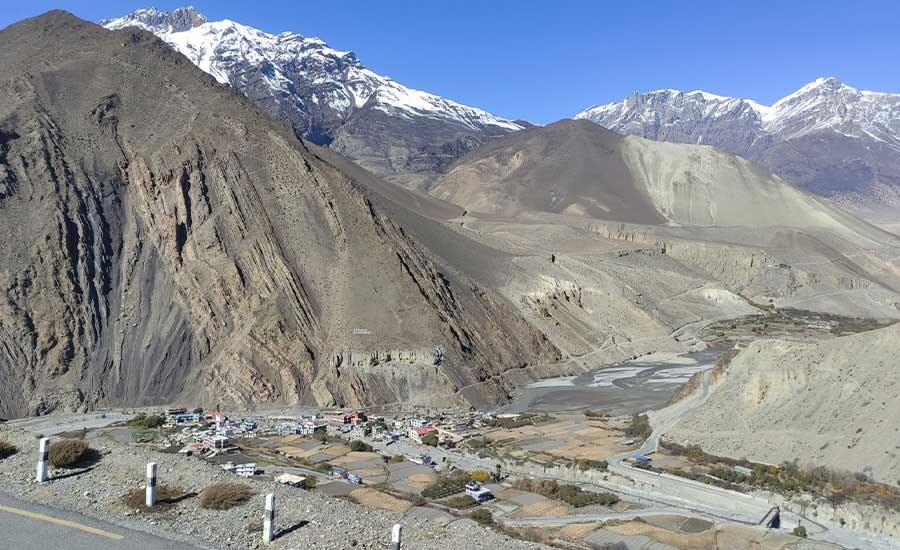
Planning to travel from Pokhara to Kagbeni in Nepal? The journey takes you from the green hills and lakes of Pokhara into the dramatic Kali Gandaki Valley, passing waterfalls, traditional villages, apple orchards and the spectacular mountain landscapes of Lower Mustang. Kagbeni (approximately 2,804 m) is one of Nepal's most atmospheric Himalayan villages and the traditional gateway to Upper Mustang.
The Pokhara to Kagbeni road distance is approximately 175–195 km, depending on the starting point and road alignment. A private jeep journey generally takes around 8–11 hours or longer, depending on road conditions, weather, traffic and sightseeing stops. Many travelers prefer to divide the journey into two days, allowing time to explore Tatopani, Marpha and Jomsom before reaching Kagbeni.
Another option is to take an early morning flight from Pokhara to Jomsom, followed by a short road journey to Kagbeni. However, flights are weather-dependent and may not operate on every travel date.
Whether you are planning a visit to Kagbeni, a pilgrimage to Muktinath, an Upper Mustang Trek or a scenic Upper Mustang Jeep Tour, understanding this route will help you plan a more comfortable and enjoyable journey.
In this complete Pokhara to Kagbeni travel guide, Himalayan Dream Team explains the road distance, driving time, transportation options, road conditions, estimated costs, scenic stops, best travel seasons, permits, accommodation and the most interesting places to visit around Kagbeni.
Pokhara to Kagbeni – Quick Facts
| Travel Information | Details |
|---|---|
| Starting Point | Pokhara, Gandaki Province, Nepal |
| Destination | Kagbeni, Mustang District, Nepal |
| Pokhara Elevation | Approximately 822 m / 2,697 ft |
| Kagbeni Elevation | Approximately 2,804 m / 9,199 ft |
| Approximate Road Distance | 175–195 km, depending on route and measuring points |
| Driving Time | Approximately 8–11 hours or longer |
| Recommended Vehicle | Private 4WD jeep |
| Alternative Transport | Shared jeep, local bus or flight to Jomsom followed by road transfer |
| Pokhara–Jomsom Flight | Approximately 20–25 minutes when operating |
| Jomsom to Kagbeni | Approximately 12–15 km by road |
| Jomsom–Kagbeni Drive | Approximately 30–60 minutes depending on conditions |
| Region | Lower Mustang / Annapurna Conservation Area |
| Best Travel Seasons | March–May and September–November |
| Main Attractions | Kali Gandaki Valley, Tatopani, Marpha, Jomsom, Kagbeni and Muktinath |
| Onward Destination | Upper Mustang and Lo Manthang |
| Recommended Trip Duration | 2–4 days for a relaxed Lower Mustang visit; longer for Upper Mustang |
Note: Distances and travel times are planning estimates, not guaranteed journey times. Road construction, seasonal damage, landslides, traffic and local diversions can change the actual route.
Where Is Kagbeni in Nepal?
Kagbeni is a historic Himalayan village in Mustang District, Gandaki Province, north-central Nepal. It lies near the confluence of the Kali Gandaki and Jhong rivers, approximately 12–15 km north of Jomsom.
Situated at approximately 2,804 metres above sea level, Kagbeni is known for its traditional earthen houses, narrow lanes, Buddhist monastery, old trading-route heritage and dramatic views across the Kali Gandaki Valley.
For centuries, Kagbeni occupied an important position along the trans-Himalayan trade route connecting the lower valleys of Nepal with settlements farther north towards the Tibetan Plateau.
Today, the village remains an important cultural and transport gateway for travelers exploring Lower Mustang, Muktinath and the restricted region of Upper Mustang.
Is Kagbeni in Upper or Lower Mustang?
Kagbeni is generally described as part of Lower Mustang and the traditional gateway to Upper Mustang.
The village occupies an important transition point between the more accessible Lower Mustang region and the restricted area farther north.
Travelers visiting Kagbeni itself do not automatically need an Upper Mustang Restricted Area Permit. However, those continuing beyond the designated restricted-area entry point towards Chhusang, Ghami and Lo Manthang must obtain the required authorization.
For more information about the region's traditional settlements, read our Upper Mustang Villages Guide.
Pokhara to Kagbeni Distance and Travel Time
The distance from Pokhara to Kagbeni is approximately 175–195 kilometres by road, depending on the exact starting point, road alignment and destination within the village.
Although this distance may appear relatively short, the journey takes much longer than a normal highway drive.
The road passes through mountain valleys, river corridors and sections where surfaces may be uneven, dusty, muddy or affected by ongoing maintenance.
How Long Does It Take to Drive from Pokhara to Kagbeni?
In suitable road conditions, a private jeep journey commonly requires approximately 8–11 hours, sometimes longer.
The actual driving time depends on:
- Road conditions between Beni and Jomsom.
- Weather and recent rainfall.
- Landslides, road repairs and traffic delays.
- Vehicle type and driver experience.
- Stops for meals, photography and sightseeing.
- Seasonal road diversions or restrictions.
For travelers who want to enjoy the scenery and explore the villages, Himalayan Dream Team generally recommends allowing two days rather than rushing the entire journey.
Pokhara to Kagbeni Distance by Route Section
| Route Section | Approximate Distance | Travel Notes |
|---|---|---|
| Pokhara to Beni | 80–90 km | Main road through the lower hills |
| Beni to Tatopani | 20–25 km | Mountain road following the Kali Gandaki corridor |
| Tatopani to Jomsom | 55–65 km | Mountain road with variable surfaces and conditions |
| Jomsom to Kagbeni | 12–15 km | Short road journey through the upper Kali Gandaki Valley |
These figures are approximate and should not be added together as an exact surveyed distance. Road alignments and measuring points differ.
Pokhara to Kagbeni Road Route
The usual overland journey follows the Kali Gandaki corridor from Pokhara into Mustang.
Pokhara → Kusma → Beni → Tatopani → Ghasa → Lete → Kalopani → Tukuche → Marpha → Jomsom → Kagbeni
The route offers one of Nepal's most striking landscape transitions.
Near Pokhara, you travel through green hills, farmland and river valleys. Farther north, the road enters the dramatic Kali Gandaki Gorge before reaching the drier landscapes of Mustang.
Stage 1: Pokhara to Beni
The journey begins in Pokhara, a beautiful lakeside city and one of Nepal's main gateways to the Annapurna region.
Leaving Pokhara, the road heads towards Kusma and Beni through settlements, cultivated hillsides and river valleys.
Beni is an important transport junction and a common stopping point before continuing into the Kali Gandaki corridor.
Stage 2: Beni to Tatopani
From Beni, the road follows the Kali Gandaki River towards Tatopani.
This section introduces travelers to a more rugged mountain environment, with steep hillsides, river views and waterfalls.
Tatopani is known for its natural hot springs and is a popular overnight stop for travelers heading towards Mustang.
Many Himalayan Dream Team itineraries use Tatopani as a comfortable break before continuing north.
Stage 3: Tatopani to Ghasa, Lete and Kalopani
Continuing north, the road enters increasingly dramatic mountain scenery.
The route passes near Rupse Waterfall and through the Kali Gandaki Gorge, where the great Annapurna and Dhaulagiri massifs rise on opposite sides of the valley.
Ghasa, Lete and Kalopani are traditional settlements along this mountain corridor.
Depending on weather and visibility, travelers may enjoy beautiful views towards Dhaulagiri, Annapurna and Nilgiri.
Stage 4: Kalopani to Tukuche, Marpha and Jomsom
As the road continues north, the valley becomes wider and the scenery noticeably drier.
Tukuche and Marpha are attractive Thakali settlements known for traditional stone buildings, narrow lanes and apple-growing traditions.
Marpha is particularly worth visiting if your itinerary allows time for a village walk.
From Marpha, continue to Jomsom, the main transport and administrative centre of Mustang District.
For more detailed information about this section, read our Pokhara to Jomsom Travel Guide.
Stage 5: Jomsom to Kagbeni
The final section from Jomsom to Kagbeni is relatively short but especially scenic.
The road continues north through the broad Kali Gandaki Valley, where dry hills, riverbeds and dramatic mountain formations create a landscape very different from Pokhara.
After approximately 30–60 minutes of driving, depending on road conditions, you reach Kagbeni.
On arrival, take time to explore the old village rather than only stopping for a photograph beside the road.
How to Get from Pokhara to Kagbeni
There are several ways to reach Kagbeni from Pokhara. The best option depends on your budget, travel dates, available time and preferred level of comfort.
1. Pokhara to Kagbeni by Private Jeep
A private 4WD jeep is one of the most practical options for travelers who want flexibility and comfort on the mountain road.
With a private vehicle, you can arrange suitable stops for photographs, meals, short village walks and sightseeing.
It is particularly useful for families, small groups, photographers and travelers continuing towards Muktinath or Upper Mustang.
Advantages:
- Flexible departure time and sightseeing stops.
- Suitable for families and private groups.
- More convenient luggage arrangements.
- Experienced local driver familiar with mountain roads.
- Opportunity to visit Marpha, Tatopani and other places.
Things to consider: Even in a private 4WD, the road can be rough and uncomfortable. Travel time is affected by weather and road conditions.
2. Pokhara to Kagbeni by Shared Jeep
Shared jeeps may be available on parts of the route, particularly between established transport hubs such as Pokhara, Beni, Jomsom and Kagbeni.
Services, departure points and schedules can change, and travelers may need to change vehicles along the way.
This option is generally more economical than hiring a private jeep, but it offers less flexibility.
Shared vehicles may be crowded and have limited luggage space.
We recommend confirming the route, price, departure time and final destination locally before travel.
3. Pokhara to Kagbeni by Local Bus
Local buses operate on sections of the Mustang transport corridor, although direct services and schedules should not be assumed.
Depending on current services, travelers may need to change transport at Beni or Jomsom.
Local buses can be a budget-friendly option, but the journey may take longer and involve more stops.
For travelers unfamiliar with Nepal's mountain roads, a private or shared jeep may be more convenient.
4. Pokhara to Kagbeni by Flight and Jeep
Another option is to fly from Pokhara to Jomsom and then continue to Kagbeni by road.
The flight usually takes approximately 20–25 minutes when operating and offers beautiful views of the Annapurna and Dhaulagiri ranges in clear weather.
From Jomsom Airport, Kagbeni is approximately 12–15 km away by road.
The transfer usually takes approximately 30–60 minutes, depending on conditions.
Important: Pokhara–Jomsom flights are weather-dependent, may be seasonal and are particularly sensitive to wind and visibility. They should never be treated as guaranteed.
Travelers with fixed international connections should keep suitable contingency time.
5. Pokhara to Kagbeni by Motorbike
The Pokhara to Kagbeni route is also popular among experienced motorcycle travelers.
The journey combines winding mountain roads, gravel sections, river valleys, strong winds and dramatic Himalayan scenery.
However, it is not an easy beginner motorcycle route.
Riders should have experience on uneven surfaces and be prepared for dust, loose stones, rough sections and changing weather.
For organized motorcycle adventures, explore our Upper Mustang Motorbike Tour and Motorbike Tours in Nepal Guide.
Which Transport Option Is Best?
| Transport | Best For | Main Consideration |
|---|---|---|
| Private 4WD Jeep | Families, private groups and photographers | Higher cost, but flexible and convenient |
| Shared Jeep | Budget-conscious travelers | Schedules and transfers may vary |
| Local Bus | Travelers prioritizing lower transport costs | Longer journey and less comfort |
| Flight to Jomsom + Jeep | Travelers with limited time | Flight cancellations and seasonal availability |
| Motorbike | Experienced adventure riders | Rough roads, wind and riding risks |
Pokhara to Kagbeni Road Conditions in 2027
Road conditions are among the most important considerations when planning a journey from Pokhara to Kagbeni.
The route includes a mixture of improved road sections, mountain roads and stretches that can be affected by gravel, dust, mud, construction and seasonal damage.
Some sections have been upgraded over recent years, but road improvements do not eliminate the risks associated with mountain travel.
Pokhara to Beni Road Conditions
The lower section generally follows established roads through populated areas and the middle hills.
Travel may still be affected by roadworks, traffic, rain and local diversions.
Beni to Jomsom Road Conditions
This is the section that requires the most careful planning.
Parts of the road pass below steep mountain slopes and through areas exposed to landslides, falling rocks and seasonal river-related damage.
Road surfaces can vary considerably, and recent rainfall may create muddy or difficult conditions.
Some sections may be temporarily closed for maintenance or safety reasons.
Jomsom to Kagbeni Road Conditions
The road between Jomsom and Kagbeni is comparatively short, but travelers should still expect possible dust, strong winds and uneven sections.
Wind can become particularly noticeable in the Kali Gandaki Valley during the afternoon.
Is the Pokhara to Kagbeni Road Safe?
The journey is regularly undertaken by local residents and travelers, but mountain-road travel involves genuine risks.
Conditions can change quickly after heavy rain, landslides or road damage.
For private trips, Himalayan Dream Team recommends a suitable vehicle, an experienced local driver, daylight travel and confirmation of current road accessibility before departure.
We do not recommend assuming that a route is safe simply because it appears open on a digital map.
Pokhara to Kagbeni Travel Cost
The cost of traveling from Pokhara to Kagbeni depends on the type of transport, season, vehicle availability and services included.
A private jeep generally costs more than shared transport, but the total vehicle cost can be divided among the passengers.
Flight-and-jeep arrangements have a different cost structure because they include domestic airfare and an onward transfer from Jomsom.
What Affects the Travel Cost?
- Private versus shared transportation.
- One-way or round-trip journey.
- Number of passengers.
- Vehicle size and luggage requirements.
- Travel season and local availability.
- Fuel and road conditions.
- Overnight accommodation and meals.
- Sightseeing stops and additional destinations.
- Whether the itinerary continues to Muktinath or Upper Mustang.
For a private jeep, ask whether the quotation includes fuel, driver expenses, parking, applicable road charges and return vehicle arrangements.
We recommend obtaining a current quotation rather than relying on old online fare estimates.
Himalayan Dream Team can arrange a private Pokhara to Kagbeni journey or include Kagbeni as part of a longer Mustang tour.
Best Places to Visit Between Pokhara and Kagbeni
The journey from Pokhara to Kagbeni is much more than a transfer between two destinations.
With enough time, travelers can explore beautiful villages, natural attractions and some of Nepal's most distinctive mountain scenery.
1. Beni – Gateway to the Kali Gandaki Valley
Beni is an important town and transport junction at the meeting of the Kali Gandaki and Myagdi rivers.
It is a practical place to stop for refreshments before continuing into the mountain road corridor.
2. Tatopani – Natural Hot Springs
Tatopani is well known for its natural hot springs.
The village is a popular stopping point for travelers and trekkers moving between the Annapurna region and Mustang.
Depending on local access and opening arrangements, visitors may be able to enjoy the hot spring facilities.
For travelers who prefer a relaxed itinerary, Tatopani makes a useful overnight stop.
3. Rupse Waterfall – A Scenic Mountain Waterfall
Rupse Waterfall is one of the most attractive natural features along the road north of Beni.
Water descends from the steep mountainside near the Kali Gandaki corridor, creating an impressive sight, especially when water levels are high.
Stop only where parking and viewing conditions are safe. Waterfalls and nearby slopes can be hazardous during heavy rain.
4. Kali Gandaki Gorge – Between Annapurna and Dhaulagiri
The Kali Gandaki Valley is famous for its dramatic mountain geography.
The river corridor runs between the Annapurna and Dhaulagiri massifs, creating one of the world's most remarkable mountain valleys.
As you travel north, the scenery changes from forested hillsides to increasingly open and rugged Himalayan landscapes.
For photographers, this transition is one of the highlights of the entire journey.
5. Kalopani and Lete – Himalayan Mountain Views
Kalopani and Lete are attractive mountain settlements along the route.
On clear days, the surrounding area offers beautiful views towards Dhaulagiri, Annapurna and nearby peaks.
The villages also provide opportunities to experience the changing architecture and landscape of the upper Kali Gandaki Valley.
6. Tukuche – Traditional Thakali Heritage
Tukuche is a historic Thakali settlement with traditional houses and a long association with trade through the Kali Gandaki Valley.
Its location makes it an interesting cultural stop for travelers exploring Lower Mustang.
7. Marpha – The Apple Village of Mustang
Marpha is one of the most charming villages in Lower Mustang.
It is known for its traditional stone-paved lanes, whitewashed houses, apple orchards and local food products.
Walking through Marpha offers a different experience from the main road journey.
Depending on the season, visitors may find local apples, dried fruit, apple juice and other regional products.
We recommend allowing time for a short village walk rather than only stopping beside the road.
8. Jomsom – Main Gateway to Mustang
Jomsom is the principal transport hub of Lower Mustang and an important base for travelers heading to Kagbeni, Muktinath and Upper Mustang.
The town has an airport, lodges, restaurants, shops and transport services.
It is also known for the strong winds that frequently develop along the Kali Gandaki Valley.
Learn more in our Pokhara to Jomsom Travel Guide.
Best Things to Do in Kagbeni, Mustang
Kagbeni is worth more than a short roadside stop.
The village has a distinctive atmosphere, with old earthen buildings, narrow lanes, Buddhist monuments and views across the surrounding mountains and river valley.
1. Explore the Old Village of Kagbeni
One of the best experiences in Kagbeni is simply walking through its old streets.
The traditional settlement contains narrow lanes, mud-brick houses, small courtyards and religious structures that reflect the region's history and culture.
The village developed along an important historic trade route, and its architecture remains one of its most interesting features.
Take your time to explore respectfully, remembering that these are private homes and active community spaces.
2. Visit Kag Chode Monastery
Kag Chode Thupten Samphel Ling is an important Buddhist monastery in Kagbeni.
It reflects the village's long connection with Tibetan Buddhist religious traditions.
Visitors should follow local guidance about access, photography and appropriate behavior.
Some areas may not be open to visitors at all times.
3. Enjoy the Kali Gandaki River Views
Kagbeni lies near the meeting of the Kali Gandaki and Jhong rivers.
The broad river valley, dry hills and distant mountain scenery make the area particularly attractive for photography.
Early morning and late afternoon light can create beautiful contrasts across the landscape.
Keep a safe distance from unstable riverbanks and avoid entering fast-flowing water.
4. Discover Traditional Mustang Architecture
The older houses in Kagbeni are very different from the buildings commonly seen around Pokhara.
Thick earthen walls, flat roofs and narrow passages reflect the dry climate and local building traditions.
These architectural features also introduce travelers to the settlements found farther north in Upper Mustang.
5. Learn About Kagbeni's Buddhist Culture
Prayer wheels, chortens, religious images and monastery traditions are important parts of Kagbeni's cultural landscape.
Travelers interested in Himalayan Buddhism will find the village a meaningful introduction to the cultural heritage of Mustang.
Respect local customs and ask permission before photographing people or religious ceremonies.
6. Enjoy Himalayan Views and Photography
Kagbeni offers a wonderful combination of old village streets, dry mountain landscapes, river valleys and Himalayan scenery.
Photographers can explore the contrast between traditional earthen architecture and the rugged natural surroundings.
7. Stay Overnight in a Local Lodge
Spending a night in Kagbeni allows you to experience the village after daytime visitors have left.
You can enjoy a relaxed evening, explore the old settlement and appreciate the quieter atmosphere of Lower Mustang.
For travelers continuing to Upper Mustang, an overnight stop can also provide time to organize the next stage of the journey.
Kagbeni to Muktinath – A Popular Side Trip
One of the most popular excursions from Kagbeni is a visit to Muktinath, an important pilgrimage destination for both Hindus and Buddhists.
Muktinath Temple is situated at approximately 3,710 m, while the surrounding settlement and road approach lie at somewhat different elevations.
The temple complex is famous for its religious significance, 108 water spouts and sacred flame traditions.
How Far Is Muktinath from Kagbeni?
The road distance is approximately 12–15 km, depending on the destination and measuring point.
The drive towards Ranipauwa, the main settlement serving Muktinath, generally takes around 30–60 minutes depending on road conditions.
From the vehicle-access area, visitors continue towards the temple on foot or by locally available assistance, where applicable.
Can You Visit Muktinath and Kagbeni in One Day?
Yes, if you are already staying in Jomsom or Kagbeni and conditions are suitable.
However, combining a full Pokhara-to-Kagbeni drive with a Muktinath visit on the same day can be tiring.
For a more enjoyable journey, we recommend staying overnight in Lower Mustang and visiting Muktinath the following morning.
Altitude Considerations for Muktinath
Traveling quickly from Pokhara to Kagbeni and then climbing to Muktinath involves a considerable altitude gain.
Even when traveling by jeep, altitude sickness can occur. Vehicle travel does not provide protection against altitude illness.
Travelers should avoid rushing to higher elevations, monitor symptoms and allow additional time when needed.
Kagbeni to Upper Mustang and Lo Manthang
Kagbeni is the traditional gateway for journeys into Upper Mustang, one of Nepal's most distinctive cultural and geographical regions.
Beyond the restricted-area entry point, the landscape becomes increasingly dry and dramatic, with colorful cliffs, deep valleys, ancient caves and traditional Tibetan-influenced villages.
The historic walled settlement of Lo Manthang (approximately 3,840 m) is the main destination for many Upper Mustang journeys.
Upper Mustang Route from Kagbeni
A common road journey follows:
Kagbeni → Chhusang → Chele → Samar → Syangmochen → Ghiling → Ghami → Tsarang → Lo Manthang
Trekking itineraries may use different trails and include cultural detours through places such as Chungsi Cave, Drakmar and Ghar Gompa.
Upper Mustang Trek from Kagbeni
For travelers who enjoy walking, the Upper Mustang Trek – 15 Days offers an opportunity to explore the region through traditional trails and mountain villages.
Himalayan Dream Team's itinerary begins the trekking section from Kagbeni and continues through Chele, Ghiling, Drakmar and Ghar Gompa before reaching Lo Manthang.
The journey combines spectacular high-desert scenery, Buddhist monasteries, caves, traditional villages and important mountain passes.
Upper Mustang Jeep Tour from Kagbeni
Travelers who prefer less walking can explore Upper Mustang by private 4WD jeep.
Our Upper Mustang Jeep Tour – 12 Days includes Kagbeni, Muktinath, traditional Mustang villages and Lo Manthang.
Traveling by jeep provides flexibility for sightseeing, photography and cultural visits, although road conditions remain rugged.
Upper Mustang Motorbike Tour
For experienced riders, the journey from Pokhara through Kagbeni and onward to Lo Manthang is one of Nepal's most memorable motorcycle adventures.
The route includes mountain roads, gravel sections, strong winds and spectacular high-desert scenery.
See our Upper Mustang Motorbike Tour for a guided riding itinerary.
Visit Upper Mustang During the Tiji Festival
The Tiji Festival is one of Upper Mustang's most important annual Buddhist cultural celebrations.
Held in Lo Manthang, the festival includes sacred masked dances, rituals, music and community gatherings.
The Tiji Festival in 2027 is scheduled for 1–3 June 2027. Travelers should reconfirm the dates before making non-refundable arrangements.
Himalayan Dream Team offers a dedicated Mustang Tiji Festival Trek – 16 Days for travelers who want to combine trekking with the festival.
Read our Mustang Festivals Guide to learn more about Tiji and Yartung traditions.
Explore Lo Manthang
Lo Manthang is the historic cultural centre of the former Kingdom of Lo.
The settlement is known for its old walls, traditional houses, Buddhist monasteries and access to the remarkable caves around Chhoser.
Our Lo Manthang Travel Guide explains its history, attractions, accommodation, permits and travel options in detail.
Recommended Pokhara to Kagbeni Itineraries
The best itinerary depends on whether you want to visit Kagbeni only, combine it with Muktinath or continue into Upper Mustang.
Option 1: Pokhara to Kagbeni – 2 Days
| Day | Program | Overnight |
|---|---|---|
| Day 1 | Drive from Pokhara to Kagbeni via Beni, Tatopani, Marpha and Jomsom, with short stops according to road conditions. | Kagbeni |
| Day 2 | Explore old Kagbeni and return to Pokhara by road. | Pokhara |
Best for: Travelers with limited time who want to see Kagbeni and experience the Kali Gandaki Valley.
Important: This is a demanding road itinerary, with long driving days and little time for sightseeing.
Option 2: Pokhara, Tatopani, Kagbeni and Muktinath – 4 Days
| Day | Program | Overnight |
|---|---|---|
| Day 1 | Drive from Pokhara to Tatopani via Beni. Explore the village and hot springs if accessible. | Tatopani |
| Day 2 | Drive through the Kali Gandaki Valley via Marpha and Jomsom to Kagbeni. Explore the old village. | Kagbeni |
| Day 3 | Visit Muktinath, allowing time for the altitude and temple visit. Return to Jomsom or Marpha. | Jomsom or Marpha |
| Day 4 | Drive back to Pokhara with suitable breaks along the way. | Pokhara |
Best for: Families, couples, cultural travelers and visitors who want a more relaxed Lower Mustang journey.
Additional time may be advisable for travelers sensitive to altitude or those who prefer shorter driving days.
Option 3: Pokhara to Kagbeni and Upper Mustang
For a longer cultural journey, continue north from Kagbeni towards Chhusang, Ghami, Tsarang and Lo Manthang.
The itinerary should include suitable overnight stops, permit arrangements and time to explore the historic villages and monasteries.
Himalayan Dream Team offers:
- Upper Mustang Trek – 15 Days
- Upper Mustang Jeep Tour – 12 Days
- Upper Mustang Motorbike Tour
- Mustang Tiji Festival Trek – 16 Days
Best Time to Travel from Pokhara to Kagbeni
The best general periods for the Pokhara to Kagbeni journey are spring and autumn.
Mustang's location north of the main Himalayan ranges creates a relatively dry climate compared with many other parts of Nepal.
However, the road from Pokhara passes through wetter lower valleys, so access conditions remain important throughout the year.
Spring: March to May
Spring is a popular time for Mustang travel.
The lower valleys become warmer, mountain views can be beautiful and the region begins to welcome more visitors after winter.
March can still be cold at higher elevations, while April and May generally offer more comfortable daytime conditions.
Dust and strong afternoon winds are common in parts of Mustang.
Summer and Monsoon: June to August
Upper Mustang lies in a Himalayan rain-shadow region and receives less rainfall than the southern slopes of the Annapurna range.
However, the access road from Pokhara passes through monsoon-affected areas, particularly between Beni and the higher Mustang valley.
Heavy rain, landslides, road closures and flight disruptions can affect the journey.
Summer travel is possible, but flexibility is essential.
Autumn: September to November
Autumn is one of the most popular seasons for traveling in Mustang.
After the monsoon, mountain visibility often improves, and the weather is generally favorable for sightseeing and trekking.
October is particularly popular, while November brings colder temperatures, especially in the mornings and evenings.
Winter: December to February
Winter in Mustang can be very cold, with freezing nights and possible snowfall.
Road access may be affected by snow, ice or seasonal conditions, especially on higher routes.
Some tourist services may also operate on a reduced schedule.
Pokhara to Kagbeni Seasonal Travel Guide
| Season | Months | Typical Conditions | Travel Advice |
|---|---|---|---|
| Spring | March–May | Warmer days, possible dust and strong winds | Excellent general travel season |
| Monsoon | June–August | Rain and landslide risk on lower access roads | Allow extra time and confirm road access |
| Autumn | September–November | Often clearer mountain views and cooler weather | Excellent general travel season |
| Winter | December–February | Cold weather and possible snow or ice | Check access and accommodation availability |
Permits Required for Pokhara to Kagbeni
Permit requirements depend on whether you are visiting Kagbeni and Lower Mustang or continuing into the restricted Upper Mustang region.
Annapurna Conservation Area Permit (ACAP)
Kagbeni lies within the Annapurna Conservation Area, and the ACAP permit is the principal conservation-area permit relevant to eligible foreign visitors.
The standard fee for most non-SAARC foreign visitors has been NPR 3,000, with different rates or exemptions potentially applying to other visitor categories.
Travelers should confirm the current fee and permit applicability for their nationality and itinerary.
Official conservation-area permit information is available through the National Trust for Nature Conservation permit portal.
Do You Need an Upper Mustang Restricted Area Permit for Kagbeni?
No, not simply to visit Kagbeni. Kagbeni is the traditional gateway to the restricted region.
Travelers continuing north beyond the designated restricted-area checkpoint towards Lo Manthang require the applicable Upper Mustang Restricted Area Permit.
Upper Mustang Restricted Area Permit
Under the newer permit structure reported for 2026, the Upper Mustang Restricted Area Permit is charged at USD 50 per person per day.
Older travel articles may still mention the previous USD 500 minimum for the first ten days. These older figures should not be used without checking the current regulations.
Restricted-area permits must be arranged through the appropriate registered trekking or travel agency, with guide and group requirements confirmed for the actual travel dates.
Himalayan Dream Team arranges the required permits for guests booking our organized Upper Mustang journeys.
For more details, see our Upper Mustang Trek Guide.
Altitude, Weather and Travel Safety
Traveling from Pokhara to Kagbeni involves a significant increase in elevation.
Pokhara is approximately 822 m above sea level, while Kagbeni is approximately 2,804 m.
This means travelers gain nearly 2,000 metres in elevation during the journey.
Can You Get Altitude Sickness in Kagbeni?
Yes. Although Kagbeni is lower than many Himalayan trekking destinations, altitude sickness can occur above approximately 2,500 m, especially after a rapid ascent.
Symptoms may include headache, nausea, dizziness, fatigue and poor appetite.
Travelers who develop symptoms should avoid ascending higher until they have recovered and should seek medical advice when needed.
Severe symptoms such as confusion, difficulty walking normally or breathlessness at rest require urgent medical attention and descent when feasible.
Important Safety Advice
- Travel during daylight where possible.
- Confirm current road conditions before leaving Pokhara.
- Use a suitable vehicle and experienced driver.
- Allow extra time during monsoon and winter.
- Carry drinking water and suitable clothing.
- Avoid rushing to Muktinath or higher Upper Mustang settlements.
- Keep essential medication accessible during the journey.
- Allow contingency time for road or flight delays.
- Ensure travel insurance is suitable for your activities and altitude.
For longer Upper Mustang journeys, gradual ascent and sensible overnight planning are particularly important.
Accommodation and Food in Kagbeni
Kagbeni has locally operated lodges, guesthouses and teahouses serving visitors traveling through Lower Mustang and towards Upper Mustang.
Accommodation ranges from simple mountain rooms to more comfortable local lodges, depending on availability.
What Facilities Can You Expect?
Facilities vary, but accommodation may include:
- Private or shared rooms.
- Attached or shared bathrooms.
- Hot water where available.
- Dining areas serving local and common trekking meals.
- Electricity and charging facilities.
- Wi-Fi or mobile connectivity, subject to coverage.
Services may be less reliable during bad weather or periods of high visitor demand.
What Food Can You Eat in Kagbeni?
Common dishes include dal bhat, vegetable curry, rice, noodles, soups, momos and Tibetan-style bread.
Mustang is also known for Thakali food traditions, particularly in settlements such as Marpha and Tukuche.
Local menus vary by lodge, season and availability.
We recommend trying regional food while respecting local customs and avoiding unnecessary food waste.
What to Pack for Pokhara to Kagbeni
Although the journey can be completed by vehicle, Kagbeni's altitude, wind and variable temperatures make appropriate packing important.
| Category | Recommended Items |
|---|---|
| Clothing | Warm jacket, fleece, comfortable trousers and layered clothing |
| Weather Protection | Windproof jacket and rain protection |
| Footwear | Comfortable walking shoes with good grip |
| Sun Protection | Sunglasses, sun hat, sunscreen and lip balm |
| Dust Protection | Buff, scarf or suitable face covering |
| Personal Essentials | Medication, toiletries and reusable water bottle |
| Electronics | Mobile phone, camera, power bank and charging cables |
| Documents | Passport, permits, insurance information and booking details |
| Optional | Binoculars, small daypack and trekking poles for longer walks |
Travelers continuing to Upper Mustang or trekking at higher elevations will need additional equipment suited to their itinerary and season.
Practical Tips for Traveling from Pokhara to Kagbeni
Start Early from Pokhara
An early departure provides more daylight for the journey and allows flexibility for road delays.
Do Not Rush the Journey
The road is scenic but can be tiring. A two-day journey is often more enjoyable than attempting to cover the entire route with many sightseeing stops in one day.
Keep Some Cash
Cash is useful for small purchases, local meals and services where digital payments may not be available or reliable.
Expect Strong Winds
The Kali Gandaki Valley is known for strong winds, especially during the afternoon.
Carry a windproof jacket and protect cameras and other equipment from dust.
Confirm Flight Availability
If planning to fly to Jomsom, check whether flights are operating during your travel dates and allow time for weather-related changes.
Respect Local Communities
Kagbeni is a living village with important Buddhist traditions and local customs.
Ask permission before photographing residents and follow monastery rules.
Travel Responsibly
Carry reusable water bottles, dispose of waste properly and support local lodges, restaurants and businesses.
Plan Upper Mustang Permits in Advance
If you intend to continue north beyond Kagbeni, arrange the necessary restricted-area permits before entering the controlled region.
Frequently Asked Questions About Pokhara to Kagbeni
1. How far is Kagbeni from Pokhara?
The road distance is approximately 175–195 km, depending on the starting point, road alignment and final destination.
2. How long does it take to drive from Pokhara to Kagbeni?
A private jeep journey generally takes approximately 8–11 hours or longer, depending on weather, road conditions, traffic and stops.
3. Can I travel from Pokhara to Kagbeni in one day?
Yes, when road conditions allow. However, it is a long journey, and a two-day itinerary is more comfortable if you want to explore the villages along the way.
4. Is there a direct flight from Pokhara to Kagbeni?
No. Kagbeni does not have a commercial airport. Travelers can fly from Pokhara to Jomsom when flights are operating and continue by road to Kagbeni.
5. How long is the flight from Pokhara to Jomsom?
The flight usually takes approximately 20–25 minutes when operating. Services are weather-dependent and may be seasonal.
6. How far is Kagbeni from Jomsom?
Kagbeni is approximately 12–15 km north of Jomsom by road.
7. How long does it take from Jomsom to Kagbeni?
The drive usually takes approximately 30–60 minutes, depending on road and traffic conditions.
8. Is the road from Pokhara to Kagbeni good?
Conditions vary. Some sections are improved, while others can be rough, dusty, muddy or affected by landslides and roadworks.
9. Do I need a 4WD jeep?
A 4WD jeep is recommended for a private journey because it is better suited to variable mountain-road conditions. Actual vehicle requirements depend on the current road state.
10. Can I take a local bus to Kagbeni?
Local transport is available on parts of the route, but direct services and schedules vary. You may need to change vehicles at Beni or Jomsom.
11. Is Pokhara to Kagbeni suitable for a motorbike tour?
Yes, for experienced riders comfortable with rough mountain roads, gravel, dust and strong winds. It is not an ideal first off-road motorcycle journey.
12. What is the altitude of Kagbeni?
Kagbeni is situated at approximately 2,804 m / 9,199 ft above sea level.
13. Can altitude sickness occur in Kagbeni?
Yes. Altitude sickness can occur above approximately 2,500 m, particularly after a rapid ascent from lower elevations.
14. Is Kagbeni worth visiting?
Yes. Kagbeni is known for its traditional village architecture, Buddhist monastery, old streets, Kali Gandaki scenery and importance as the gateway to Upper Mustang.
15. What are the best things to do in Kagbeni?
Explore the old village, visit Kag Chode Monastery when accessible, enjoy the river valley views, photograph traditional architecture and experience local Mustang hospitality.
16. How many days should I spend in Kagbeni?
One overnight stay is worthwhile for most travelers. Additional time is useful if you want to explore the surrounding area or visit Muktinath.
17. How far is Muktinath from Kagbeni?
Muktinath is approximately 12–15 km from Kagbeni by road, depending on the exact destination.
18. Can I visit Muktinath from Kagbeni?
Yes. Muktinath is a popular excursion from Kagbeni, although travelers should consider the significant increase in altitude.
19. Is Kagbeni part of Upper Mustang?
Kagbeni is generally considered part of Lower Mustang and is the traditional gateway to the restricted Upper Mustang region.
20. Do I need an Upper Mustang permit to visit Kagbeni?
No, not simply to visit Kagbeni. The special restricted-area permit is required when entering the designated Upper Mustang restricted region beyond the gateway.
21. Do I need an ACAP permit?
Eligible foreign visitors traveling in the Annapurna Conservation Area generally require the applicable conservation-area permit. Confirm the requirements for your nationality and itinerary.
22. Can I continue from Kagbeni to Lo Manthang?
Yes. Travelers can continue north by trekking or suitable 4WD vehicle with the required restricted-area permits and travel arrangements.
23. What is the best time to visit Kagbeni?
Spring and autumn are generally the most favorable periods. Summer travel is possible, but monsoon conditions can affect access roads.
24. Can I visit Kagbeni during the monsoon?
Yes, but the lower access road from Pokhara may be affected by rain, landslides and temporary closures.
25. Is Kagbeni safe for families?
Kagbeni can be visited by families, but suitability depends on the travelers' health, altitude tolerance, road conditions and itinerary. Families should avoid overly rushed travel plans.
26. Are there hotels and lodges in Kagbeni?
Yes. Kagbeni has local lodges, guesthouses and teahouses, although facilities and availability vary.
27. Is there mobile network coverage in Kagbeni?
Mobile and internet services may be available, but reliability varies. Travelers should not depend on continuous connectivity.
28. Can I combine Kagbeni with an Upper Mustang Jeep Tour?
Yes. Himalayan Dream Team's Upper Mustang Jeep Tour includes Kagbeni as part of the journey towards Lo Manthang.
29. Can I travel to Kagbeni from Kathmandu?
Yes. Most travelers first reach Pokhara by flight or road and then continue to Kagbeni through the Kali Gandaki Valley or via Jomsom Airport.
30. Can Himalayan Dream Team arrange a private Pokhara to Kagbeni trip?
Yes. Himalayan Dream Team can arrange private vehicle travel, local accommodation, sightseeing and longer Mustang itineraries according to your travel dates and requirements.
Related Mustang Trips and Travel Guides
Planning a longer journey through Mustang? Himalayan Dream Team offers trekking, jeep and motorbike adventures, along with detailed travel guides covering the region's villages, monasteries, festivals and routes.
Explore Our Mustang Trips
- Upper Mustang Trek – 15 Days – trek from Kagbeni through traditional Mustang villages to Lo Manthang.
- Upper Mustang Jeep Tour – 12 Days – discover Kagbeni, Muktinath, Lo Manthang and Upper Mustang by private 4WD.
- Upper Mustang Motorbike Tour – explore Mustang's spectacular roads on a guided motorcycle adventure.
- Mustang Tiji Festival Trek – 16 Days – experience Upper Mustang's famous Buddhist festival in Lo Manthang.
Useful Mustang Travel Guides
- Pokhara to Jomsom Travel Guide – distance, flights, road conditions and transport options.
- Upper Mustang Villages Guide – traditional settlements, monasteries, caves and local culture.
- Lo Manthang Nepal Travel Guide – history, monasteries, caves, altitude and travel information.
- Upper Mustang Trek Guide – trekking route, itinerary, permits, seasons and preparation.
- Guide to Upper Mustang Trek – additional information about trekking through the former Kingdom of Lo.
- Mustang: The Land of Stories and Festivals – learn about the Tiji and Yartung celebrations.
- Motorbike Tours in Nepal 2027 – routes, riding conditions, costs and practical motorcycle travel advice.
Why Travel from Pokhara to Kagbeni with Himalayan Dream Team?
Himalayan Dream Team Treks & Tours Pvt. Ltd. is a Kathmandu-based, women-led travel company organizing trekking, cultural tours and adventure journeys throughout Nepal.
Our Mustang programs combine local knowledge, carefully planned routes and personal assistance to help travelers explore the region according to their interests and available time.
What We Can Arrange
- Private 4WD jeep transportation from Pokhara to Kagbeni.
- Experienced local drivers familiar with mountain roads.
- Hotel and lodge accommodation in Lower Mustang.
- Visits to Tatopani, Marpha, Jomsom and Kagbeni.
- Muktinath pilgrimage and sightseeing arrangements.
- Upper Mustang Jeep Tours and trekking programs.
- Licensed guides for organized Mustang journeys.
- Restricted-area permits for eligible Upper Mustang itineraries.
- Customized private tours for couples, families and groups.
- Guided motorbike adventures for experienced riders.
- Festival journeys to Lo Manthang.
We recommend planning the journey according to road conditions, travel season and the places you most want to visit rather than rushing between destinations.
Final Thoughts: Is the Journey from Pokhara to Kagbeni Worth It?
Yes. The journey from Pokhara to Kagbeni is one of Nepal's most scenic overland adventures and an excellent introduction to the landscapes and culture of Mustang.
Along the way, travelers experience a remarkable transition from green hills and river valleys to dramatic mountain scenery, traditional Thakali villages and the dry landscapes of Lower Mustang.
Highlights such as Tatopani, Rupse Waterfall, the Kali Gandaki Gorge, Marpha and Jomsom make the journey rewarding even before reaching Kagbeni.
Kagbeni itself deserves time to explore. Its old lanes, traditional houses, Buddhist monastery and historic position on the route to Upper Mustang make it one of the most interesting villages in the region.
Whether you are planning a short Lower Mustang visit, a pilgrimage to Muktinath or a longer journey towards Lo Manthang, the Pokhara to Kagbeni route offers beautiful scenery and a memorable introduction to Nepal's trans-Himalayan landscape.
For the best experience, allow enough time, choose suitable transport and remain flexible for mountain weather and road conditions.
Plan Your Pokhara to Kagbeni and Upper Mustang Journey
Would you like to explore Kagbeni, Muktinath and the beautiful villages of Mustang with a local Nepalese travel company?
Himalayan Dream Team can help you organize a private jeep journey from Pokhara to Kagbeni, a Lower Mustang sightseeing tour or a longer adventure into Upper Mustang.
Our team can advise you about transportation, accommodation, sightseeing, trekking options, permits and the most suitable itinerary for your travel dates.
Explore our Upper Mustang Jeep Tour or Upper Mustang Trek and contact us to plan your Mustang journey.
Himalayan Dream Team Treks & Tours Pvt. Ltd.
Kathmandu, Nepal
www.himalayandream.team