Lo Manthang, Nepal: Complete Travel Guide to the Walled City of Upper Mustang
Lo Manthang is one of Nepal's most extraordinary destinations: an ancient walled settlement surrounded by the dramatic high-desert landscapes of Upper Mustang. Located close to the Tibetan Plateau in northern Nepal, this historic town was the cultural and political centre of the former Kingdom of Lo and remains one of the best places in Nepal to experience Tibetan-influenced Buddhist culture, centuries-old monasteries, traditional architecture and the remarkable landscapes of the Trans-Himalayan region.
For centuries, Lo Manthang developed in relative isolation behind the great Himalayan ranges. Today, travellers come here not only for the scenery but also for its monasteries, caves, traditional villages, Buddhist heritage and festivals. The journey itself is part of the experience, whether you travel from Pokhara to Lo Manthang by jeep or follow the ancient trails on an Upper Mustang Trek.
This complete Lo Manthang travel guide by Himalayan Dream Team explains where Lo Manthang is, its history, altitude, culture, attractions, monasteries, caves, festivals, permits, accommodation, food, weather, best time to visit and how to travel from Kathmandu and Pokhara to Lo Manthang.
Lo Manthang at a Glance
| Location | Upper Mustang, Mustang District, Gandaki Province, Nepal |
| Region | Mustang Region |
| Altitude | Approximately 3,840 m (12,598 ft) |
| Known For | Walled settlement, Tibetan Buddhist culture, monasteries, caves and Tiji Festival |
| Former Kingdom | Kingdom of Lo |
| Landscape | High-altitude Trans-Himalayan desert |
| Main Gateway | Jomsom and Kagbeni |
| Restricted Area Permit | USD 50 per person per day under current Nepal immigration regulations |
| Additional Permit | Annapurna Conservation Area Permit (ACAP) |
| Best Travel Period | Spring, summer/monsoon and autumn; winter is considerably colder |
| Popular Festival | Tiji Festival |
| Ways to Visit | Trekking or 4WD jeep tour |
Where Is Lo Manthang?
Lo Manthang lies in the northern part of Nepal's Mustang District, within the restricted Upper Mustang region and close to the Tibetan Plateau. It is situated north of Kagbeni, beyond the official restricted-area entry point.
The settlement lies at approximately 3,840 metres above sea level in a broad valley surrounded by barren hills, eroded cliffs and high plateaus. Unlike the green middle hills of Nepal, Upper Mustang has a dry, almost desert-like appearance because it lies in the rain shadow of the Annapurna and Dhaulagiri massifs.
This geography is one of the reasons Lo Manthang feels so different from Kathmandu, Pokhara or Nepal's more familiar trekking regions.
Is Lo Manthang the Capital of Upper Mustang?
Lo Manthang is commonly described as the historic or former capital of the Kingdom of Lo. It remains the cultural centre of Upper Mustang, although Mustang is now administratively part of Nepal's Gandaki Province.
The historic Kingdom of Lo no longer exists as a political kingdom, but its architecture, monasteries, traditions, festivals and royal history remain important parts of Upper Mustang's identity.
What Does Lo Manthang Mean?
The names Lo and Lo Manthang are deeply connected with the historic Kingdom of Lo. The settlement is frequently referred to as the Walled City of Lo Manthang because its old town developed within defensive walls.
Visitors may also see different spellings, including Lo-Manthang, Lomanthang and Lo Manthang. They generally refer to the same historic settlement and surrounding municipality.
A Brief History of Lo Manthang and the Kingdom of Lo
The history of Lo Manthang is closely connected with the former Kingdom of Lo, a Himalayan kingdom that developed strong cultural, religious and trading connections with Tibet.
Lo Manthang grew as an important fortified settlement and political centre along historic Trans-Himalayan trade routes. Salt, wool, grain and other goods once moved through Mustang between the Tibetan Plateau and the lower valleys of Nepal.
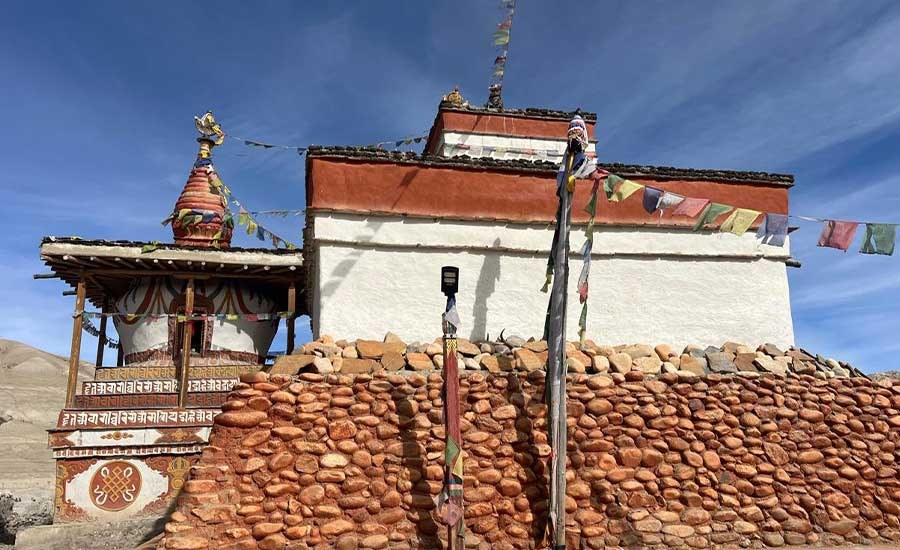
The town's traditional walls, monasteries, chortens, prayer walls and mud-brick houses reflect centuries of adaptation to the dry Himalayan environment.
Upper Mustang remained highly restricted to international travellers until the late twentieth century. Controlled tourism has since allowed visitors to enter while helping limit some of the pressures that mass tourism can place on fragile landscapes and cultural heritage.
To learn more about the wider region, read our Guide to Upper Mustang Trek.
Why Is Lo Manthang Called a Walled City?
The historic centre of Lo Manthang is enclosed by an old defensive wall. Inside are narrow lanes, traditional homes, Buddhist monuments and important monasteries.
The compact layout reflects the town's historic need for protection from harsh weather and outside threats. Walking through its lanes provides a very different experience from travelling through the open valleys and scattered villages elsewhere in Mustang.
Although modern construction and roads are gradually changing parts of the surrounding region, the old town remains the cultural heart of Lo Manthang.
Why Is Lo Manthang So Special?
Lo Manthang combines several elements rarely found together in one Himalayan destination: a historic walled settlement, living Tibetan Buddhist traditions, ancient monasteries, extraordinary cave systems, traditional architecture and a stark Trans-Himalayan landscape.
It is not simply a sightseeing stop. Families still live here, monks continue religious practices, farmers work the surrounding land, festivals bring communities together and centuries-old traditions remain part of everyday life.
This living culture is what makes Lo Manthang different from an archaeological site or abandoned historic town.
Upper Mustang: Nepal's Trans-Himalayan Landscape
Upper Mustang lies north of the main Himalayan barrier. The Annapurna and Dhaulagiri ranges block much of the moisture carried by the summer monsoon, creating a dramatic rain-shadow landscape.
Expect:
- Red, brown, grey and ochre cliffs
- Deep canyons and dry river valleys
- Wind-eroded rock formations
- High plateaus
- Cave settlements
- Traditional mud-brick villages
- Fields of barley and buckwheat around settlements
- Snow-covered Himalayan peaks in the distance
This unusual geography also means that Upper Mustang can be visited during parts of Nepal's summer monsoon when many other trekking regions receive considerably more rainfall.
Culture and People of Lo Manthang
The people of Lo Manthang maintain strong cultural and historical connections with Tibetan Buddhism and the Tibetan Plateau. Religion is visible throughout the landscape in monasteries, chortens, mani walls, prayer flags and sacred caves.
Traditional agriculture, animal husbandry and trade have historically supported communities in this harsh environment. Tourism has now become another important part of the local economy.
Travellers should remember that Lo Manthang is a living community rather than an outdoor museum. Respect for homes, monasteries, religious ceremonies and local customs is essential.
Buddhism in Lo Manthang
Tibetan Buddhism has shaped the art, architecture, festivals and daily life of Upper Mustang for centuries. Monasteries contain Buddhist sculptures, murals, manuscripts and religious objects, while chortens and mani walls appear throughout the surrounding valleys.
Many of the region's most important festivals and ceremonies are connected with Vajrayana Buddhist traditions. The most famous is the annual Tiji Festival in Lo Manthang.
Important Monasteries in Lo Manthang
One of the greatest reasons to spend more than one night in Lo Manthang is the opportunity to explore its historic Buddhist monasteries.
Jampa Lhakhang
Jampa Lhakhang, sometimes called Jampa Gompa, is one of the most important religious monuments within the old town. It is known for its Buddhist art, sculptures and historic significance.
Thubchen Gompa
Thubchen Gompa is another major monastery within Lo Manthang. Its large assembly hall and traditional Buddhist artwork make it one of the settlement's most impressive religious buildings.
Chhoede Monastery
Chhoede Monastery remains an important centre of religious life in Lo Manthang. Its monks are closely associated with the sacred rituals and masked dances of the annual Tiji Festival.
Opening arrangements and photography rules can change, so travellers should follow the instructions of local caretakers and guides.
The Royal Palace of Lo Manthang
The historic royal palace stands near the centre of the old settlement and is an important reminder of Lo Manthang's history as the seat of Mustang's former rulers.
Even when interior access is limited, the palace remains an important landmark for understanding the town's history and its former political structure.
Chhoser Valley: Caves and Monasteries North of Lo Manthang
A visit to Lo Manthang should ideally include a full-day excursion north toward Chhoser. The area contains some of Upper Mustang's most remarkable caves, monasteries and cliff formations.
Jhong Cave
Jhong Cave is a remarkable multi-level cave complex carved into a cliff. Narrow passages, rooms and openings provide an extraordinary glimpse into Mustang's long history of cave use.
Niphu and Garphu Monasteries
The Chhoser area also contains historic Buddhist monasteries built dramatically against the surrounding cliffs. Together with the caves and desert landscape, they make the northern excursion one of the highlights of a visit to Lo Manthang.
The Mysterious Caves of Upper Mustang
Thousands of man-made caves are scattered through the cliffs of Mustang. Archaeologists and researchers have found evidence that different caves were used at different times for habitation, burial, religious retreat, storage and other purposes.
The caves are among Upper Mustang's most intriguing cultural features. Some are easily accessible, while others are located high in cliff faces and should not be approached without appropriate local knowledge and permission.
Ghar Gompa – Lo Gekar Monastery
Another important religious site in Upper Mustang is Ghar Gompa, or Lo Gekar. It lies outside Lo Manthang and is commonly visited on trekking routes through Drakmar.
The monastery is traditionally associated with Guru Rinpoche (Padmasambhava) and is an important pilgrimage and cultural site in Mustang.
Our Mustang Tiji Festival Trek follows a beautiful route through Drakmar and Ghar Gompa before crossing Chogo La and reaching Lo Manthang.
Tiji Festival in Lo Manthang
The Tiji Festival is Lo Manthang's best-known annual religious celebration and one of the most fascinating festivals in the Himalayas.
Held over three days, the festival includes sacred masked dances, Buddhist rituals, prayers, music and ceremonies performed by monks. The rituals are associated with Vajrakila practices and prayers for protection, peace and the removal of destructive forces.
During Tiji, residents from surrounding villages gather in Lo Manthang along with monks, pilgrims and visitors, transforming the normally quiet settlement into a major centre of religious and community activity.
Tiji Festival 2027 Dates
The Tiji Festival 2027 is scheduled for 1, 2 and 3 June 2027 in Lo Manthang.
Himalayan Dream Team offers two specially timed journeys:
- Mustang Tiji Festival Trek – 16 Days – for travellers who want to walk the historic trails of Upper Mustang and experience all three festival days.
- Upper Mustang Tiji Festival Jeep Tour – 14 Days – for travellers who prefer an overland journey with less trekking.
Yartung Festival in Mustang
Tiji is not the only important festival associated with Mustang. Yartung is another traditional celebration known particularly for horse racing, community gatherings and local festivities.
Travellers interested in Himalayan festivals can explore our Upper Mustang Yartung Festival Jeep Tour.
You can also read our guide to Upper Mustang, Tiji and Yartung Festivals.
How to Get to Lo Manthang
There is no direct commercial flight to Lo Manthang. Most international travellers first reach Kathmandu, continue to Pokhara and then enter Mustang through Jomsom and Kagbeni.
A typical route is:
Kathmandu → Pokhara → Jomsom → Kagbeni → Upper Mustang → Lo Manthang
Kathmandu to Lo Manthang
Travellers normally break the journey into several stages rather than travelling directly from Kathmandu to Lo Manthang.
Stage 1: Kathmandu to Pokhara
You can travel from Kathmandu to Pokhara by domestic flight or road. Flying is the fastest option, while travelling overland allows you to see Nepal's river valleys, towns and middle hills.
Stage 2: Pokhara to Jomsom
From Pokhara, travellers can either take an early morning flight to Jomsom or travel overland through the Kali Gandaki Valley.
Stage 3: Jomsom to Kagbeni
Jomsom is the principal transport and trekking gateway to Mustang. From Jomsom, continue north to the historic village of Kagbeni.
Stage 4: Kagbeni to Lo Manthang
After completing the required restricted-area formalities, the journey continues north into Upper Mustang, either on foot or by 4WD.
Pokhara to Lo Manthang: Complete Route
Pokhara to Lo Manthang is one of the most searched routes for travellers planning an Upper Mustang journey.
The usual overland route follows:
Pokhara → Beni → Tatopani → Marpha → Jomsom → Kagbeni → Chhusang → Chele → Samar → Syangbochen → Ghiling → Ghami → Tsarang → Lo Manthang
The exact overnight stops depend on the itinerary, road conditions, acclimatization plan and whether you are travelling by jeep or trekking.
Pokhara to Lo Manthang by Flight and Jeep
A popular option is to fly from Pokhara to Jomsom and continue north by jeep. Flights are generally scheduled in the morning because winds in the Kali Gandaki Valley often become stronger later in the day.
Mountain flights remain weather-dependent, so travellers should keep some flexibility in their itinerary.
After landing in Jomsom, you continue through Kagbeni and enter Upper Mustang according to your permit and itinerary.
Pokhara to Lo Manthang by Jeep
Travelling entirely by road is increasingly popular. The journey follows the Kali Gandaki corridor from Pokhara toward Beni, Tatopani, Marpha, Jomsom and Kagbeni before entering Upper Mustang.
Beyond Kagbeni, the road climbs through the extraordinary dry valleys and colourful cliffs of Upper Mustang toward Lo Manthang.
Road conditions can be rough and travel times vary considerably due to weather, maintenance, landslides, river conditions and ongoing road work. A high-clearance 4WD and experienced local driver are strongly recommended.
Travellers who prefer this style of journey can explore our Upper Mustang Jeep Tour.
Jomsom to Lo Manthang
Jomsom sits at approximately 2,720 metres and is the main gateway for both Upper and Lower Mustang. From Jomsom, travellers continue through Kagbeni before entering the restricted region.
Although it is possible to cover substantial distances by jeep, Himalayan Dream Team normally recommends a well-paced itinerary rather than rushing directly to Lo Manthang. Gradual travel provides more time to adjust to altitude and experience the villages, monasteries and landscapes along the route.
Kagbeni: Gateway to Upper Mustang
Kagbeni is one of the most atmospheric settlements in the Kali Gandaki Valley and traditionally marks the gateway to Upper Mustang.
The old village contains narrow lanes, traditional houses, Buddhist monuments and an important monastery. It is also located near the confluence of the Kali Gandaki and Jhong rivers.
For travellers continuing north, Kagbeni represents the transition from Lower Mustang into the restricted Upper Mustang region.
Villages Between Kagbeni and Lo Manthang
The journey is not only about reaching Lo Manthang. Several villages along the way are important parts of the Upper Mustang experience.
Chhusang
Chhusang is surrounded by striking cliffs and cave formations near the Kali Gandaki corridor.
Chele
Beyond Chele, the landscape becomes increasingly dry and distinctly Trans-Himalayan.
Samar
Samar is a traditional settlement surrounded by open highland scenery and forms part of several classic trekking routes.
Ghiling
Ghiling is known for its traditional houses, Buddhist monuments and surrounding fields.
Ghami
Ghami is one of Upper Mustang's larger traditional settlements and is associated with impressive mani walls and colourful cliffs.
Drakmar
Drakmar is famous for its dramatic red cliffs and is commonly included in trekking itineraries connecting Ghami, Ghar Gompa and Lo Manthang.
Tsarang
Tsarang, also written Charang, is one of the most historically significant settlements south of Lo Manthang, with a monastery, traditional architecture and the remains of its former palace complex.
Trekking to Lo Manthang vs Jeep Tour
| Experience | Upper Mustang Trek | Upper Mustang Jeep Tour |
|---|---|---|
| Travel Style | Mainly walking | Mainly 4WD vehicle |
| Physical Demand | Moderate trekking | Lower physical demand |
| Interaction with Landscape | Slow and immersive | Covers greater distances quickly |
| Remote Trails | Greater access | Limited to road-accessible areas plus short walks |
| Suitable For | Trekkers and active travellers | Families, older travellers and travellers with limited time |
| Main Destination | Lo Manthang | Lo Manthang |
For travellers who enjoy walking, our Upper Mustang Trek provides the deeper trail experience. Those wanting to experience the region without a long trek can choose the Upper Mustang Jeep Tour.
Lo Manthang Altitude
Lo Manthang is situated at approximately 3,840 metres (12,598 feet). Although this is lower than Everest Base Camp and many high Himalayan passes, altitude should still be taken seriously.
The journey from Pokhara, at around 822 metres, to Upper Mustang involves a significant increase in elevation. A sensible itinerary should therefore allow the body time to adjust gradually.
Altitude Sickness in Lo Manthang
Some visitors may experience headache, fatigue, poor sleep, loss of appetite or shortness of breath as they gain altitude.
Good practices include:
- Gain altitude gradually
- Drink sufficient water
- Avoid rushing the itinerary
- Eat regular meals
- Limit alcohol during acclimatization
- Inform your guide immediately if symptoms develop
- Never continue ascending with worsening symptoms
A well-designed Upper Mustang itinerary should balance sightseeing and travel with appropriate acclimatization.
Best Time to Visit Lo Manthang
Lo Manthang has a different climate pattern from many popular trekking regions of Nepal because Upper Mustang lies in a rain shadow.
March to May – Spring
Spring brings gradually warmer temperatures and is an excellent period for trekking and cultural travel. Depending on the Tibetan lunar calendar, the Tiji Festival often falls during late spring or early summer.
June to August – Summer and Nepal Monsoon
Upper Mustang receives significantly less monsoon rainfall than many other parts of Nepal. This makes it one of Nepal's notable summer trekking destinations.
However, travellers should remember that Kathmandu, Pokhara and the southern approach routes do receive monsoon rain, which can affect road and flight schedules.
September to November – Autumn
Autumn is another excellent period for visiting Lo Manthang, with generally stable conditions, good visibility and comfortable daytime trekking temperatures.
December to February – Winter
Winter is cold, especially at night. Snow, freezing temperatures and seasonal closures can make travel more difficult, and some local residents temporarily move to lower elevations.
Weather in Lo Manthang
Lo Manthang generally has a dry, windy high-altitude climate. Even when days are sunny, temperatures can change quickly after sunset.
The strong afternoon winds of the Kali Gandaki and Upper Mustang region are another important consideration. Layered clothing, sun protection and wind protection are useful throughout much of the travel season.
How Many Days Do You Need for Lo Manthang?
The ideal duration depends on how you travel.
A jeep journey can reach Lo Manthang considerably faster than a trekking itinerary, but we recommend allowing enough time to visit villages and cultural sites rather than simply driving in and out.
For a complete Upper Mustang experience from Kathmandu, approximately 12 to 16 days works well for many travellers, depending on whether the journey is primarily by jeep or on foot.
During the Tiji Festival, extra time in Lo Manthang is particularly worthwhile so you can experience all three festival days.
Things to Do in Lo Manthang
- Walk through the historic walled settlement
- Visit Jampa Lhakhang
- Explore Thubchen Gompa
- Visit Chhoede Monastery
- See the historic royal palace
- Observe traditional architecture
- Walk around the surrounding agricultural fields
- Visit Chhoser Valley
- Explore Jhong Cave
- Visit Niphu and Garphu monasteries
- Learn about Tibetan Buddhist traditions
- Photograph Mustang's extraordinary landscapes
- Experience the Tiji Festival when travelling on festival dates
- Explore nearby villages and ancient trade routes
Accommodation in Lo Manthang
Accommodation in Lo Manthang is primarily in locally operated lodges and guesthouses. Facilities have improved considerably, but travellers should not expect the same standards or infrastructure available in Kathmandu or Pokhara.
Rooms are generally simple and comfortable. Depending on the lodge, attached bathrooms, hot showers, charging and Wi-Fi may be available, sometimes for an additional fee.
During the Tiji Festival and other busy periods, accommodation can fill quickly, so advance reservations are strongly recommended.
Food in Lo Manthang
Local lodges generally serve a combination of Nepali, Tibetan-influenced and simple international meals.
Common options may include:
- Dal bhat
- Momos
- Thukpa or noodle soup
- Tibetan bread
- Fried rice
- Noodles
- Potatoes
- Egg dishes
- Tea and hot drinks
Because everything must be transported over long distances, menus are naturally more limited than in Kathmandu or Pokhara.
Drinking Water
Travellers should avoid relying on single-use plastic bottles whenever possible. Depending on the route and lodge facilities, boiled or treated water may be available.
A reusable water bottle and reliable purification method are useful additions to your packing list.
Electricity, Charging and Internet
Electricity and mobile connectivity have improved in Upper Mustang, particularly in larger settlements, but services should not be expected to be as reliable as in Nepal's cities.
Carry a power bank and keep important travel information available offline. Internet availability and speed can vary due to weather, local infrastructure and power supply.
Money and ATMs
Do not depend on cards or ATMs once travelling deep into Upper Mustang. Carry sufficient Nepalese rupees for personal expenses, drinks, charging, hot showers, tips and purchases.
Kathmandu and Pokhara are the best places to arrange cash before travelling, while Jomsom may offer limited banking facilities.
Upper Mustang Restricted Area Permit
Upper Mustang remains a restricted trekking area of Nepal. International visitors require a Restricted Area Permit before entering the designated restricted zone.
Under the current Nepal Department of Immigration fee schedule, the Upper Mustang Restricted Area Permit costs USD 50 per person per day.
Permit regulations can change, so Himalayan Dream Team checks the latest requirements during trip preparation.
Annapurna Conservation Area Permit – ACAP
Upper Mustang lies within the wider Annapurna Conservation Area, so travellers also require the relevant Annapurna Conservation Area Permit (ACAP).
Himalayan Dream Team arranges the required trekking and restricted-area permit formalities for guests travelling on our organized Upper Mustang programs.
Can You Travel to Lo Manthang Independently?
Upper Mustang is not the same as unrestricted trekking areas of Nepal. Special restricted-area regulations apply, and international travellers should plan the journey through an authorized Nepal trekking company that can arrange the required permits and current guiding requirements.
Because regulations can change, always check the latest rules before finalizing your travel plans.
Photography in Lo Manthang
Lo Manthang is an exceptional destination for landscape, cultural and architectural photography. Early morning and late afternoon light can be especially beautiful on the earth-coloured walls, cliffs and surrounding mountains.
However, visitors should always ask before photographing local people. Photography may be restricted inside monasteries, around sacred objects and during particular religious ceremonies.
Drone use should never be assumed to be permitted. Nepalese aviation rules, restricted-area regulations, local permissions and cultural considerations may all apply.
What to Pack for Lo Manthang
- Layered trekking clothing
- Warm jacket
- Windproof outer layer
- Comfortable trekking boots or walking shoes
- Sun hat
- Warm hat and gloves
- Sunglasses with good UV protection
- High-SPF sunscreen
- Reusable water bottle
- Personal medications
- Basic first-aid items
- Power bank
- Headlamp
- Small daypack
- Dust protection or buff
- Camera and spare batteries
Responsible Travel in Lo Manthang
Upper Mustang has a fragile environment and an equally precious cultural heritage. Responsible travel is therefore especially important.
- Ask permission before photographing people
- Follow monastery photography rules
- Dress respectfully at religious sites
- Do not touch murals, manuscripts or religious objects
- Walk clockwise around Buddhist chortens and mani walls where local custom requires
- Reduce single-use plastic
- Carry your waste responsibly
- Use locally owned accommodation and services where possible
- Do not remove fossils, stones, religious objects or archaeological material
- Respect private homes and agricultural land
- Follow your local guide's cultural advice
Lo Manthang and the Ancient Salt Trade Route
Mustang historically occupied an important position on trade routes linking Tibet with Nepal's lower valleys. Salt, wool and other goods moved south while grain and other commodities travelled north.
Kagbeni, Lo Manthang and the settlements of Upper Mustang developed partly because of this Trans-Himalayan trade network. Modern roads have changed transportation dramatically, but traces of the historic trading culture remain visible throughout the region.
Can You Visit the Nepal–Tibet Border from Lo Manthang?
The northern Mustang region extends toward the Nepal–China border at Korala. Access conditions and permissions near international border areas can change, and travellers should not assume that crossing the border or visiting every border location is permitted.
Your guide will advise what areas can legally and safely be visited during your journey.
Lo Manthang or Lower Mustang – What Is the Difference?
Travellers sometimes use the word “Mustang” for the entire district, but Lower Mustang and Upper Mustang offer quite different experiences.
| Lower Mustang | Upper Mustang / Lo Manthang |
|---|---|
| Includes Jomsom, Marpha and nearby areas | Includes the restricted region north toward Lo Manthang |
| Easier access | Restricted-area regulations apply |
| Strong Thakali cultural influence | Strong Tibetan Buddhist cultural influence |
| Popular on the Annapurna Circuit | Known for the Kingdom of Lo and walled Lo Manthang |
| No Upper Mustang RAP required | Upper Mustang RAP required for international visitors |
Lo Manthang and Muktinath
Muktinath is another major destination in Mustang and is sacred to both Hindus and Buddhists. Although it is not located in Lo Manthang, many jeep itineraries combine Upper Mustang with Muktinath.
This creates a journey that combines Lo Manthang's Tibetan Buddhist heritage with one of Nepal's most important Himalayan pilgrimage sites.
Lo Manthang and Pokhara
Pokhara is the main tourism gateway for most journeys to Mustang. Travellers often spend at least one night in Pokhara before or after travelling into the region.
The contrast is remarkable: Pokhara is green, subtropical and famous for lakes and Annapurna views, while Lo Manthang is dry, high, windswept and strongly influenced by the Tibetan Plateau.
Combining the two destinations therefore provides an excellent introduction to Nepal's geographical diversity.
Is Lo Manthang Worth Visiting?
For travellers interested in Himalayan culture, Buddhist heritage, archaeology, photography, trekking and remote landscapes, Lo Manthang is one of Nepal's most rewarding destinations.
The attraction is not a single monument. It is the complete journey: flying or driving into the Kali Gandaki Valley, passing through Kagbeni, travelling through the desert landscapes of Upper Mustang, exploring ancient villages and monasteries and finally entering the historic walled settlement of Lo Manthang.
Frequently Asked Questions About Lo Manthang
1. Where is Lo Manthang located?
Lo Manthang is located in Upper Mustang in northern Nepal's Mustang District, Gandaki Province, close to the Tibetan Plateau.
2. What is the altitude of Lo Manthang?
Lo Manthang lies at approximately 3,840 metres (12,598 feet) above sea level.
3. Why is Lo Manthang famous?
Lo Manthang is famous for its historic walled old town, former royal history, Tibetan Buddhist culture, ancient monasteries, nearby caves and the annual Tiji Festival.
4. Is Lo Manthang in Tibet?
No. Lo Manthang is in Nepal, although its geography, history, language, religion and culture have strong connections with the Tibetan Plateau.
5. Is Lo Manthang in Upper Mustang?
Yes. Lo Manthang is the historic and cultural heart of Upper Mustang.
6. How do I get from Pokhara to Lo Manthang?
You can travel from Pokhara toward Jomsom by flight or road and then continue through Kagbeni into Upper Mustang by trekking or 4WD jeep.
7. Can I drive from Pokhara to Lo Manthang?
Yes. An overland journey by suitable 4WD vehicle is possible, although road conditions and travel times vary.
8. Can I fly directly to Lo Manthang?
There is no regular commercial passenger flight directly from Kathmandu or Pokhara to Lo Manthang. Jomsom is the usual aviation gateway.
9. How long does it take to reach Lo Manthang?
It depends on whether you travel by jeep or trek. Rather than rushing directly from low elevation, a multi-day itinerary is recommended for sightseeing and acclimatization.
10. Do I need a permit for Lo Manthang?
Yes. International visitors entering Upper Mustang require a Restricted Area Permit as well as the relevant conservation-area permit.
11. How much is the Upper Mustang permit?
Under the current Nepal Department of Immigration fee schedule, the Upper Mustang Restricted Area Permit is USD 50 per person per day. Regulations should always be reconfirmed before travel.
12. What is the best month to visit Lo Manthang?
Spring and autumn are excellent, while Upper Mustang's rain-shadow location also makes summer travel possible. The best month depends on whether your priority is trekking, photography, warmer temperatures or attending a festival.
13. Can I visit Lo Manthang during Nepal's monsoon?
Yes. Upper Mustang receives considerably less monsoon rainfall than many other parts of Nepal. However, rain elsewhere can still affect flights and roads used to reach Mustang.
14. When is the Tiji Festival in Lo Manthang?
The dates follow the Tibetan calendar and vary each year. The 2027 Tiji Festival is scheduled for 1–3 June 2027.
15. Is Lo Manthang suitable for older travellers?
It can be, particularly by jeep, but altitude, rough roads, cold temperatures and limited medical facilities must be considered. The itinerary should be adapted to the traveller's fitness and health.
16. Is Lo Manthang suitable for children?
Family travel is possible, but altitude and long road journeys require careful planning. Families should discuss the age, trekking experience and health of children before choosing an itinerary.
17. Is there internet in Lo Manthang?
Connectivity is available in some places but can be slow or interrupted. Travellers should not rely on continuous high-speed internet.
18. Are there ATMs in Lo Manthang?
Travellers should not depend on ATM access in Lo Manthang. Carry enough Nepalese rupees before travelling deep into Upper Mustang.
19. How many nights should I stay in Lo Manthang?
At least two nights are useful for travellers who want time to explore the town and make an excursion toward Chhoser. More time is recommended during the Tiji Festival.
20. Is trekking or a jeep tour better for Lo Manthang?
Both offer different experiences. Trekking provides slower cultural immersion and access to walking trails, while a jeep tour is better suited to travellers with less time or those who prefer less walking.
Explore Lo Manthang with Himalayan Dream Team
Lo Manthang is not simply the final destination of an Upper Mustang journey. The real experience begins long before you reach its walls: the flight or drive toward Jomsom, the ancient lanes of Kagbeni, the Kali Gandaki Valley, colourful cliffs, remote villages, Buddhist monasteries, caves and the people who continue to preserve Mustang's unique traditions.
At Himalayan Dream Team Treks & Tours, we organize carefully planned journeys to Upper Mustang with experienced local guides, required permit arrangements, transportation, accommodation and itineraries designed around the interests and pace of our guests.
Whether you want to trek ancient trails, travel comfortably by 4WD or experience the colourful Tiji Festival, you can choose from our Mustang journeys:
- Upper Mustang Trek
- Upper Mustang Jeep Tour
- Mustang Tiji Festival Trek 2027
- Upper Mustang Tiji Festival Jeep Tour 2027
- Upper Mustang Yartung Festival Jeep Tour
- Explore All Mustang Region Trips
For travellers seeking one of Nepal's most culturally distinctive journeys, Lo Manthang and Upper Mustang offer a rare combination of Himalayan history, living Buddhist traditions, ancient architecture and extraordinary landscapes.
Plan your Lo Manthang journey with Himalayan Dream Team and discover the ancient heart of Upper Mustang at a comfortable and responsible pace.