

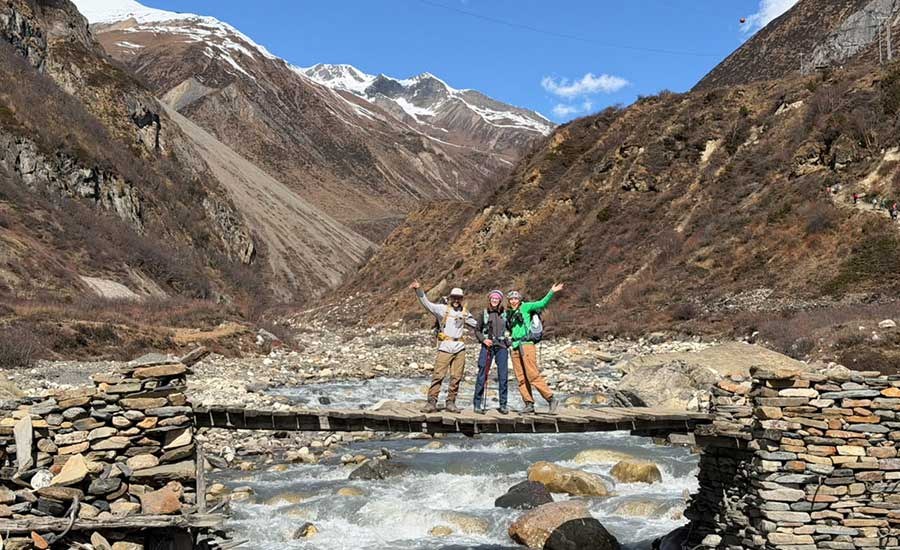
Is May a good time for the Manaslu Circuit Trek? Yes. May is one of the best months to experience the Manaslu Circuit in Nepal, particularly for trekkers who enjoy warmer walking conditions, green mountain valleys, spring flowers and snow-covered Himalayan peaks. Early May often offers an excellent balance of trekking weather and mountain scenery, while late May brings a greater possibility of afternoon clouds, humidity and pre-monsoon rainfall.
The Manaslu Circuit Trek in May takes you around Mount Manaslu (8,163 m), the eighth-highest mountain in the world. The route follows the beautiful Budhi Gandaki Valley through traditional villages, forests, suspension bridges and Tibetan Buddhist settlements before crossing the spectacular Larkya La Pass (5,106 m).
May offers an interesting contrast between the different elevations of the Manaslu region. The lower valleys are warm and green, the forests are full of spring vegetation, and the upper villages around Samagaun and Samdo remain cool beneath enormous Himalayan peaks. At Larkya La, temperatures can still fall below freezing, and snow or ice may remain on the trail.
However, trekking in May requires thoughtful planning. Although the main monsoon normally begins in June, pre-monsoon showers and afternoon thunderstorms can develop during May. Weather, trail conditions and the crossing of Larkya La must always be assessed carefully.
In this complete Manaslu Circuit Trek May 2027 guide, Himalayan Dream Team explains the weather, temperatures, early versus late May conditions, mountain views, rhododendrons, Larkya La crossing, 16-day itinerary, permits, costs, accommodation, packing list, altitude safety and practical trekking advice.
For our complete itinerary and booking arrangements, explore the Manaslu Circuit Trek – 16 Days with Himalayan Dream Team.
Manaslu Circuit Trek in May – Quick Facts
| Trip Information | Details |
|---|---|
| Destination | Manaslu Region, Gorkha District, Nepal |
| Best Travel Period | Early to mid-May, subject to current weather conditions |
| Himalayan Dream Team Itinerary | 16 Days |
| Highest Point | Larkya La Pass – approximately 5,106 m / 16,752 ft |
| Highest Overnight Location | Dharamsala / Larkya Phedi – approximately 4,460 m |
| Main Mountain | Mount Manaslu – 8,163 m |
| Trekking Difficulty | Moderate to challenging |
| Typical Daily Trekking | 4–7 hours; longer on Larkya La crossing day |
| May Weather | Warm lower valleys, cool upper villages and freezing conditions possible near the pass |
| Spring Scenery | Green valleys, forests, seasonal flowers and snow-covered mountains |
| Accommodation | Hotels in Kathmandu and mountain teahouses during trekking |
| Required Permits | Manaslu Restricted Area Permit, MCAP, ACAP and applicable TIMS documentation |
| Manaslu RAP Rate in May | USD 75 for the first seven restricted-area days, plus USD 10 per additional day |
| Transportation | Road journey from Kathmandu to Machha Khola and return from the Dharapani area |
| Start and End | Kathmandu, Nepal |
May is part of Nepal's spring trekking season. Conditions generally become warmer as the month progresses, but high-altitude weather remains unpredictable. The figures and seasonal descriptions in this guide are intended for planning rather than as guaranteed forecasts.
Why Trek the Manaslu Circuit in May?
May is a particularly beautiful time to explore the Manaslu region because the landscapes change dramatically as you gain altitude.
In the lower Budhi Gandaki Valley, warm temperatures encourage green vegetation and agricultural activity. Around the forested middle elevations, trekkers may encounter flowering rhododendrons and other seasonal plants. Higher up, the scenery changes to stone villages, alpine valleys, glaciers and enormous snow-covered Himalayan mountains.
Seven Reasons to Choose May for Manaslu
- Warmer walking conditions: Lower and middle elevations are generally warmer than during March or late autumn.
- Beautiful green valleys: Forests, cultivated terraces and river valleys become increasingly lush.
- Spring flowers: Rhododendrons and other flowers may still be visible at suitable elevations, especially earlier in May.
- Snow-covered Himalayan peaks: High mountains retain their spectacular snow and ice scenery.
- Longer daylight hours: May provides more daylight than winter, which is useful for long trekking days.
- Good opportunities for mountain views: Early mornings can offer excellent visibility before afternoon clouds develop.
- A quieter mountain atmosphere: Some sections may be less busy than during the busiest weeks of April and October, although this varies.
For trekkers who enjoy green landscapes, local culture and warmer daytime weather, May can be a wonderful choice.
For a broader comparison of all three spring months, read our Manaslu Circuit Trek in Spring: March, April and May Guide.
Manaslu Circuit Trek Weather and Temperatures in May
The weather on the Manaslu Circuit in May varies significantly according to altitude.
Trekkers begin in the warm lower Budhi Gandaki Valley before gradually climbing through forests and mountain villages towards Samagaun, Samdo and Dharamsala. The difference between lower-valley and high-pass conditions can be considerable.
A sunny afternoon near Machha Khola may feel hot, while the temperature around Dharamsala can fall below freezing overnight.
Estimated May Temperatures by Elevation
| Location | Altitude | Typical Daytime Range | Typical Night Range |
|---|---|---|---|
| Machha Khola | 870 m | 22–30°C | 14–20°C |
| Jagat | 1,340 m | 18–27°C | 10–17°C |
| Deng | 1,860 m | 15–24°C | 7–14°C |
| Namrung | Approx. 2,630 m | 12–21°C | 3–10°C |
| Lho | 3,180 m | 8–17°C | 0–7°C |
| Samagaun | 3,530 m | 6–15°C | -3 to 5°C |
| Samdo | 3,860 m | 4–13°C | -5 to 3°C |
| Dharamsala | 4,460 m | 0–10°C | -10 to 0°C |
| Larkya La Pass | 5,106 m | Approximately -5 to 6°C | Not an overnight stop |
These are broad illustrative temperature ranges, not verified monthly station averages or a forecast. Actual temperatures can fall outside these ranges, especially during snowfall, storms or strong winds. Wind chill at Larkya La can make conditions feel much colder.
What Is the Weather Like in the Lower Manaslu Valley?
The lower trekking route around Machha Khola, Jagat and Deng is usually warm during May.
Daytime walking can feel hot, particularly in exposed sections of the Budhi Gandaki Valley. Humidity may increase as the month progresses, and afternoon showers are possible.
Lightweight, breathable clothing, sun protection and sufficient drinking water are important in these lower sections.
What Is the Weather Like Around Namrung and Lho?
As the trail climbs above approximately 2,500 m, the weather generally becomes cooler.
Forests around Namrung, Lihi, Sho and Lho may still display seasonal flowers and fresh spring vegetation.
Morning mountain views can be beautiful, particularly around Lho, where Mount Manaslu becomes a major feature of the landscape.
Cloud may build during the afternoon, so early starts are often useful for photography and comfortable walking.
What Is the Weather Like in Samagaun and Samdo?
Samagaun and Samdo are much cooler than the lower valley.
Although May is a warmer trekking month, nights can still be close to or below freezing. Wind, snow and sudden weather changes remain possible.
Trekkers should carry warm layers, gloves, a hat and a suitable sleeping bag.
What Is the Weather Like at Larkya La in May?
Larkya La is a high mountain pass above 5,000 m, and May does not remove the risks associated with this altitude.
Early mornings can be freezing, while strong winds, cloud, snow or ice may affect the crossing.
Although winter snow may have decreased by May, recent snowfall or overnight freezing can still create difficult conditions.
Trekkers should never assume that Larkya La will be snow-free simply because the lower valleys are warm.
Early May vs Mid-May vs Late May: Which Is Better?
Not every week in May offers the same trekking conditions.
The beginning of the month often retains more of the favorable spring trekking pattern. Towards the end of May, increasing warmth and moisture can lead to more frequent afternoon cloud, rain and thunderstorms.
| Period | Typical Conditions | Our Recommendation |
|---|---|---|
| 1–10 May | Warm lower valleys, cool mountains, good chances of clear mornings and generally favorable spring conditions | Our preferred May departure window |
| 11–20 May | Warmer temperatures, greener scenery and increasing afternoon clouds or showers | Very good with early starts and weather flexibility |
| 21–31 May | Greater pre-monsoon influence, humidity, cloud development and possible rainfall | Possible, but allow more flexibility |
Is Early May Better for Manaslu Circuit Trekking?
For most trekkers, early May is our preferred part of the month.
The lower valleys are generally warm, the mountain scenery remains beautiful and the probability of persistent pre-monsoon weather is usually lower than later in the month.
However, this does not guarantee sunshine or safe pass conditions. Snowfall and storms can occur at high altitude at any time.
Can You Trek the Manaslu Circuit in Late May?
Yes, late May trekking may still be possible, but travelers should be prepared for more variable weather.
Afternoon showers, cloud cover and slippery lower trails may become more common. Road access can also be affected by heavy rainfall.
For late-May departures, we recommend a flexible schedule, good rain protection and sufficient time before your international flight.
Manaslu Trail Conditions and Rainfall in May
The Manaslu Circuit passes through several different environments, from subtropical river valleys to high alpine and glacial terrain.
Trail conditions therefore vary considerably along the route.
Lower Budhi Gandaki Valley
The trail around Machha Khola, Jagat and Deng includes suspension bridges, stone steps, rocky paths, riverbanks and narrow sections beneath steep hillsides.
In May, the lower trails may become muddy or slippery after rain. Rockfall and landslides are possible, especially after heavy rainfall.
Some sections may also be affected by road construction or changes in river crossings.
Forests Around Ghap, Namrung and Lho
The middle section passes through pine, fir, rhododendron and other forest vegetation.
May is a beautiful month for greenery, although wet roots, muddy paths and uneven stones require careful walking after rain.
Spring flowers depend on elevation and local conditions. The best rhododendron displays are not guaranteed to last throughout the month.
Upper Manaslu Valley
Beyond Samagaun and Samdo, the landscape becomes more open, dry, rocky and alpine.
Trekkers encounter glacial valleys, loose stones, moraine terrain and exposed mountain paths.
Snow or ice may remain in shaded sections and around Dharamsala and Larkya La.
Does It Rain a Lot on the Manaslu Circuit in May?
May is a pre-monsoon month, not normally the peak of Nepal's summer monsoon.
Rainfall generally increases towards June, but occasional heavy showers or thunderstorms can occur during May, especially at lower and middle elevations.
Cloud often develops later in the day, making early-morning trekking a useful strategy.
Trekkers should carry a waterproof jacket, waterproof backpack protection and suitable footwear throughout the month.
Crossing Larkya La Pass in May
The crossing of Larkya La Pass (5,106 m) is the greatest physical challenge and one of the main highlights of the Manaslu Circuit Trek.
Located between Dharamsala and Bimthang, the pass offers spectacular Himalayan views when the weather is clear.
May can provide favorable crossing opportunities, but the route remains a serious high-altitude undertaking.
What Is the Larkya La Crossing Like in May?
Trekkers normally leave Dharamsala very early in the morning, often before sunrise.
The trail climbs through rocky and glacial terrain towards the pass. Depending on recent weather, some sections may contain snow, ice or loose stones.
After reaching Larkya La, the route descends for several hours towards Bimthang.
The entire crossing day commonly takes approximately 8–10 hours or longer, depending on fitness, weather, trail conditions and the group's pace.
Why Is an Early Start Important?
Early departures are important because the crossing is long and the weather may become less favorable later in the day.
In May, afternoon cloud development can reduce visibility, while wind or precipitation may complicate travel across exposed sections.
An early start also allows more daylight for the long descent to Bimthang.
Which Mountains Can You See from Larkya La?
On a clear day, the Larkya La crossing offers views of spectacular Himalayan peaks and glacial landscapes.
Mountain views can include:
- Himlung Himal
- Cheo Himal
- Kang Guru
- Annapurna II
- Surrounding snow-covered ridges and glaciers
Is Larkya La Easier in May Than in March?
May generally brings warmer temperatures and may have less remaining winter snow than March.
However, the pass is not automatically easier or safer. Fresh snowfall, wind, poor visibility or unstable snow conditions can make the crossing difficult in any month.
Our guide assesses the latest weather, trail conditions and trekkers' health before attempting the pass.
For detailed altitude and safety information, read our Manaslu Circuit Trek Elevation Guide and Manaslu Circuit Trek Safety Guide.
Best Places, Mountain Views and Attractions in May
The Manaslu Circuit is much more than a high-pass trek. The journey combines natural scenery, Buddhist culture, traditional villages and opportunities to explore some of Nepal's most beautiful Himalayan landscapes.
1. Budhi Gandaki Valley
The Budhi Gandaki Valley forms the main approach to the Manaslu region.
During May, the lower valley is generally green and warm, with terraced fields, waterfalls, forests and riverside settlements.
Trekkers cross suspension bridges and follow mountain paths through a dramatic landscape of steep hillsides and river gorges.
2. Namrung and the Nubri Valley
As the route climbs towards Namrung, the cultural and natural landscape begins to change.
Traditional stone houses, mani walls, prayer flags and Buddhist monuments become increasingly common.
May can be particularly attractive for forest scenery and the contrast between spring vegetation and the snow-covered mountains above.
3. Lho Village and Mount Manaslu Views
Lho (approximately 3,180 m) is one of the most scenic settlements on the Manaslu Circuit.
On clear mornings, the village offers beautiful views of Mount Manaslu and surrounding peaks.
Its traditional architecture and Buddhist monasteries provide an opportunity to learn about the cultural heritage of the upper Manaslu region.
4. Pungyen Gompa
Pungyen Gompa, at approximately 4,000 m, is a remote Buddhist monastery located in a beautiful mountain setting beneath the Manaslu massif.
Himalayan Dream Team's 16-day itinerary includes the route from Lho towards Samagaun via Pungyen Gompa.
Visiting the monastery offers a combination of spiritual heritage, traditional Buddhist culture and magnificent Himalayan scenery.
The excursion is weather- and trail-dependent, and the guide may adjust the route when necessary.
5. Samagaun
Samagaun (3,530 m) is one of the most important villages on the Manaslu Circuit.
The village lies beneath Mount Manaslu and serves as a major acclimatization location before trekking towards Samdo and Larkya La.
Traditional stone houses, monasteries, prayer flags and surrounding mountain landscapes make Samagaun an interesting place to spend two nights.
6. Birendra Lake
Birendra Lake, also known as Birendra Tal, is a beautiful glacial lake near Samagaun beneath the Manaslu Glacier.
In May, the lake may display beautiful shades of blue and turquoise, depending on sunlight, ice and sediment conditions.
The surrounding mountains and glacial scenery make it a popular acclimatization excursion.
Visitors should remain on safe established paths and follow local guidance because glacial terrain, unstable slopes and changing water conditions can present hazards.
7. Manaslu Base Camp
Manaslu Base Camp, at approximately 4,800 m, is a demanding optional hike from Samagaun.
The route offers views towards Mount Manaslu, glaciers and rugged high-altitude landscapes.
May may provide opportunities for this excursion, but snow, ice and changing weather can affect access.
The hike should only be attempted by fit, properly acclimatized trekkers when the guide considers conditions suitable.
Manaslu Base Camp is optional, and reaching it is not necessary to complete the Manaslu Circuit.
8. Samdo Village
Samdo (3,860 m) is a traditional Himalayan settlement surrounded by rugged mountain scenery.
The village reflects the Tibetan-influenced culture of the upper Nubri Valley, with stone houses, prayer flags and Buddhist traditions.
The landscape is more open and alpine than the lower forested valleys.
9. Dharamsala and Larkya La
Dharamsala, also known as Larkya Phedi, is the final overnight stop before crossing Larkya La.
Accommodation is very basic, and cold nights should be expected even in May.
The following morning brings the demanding climb to the pass and the long descent towards Bimthang.
10. Bimthang and the Return Through Forests
After crossing Larkya La, the trail descends into the beautiful mountain landscape around Bimthang.
Trekkers enjoy views of surrounding peaks, glaciers and alpine valleys before continuing through forests towards the lower settlements.
May's fresh spring vegetation makes the return through the forested section particularly attractive.
For more information about the protected area, wildlife, villages and trekking routes, explore our Manaslu Conservation Area Guide.
Manaslu Circuit Trek in May – 16-Day Itinerary
Himalayan Dream Team offers a 16-day Manaslu Circuit Trek beginning and ending in Kathmandu.
The itinerary includes Kathmandu sightseeing, the scenic drive to Machha Khola, trekking through the Budhi Gandaki and Nubri valleys, acclimatization in Samagaun, the crossing of Larkya La and the return to Kathmandu.
During May, we recommend beginning trekking days early whenever practical, particularly in the lower valleys where afternoon heat and cloud may increase.
| Day | Itinerary | Overnight Elevation | Travel / Trekking Time |
|---|---|---|---|
| 1 | Arrival in Kathmandu and hotel transfer | 1,335 m | 30–45 min drive |
| 2 | Kathmandu UNESCO World Heritage sightseeing and trek preparation | 1,335 m | Approx. 5–6 hrs sightseeing |
| 3 | Drive from Kathmandu to Machha Khola | 870 m | 8–10 hrs drive or longer |
| 4 | Trek from Machha Khola to Jagat | 1,340 m | 6–7 hrs trek |
| 5 | Trek from Jagat to Deng | 1,860 m | 6–7 hrs trek |
| 6 | Trek from Deng to Ghap | 2,160 m | 4–5 hrs trek |
| 7 | Trek from Ghap to Lho via Namrung | 3,180 m | 6–7 hrs trek |
| 8 | Trek from Lho to Samagaun via Pungyen Gompa (approximately 4,000 m) | 3,530 m | 6–8 hrs or longer |
| 9 | Acclimatization in Samagaun; optional Birendra Lake or Manaslu Base Camp hike | 3,530 m | Optional hiking |
| 10 | Trek from Samagaun to Samdo | 3,860 m | 3–4 hrs trek |
| 11 | Trek from Samdo to Dharamsala / Larkya Phedi | 4,460 m | 4–5 hrs trek |
| 12 | Cross Larkya La Pass (5,106 m) and descend to Bimthang | Approx. 3,720 m | 8–10 hrs or longer |
| 13 | Trek from Bimthang to Tilije / Dharapani area | Approx. 1,860–2,300 m | 6–8 hrs, depending on overnight stop |
| 14 | Drive from the Dharapani area to Kathmandu | 1,335 m | Long road journey; timing varies |
| 15 | Free or contingency day in Kathmandu | 1,335 m | Leisure / reserve day |
| 16 | International airport transfer and departure | — | 30–45 min drive |
Itinerary note: This is a planning summary of the 16-day route. Exact overnight stops, walking hours and the return-road arrangement should follow the confirmed package. Trail, weather and acclimatization conditions may require changes. The final Kathmandu reserve day does not replace the need for additional time in the mountains if conditions make a crossing unsafe.
Why Is Samagaun Important for Acclimatization?
Samagaun is located at approximately 3,530 m, where trekkers begin to experience more significant high-altitude conditions.
Himalayan Dream Team's itinerary includes two nights in Samagaun to allow time for rest and acclimatization before ascending towards Samdo and Dharamsala.
Possible excursions include Birendra Lake or Manaslu Base Camp, depending on fitness, symptoms, weather and trail conditions.
The Manaslu Base Camp excursion is demanding and should not be treated as compulsory.
For the complete daily program, accommodation and booking details, see our Manaslu Circuit Trek – 16 Days.
Manaslu Circuit Trek Difficulty and Fitness in May
The Manaslu Circuit is a moderate-to-challenging Himalayan trek.
May's warmer lower-valley temperatures can make some walking days more comfortable than winter, but the physical demands of the route remain significant.
Trekkers must be prepared for consecutive walking days, steep climbs and descents, uneven trails, basic accommodation and a high mountain pass above 5,000 m.
| Difficulty Factor | What to Expect in May |
|---|---|
| Overall Grade | Moderate to challenging |
| Highest Point | Larkya La Pass, approximately 5,106 m |
| Typical Walking | 4–7 hours daily |
| Longest Day | Larkya La crossing, approximately 8–10 hours or longer |
| Lower Valley Conditions | Warm, sometimes humid, with possible afternoon showers |
| Upper Valley Conditions | Cool to cold, with wind and possible snow or ice |
| Technical Climbing | Not normally required on the standard route |
| Previous Trekking Experience | Helpful, especially for high-altitude trekking |
| Main Challenges | Altitude, long walking days, exposed terrain and weather changes |
Is the Manaslu Circuit Trek Suitable for Beginners in May?
Fit first-time Himalayan trekkers may be able to complete the Manaslu Circuit with suitable preparation, an experienced guide and adequate acclimatization.
However, the trek is not an easy beginner route.
Previous multi-day hiking experience is valuable, particularly because the journey includes remote trails, significant altitude gain and a long high-pass crossing.
How Should You Prepare Physically?
We recommend beginning regular trekking preparation approximately 8–12 weeks before departure, depending on your current fitness.
- Walk regularly on hilly terrain.
- Practice sustained uphill and downhill walking.
- Include stair climbing and leg-strength exercises.
- Gradually increase walking distance and duration.
- Train with a small daypack.
- Practice walking on uneven surfaces.
- Wear your trekking boots before departure.
- Allow time for rest and recovery between training sessions.
Good fitness improves endurance, but it does not prevent altitude sickness. Gradual acclimatization remains essential.
Altitude Sickness on the Manaslu Circuit
Acute mountain sickness can develop above approximately 2,500 m, especially when sleeping altitude increases too quickly.
Possible symptoms include headache, nausea, dizziness, loss of appetite and unusual fatigue.
Trekkers should inform their guide immediately if symptoms develop and should not continue ascending to sleep higher while experiencing altitude sickness symptoms.
Confusion, difficulty walking normally or breathlessness at rest are emergency warning signs requiring urgent medical attention and descent when feasible.
For detailed altitude information, read our Manaslu Circuit Trek Elevation Guide.
Manaslu Circuit Trek Permits and Fees in May 2027
The Manaslu Circuit passes through a restricted trekking area and the Manaslu Conservation Area before entering the Annapurna Conservation Area near the end of the route.
The standard circuit therefore requires the relevant restricted-area and conservation-area permits.
Required Manaslu Trekking Permits
| Permit | Published Fee | Purpose |
|---|---|---|
| Manaslu Restricted Area Permit (RAP) | USD 75 for the first 7 days in May; USD 10 per additional day | Entry into the designated restricted Manaslu area |
| Manaslu Conservation Area Permit (MCAP) | Generally NPR 3,000 for most non-SAARC foreign visitors | Entry into the Manaslu Conservation Area |
| Annapurna Conservation Area Permit (ACAP) | Generally NPR 3,000 for most non-SAARC foreign visitors | Entry into the Annapurna Conservation Area on the circuit exit |
| TIMS | Applicable requirements to be confirmed for the specific permitted itinerary | Trekker registration where required |
These are published planning rates and should be reconfirmed before applying for 2027 permits. Nationality-specific fees, exemptions and procedural changes may apply.
Why Is the Manaslu Restricted Area Permit Cheaper in May?
The Manaslu Restricted Area Permit follows two seasonal fee periods.
| Season | First 7 Days | Additional Days |
|---|---|---|
| September–November | USD 100 per person | USD 15 per person per day |
| December–August, including May | USD 75 per person | USD 10 per person per day |
For example, if your confirmed route spends eight chargeable days inside the designated Manaslu restricted area in May, the published RAP calculation would be USD 85 per person. The actual permit duration depends on the itinerary and the dates spent within the restricted area, not the total 16-day holiday.
Official fee reference: Nepal Tourism Board – Trekking Permit Fees.
Do You Need a Licensed Guide for Manaslu?
Yes. The Manaslu Circuit passes through a restricted trekking area, and the trek must be organized in accordance with the current government permit and guide requirements.
Himalayan Dream Team arranges the required permits and licensed trekking guide for its organized Manaslu Circuit departures.
Solo travelers should confirm the current permit application rules with the agency before booking, as restricted-area group and individual application procedures can change.
Manaslu Circuit Trek Cost in May 2027
The total cost of a Manaslu Circuit Trek in May depends on group size, travel dates, trekking duration, transportation, accommodation, permit fees and guide and porter arrangements.
The restricted-area permit rate is lower in May than during September–November, but this does not mean the complete trekking package will necessarily be cheaper.
What Determines the Manaslu Trek Cost?
| Cost Category | What It Covers |
|---|---|
| Accommodation | Hotel in Kathmandu and teahouses during trekking |
| Meals | Meals included according to the confirmed package |
| Trekking Guide | Licensed guide, wages, accommodation, meals and insurance |
| Porter Service | Luggage support and staff expenses |
| Permits | Manaslu RAP, MCAP, ACAP and applicable trekking documentation |
| Transportation | Airport transfers and road travel to and from the trekking region |
| Kathmandu Sightseeing | Guided cultural activities according to the itinerary |
| Personal Expenses | Insurance, drinks, charging, showers, equipment and tips |
| Optional Services | Additional trekking days, private upgrades or itinerary extensions |
For accurate pricing, request a quotation based on your travel dates, number of trekkers and preferred services.
Our 16-Day Manaslu Circuit Trek package provides the full itinerary and booking information.
Accommodation, Food and Facilities During May
Are Teahouses Open in May?
May is part of the main spring trekking season, and teahouses along the Manaslu Circuit are generally operating.
However, accommodation is basic in remote villages, especially around Samdo and Dharamsala.
Rooms usually provide simple beds and blankets. Bathrooms are often shared, and hot water may not be available at every lodge.
Advance arrangements are useful because the number of rooms is limited in some settlements.
What Food Is Available?
Teahouses commonly serve Nepali and Tibetan-influenced meals, including:
- Dal bhat with rice, lentils and vegetables
- Vegetable curry and rice
- Noodles and noodle soup
- Potatoes and fried rice
- Momos
- Tibetan bread
- Eggs and porridge
- Tea, coffee and hot drinks
Vegetarian food is generally available, while special dietary requirements should be discussed before departure.
Is Drinking Water Available?
Water is available along the route, but untreated water should not be assumed safe.
Trekkers should use properly boiled, filtered or treated drinking water.
Carry reusable bottles and an appropriate water-treatment method.
Is Wi-Fi and Mobile Network Available?
Internet and mobile coverage are limited in remote sections of the Manaslu Circuit.
Some lodges offer Wi-Fi or charging facilities for an additional fee, but service can be unreliable.
Carry a power bank and inform family members that communication may not be possible every day.
Are ATMs Available During the Trek?
Reliable ATM facilities should not be expected along the remote trekking route.
Carry sufficient Nepalese rupees for personal expenses such as drinks, snacks, hot showers, charging and tips.
Manaslu Circuit Trek Packing List for May
Packing for May requires clothing suitable for two very different environments: warm lower valleys and freezing high-altitude conditions.
Trekkers should not pack only lightweight spring clothing because Dharamsala and Larkya La can remain extremely cold.
| Category | Recommended Items |
|---|---|
| Footwear | Broken-in trekking boots, trekking socks and lightweight lodge shoes |
| Lower Valley Clothing | Breathable trekking shirts and lightweight trekking trousers |
| Warm Layers | Thermal base layers, fleece and insulated down or synthetic jacket |
| Rain Protection | Waterproof jacket, waterproof trousers and backpack rain cover |
| Head Protection | Sun hat, warm hat and neck gaiter |
| Gloves | Light gloves and warm insulated gloves for high altitude |
| Sleeping Equipment | Warm sleeping bag suitable for below-freezing nights |
| Daypack | Comfortable 25–35 litre backpack |
| Walking Equipment | Trekking poles and headlamp |
| Snow and Ice Equipment | Microspikes or additional traction equipment if advised for current conditions |
| Sun Protection | UV-protective sunglasses, sunscreen and lip balm |
| Water | Reusable bottles and water-treatment equipment |
| Personal Care | Toiletries, toilet paper, hand sanitizer and quick-drying towel |
| Medical Supplies | Personal medicines, blister care and first-aid essentials |
| Electronics | Phone, camera, power bank and charging cables |
| Documents | Passport, insurance details, emergency contacts and permit copies |
Do You Need a Down Jacket in May?
Yes. A warm insulated jacket is important for the higher Manaslu villages and the Larkya La crossing.
Even when the lower valleys are warm, temperatures around Dharamsala can fall below freezing.
Do You Need a Sleeping Bag in May?
Yes. A suitable cold-weather sleeping bag is strongly recommended.
Teahouse blankets may be insufficient at higher elevations, particularly during cold or windy weather.
Do You Need Microspikes in May?
Microspikes may be useful if snow or ice remains around Larkya La.
Whether they are necessary depends on recent weather and actual trail conditions. Your trekking guide should advise you before the crossing.
Health, Safety and Emergency Preparation in May
The Manaslu Circuit passes through remote mountain terrain where medical facilities and transportation options are limited.
Travelers should prepare carefully and remain flexible throughout the journey.
Important Safety Considerations
- Check road and trail conditions before departure.
- Start walking early when afternoon cloud or rain is expected.
- Monitor altitude symptoms throughout the trek.
- Never continue ascending with worsening altitude sickness symptoms.
- Carry adequate warm clothing for Larkya La.
- Follow your guide's advice about snow, ice and pass conditions.
- Allow flexibility for weather-related delays.
- Avoid unsafe river crossings and unstable slopes.
- Carry suitable travel insurance covering high-altitude trekking and emergency evacuation.
- Do not attempt Larkya La when conditions are unsafe.
Emergency helicopter evacuation is subject to weather, aircraft availability and suitable operating conditions. It cannot be guaranteed.
For additional practical advice, read our Manaslu Circuit Trek Safety Guide: 20 Essential Tips.
Manaslu Circuit Trek in May vs April and October
April, May and October are all popular months for the Manaslu Circuit, but each offers a slightly different trekking experience.
| Feature | April | May | October |
|---|---|---|---|
| Season | Spring | Late spring | Autumn |
| Lower Valley Temperatures | Mild to warm | Warm to hot | Generally comfortable |
| High-Altitude Nights | Cold | Cold | Cold |
| Rhododendrons | Often excellent at suitable elevations | Remaining flowers, depending on elevation | Not the flowering season |
| Green Landscapes | Increasing | Very green | Green after the monsoon, gradually drying |
| Morning Mountain Views | Often very good | Often good | Often excellent |
| Afternoon Cloud | Possible | Increasingly likely | Generally less frequent |
| Rainfall | Occasional spring showers | Greater pre-monsoon possibility | Generally lower, but storms remain possible |
| Larkya La Snow | Possible | Possible, often less remaining winter snow | Possible after fresh snowfall |
| Manaslu RAP First Week | USD 75 | USD 75 | USD 100 |
| Best For | Spring flowers and mountain scenery | Warmer weather and green valleys | Often clearer post-monsoon views |
These comparisons describe general seasonal patterns. Actual weather and trail conditions can differ substantially from year to year.
Is May Better Than April for Manaslu?
May is generally warmer than April, particularly at lower elevations.
April may offer more widespread rhododendron flowers and somewhat lower chances of pre-monsoon cloud and showers.
For travelers who prefer warmer trekking conditions, early May can be an excellent alternative to April.
Is May Better Than October?
May is attractive for spring greenery and warmer lower-valley conditions.
October is traditionally popular for clearer post-monsoon mountain views.
Neither month guarantees favorable weather, and both require careful assessment of Larkya La conditions.
Manaslu Circuit Trek in May vs Tsum Valley Trek
The Manaslu Circuit and Tsum Valley Trek both begin in the Budhi Gandaki Valley but follow different routes.
The Manaslu Circuit continues towards Samagaun, Samdo and Larkya La, while Tsum Valley branches away near Lokpa towards Chumling, Chhokang Paro, Nile and Mu Gompa.
| Feature | Manaslu Circuit | Tsum Valley |
|---|---|---|
| Main Experience | High mountain circuit and Larkya La Pass | Buddhist culture, monasteries and traditional villages |
| Main High Point | Larkya La, 5,106 m | Mu Gompa, approximately 3,700 m, with higher optional excursions |
| Himalayan Dream Team Duration | 16 Days | 16 Days |
| May Conditions | Good spring trekking with high-pass weather considerations | Good spring trekking with cultural exploration and lower main-route altitude |
| Best For | Trekkers seeking a challenging Himalayan circuit | Travelers interested in remote Buddhist culture |
Travelers who have more time can combine both routes into one longer adventure.
Explore our Tsum Valley Trek – 16 Days or the Manaslu and Tsum Valley Trek – 23 Days.
For practical questions about the combined journey, read our Manaslu Circuit and Tsum Valley Trek FAQs.
Women-Only Manaslu Circuit Trek in May
May is also a good month for women who want to experience the Manaslu Circuit as part of a guided women's trekking group.
Himalayan Dream Team is a Nepal-based, women-led trekking company offering a dedicated women-only Manaslu Circuit adventure.
The program combines mountain trekking, local culture and the Larkya La crossing with experienced female trekking guides.
Solo women travelers, friends and small groups can inquire about suitable departures and availability.
Explore our Women-Only Manaslu Circuit Trek – 16 Days.
Responsible Trekking in the Manaslu Conservation Area
The Manaslu Circuit passes through the Manaslu Conservation Area, a protected Himalayan region known for its landscapes, wildlife and cultural heritage.
Trekkers may encounter different forest ecosystems, alpine vegetation and wildlife habitats along the route.
The region supports species such as the Himalayan tahr, blue sheep, red panda and snow leopard, although sightings of rare wildlife are uncommon and cannot be expected.
Responsible trekking helps protect the environment and supports local communities.
How to Trek Responsibly
- Stay on established trails.
- Carry reusable water bottles.
- Avoid leaving plastic and other waste behind.
- Respect monasteries, prayer flags and sacred sites.
- Ask permission before photographing local people.
- Support locally operated teahouses and businesses.
- Respect wildlife and avoid disturbing animals.
- Follow conservation-area regulations and guide instructions.
Learn more in our Manaslu Conservation Area Guide.
Manaslu Circuit Trek in May – Frequently Asked Questions
1. Is May a good month for the Manaslu Circuit Trek?
Yes. May is one of the main spring trekking months in Manaslu. Early May is particularly attractive because lower valleys are warm, mountain scenery is beautiful and pre-monsoon weather is generally less developed than later in the month.
2. Is early May or late May better for Manaslu trekking?
Early May is generally our preferred period. Late May can still be suitable, but afternoon clouds, showers, humidity and possible road or trail disruptions become more likely.
3. What is the weather like on the Manaslu Circuit in May?
Lower elevations are usually warm, middle elevations are mild to cool, and upper villages remain cold at night. Freezing temperatures, snow and strong winds are possible around Dharamsala and Larkya La.
4. Does it rain on the Manaslu Circuit in May?
Yes, occasional rain and thunderstorms are possible. May is a pre-monsoon month, and rainfall risk generally increases towards the end of the month.
5. Is Larkya La Pass open in May?
Larkya La is often crossed during May, but access depends on actual snow, ice, weather and trail conditions. No particular crossing date can be guaranteed safe or open in advance.
6. Is there snow at Larkya La in May?
Snow and ice may remain at Larkya La during May, especially after recent snowfall or in shaded sections. Trekkers should follow their guide's advice about appropriate equipment.
7. Is May warmer than April in Manaslu?
Generally, yes. Lower and middle elevations tend to become warmer during May. However, high-altitude nights remain cold and freezing conditions are possible near Larkya La.
8. Can I see rhododendrons during May?
Yes, some rhododendrons may still be flowering at suitable elevations, particularly earlier in May. Flowering depends on altitude, species and seasonal conditions, so it cannot be guaranteed throughout the month.
9. Are mountain views clear in May?
Clear mountain views are possible, especially in the morning. Afternoon cloud and haze become more common as the pre-monsoon season approaches.
10. How many days are needed for the Manaslu Circuit Trek?
Himalayan Dream Team offers a 16-day itinerary from arrival to departure in Kathmandu, including sightseeing, transportation, trekking, acclimatization and a contingency day.
11. How difficult is the Manaslu Circuit Trek in May?
The trek is moderate to challenging. Most trekking days involve several hours of walking, while the Larkya La crossing is a long and demanding high-altitude day.
12. What is the highest point of the Manaslu Circuit?
The highest point is Larkya La Pass, approximately 5,106 m above sea level. Some maps and trekking sources use elevations closer to 5,160 m.
13. Is altitude sickness a risk in May?
Yes. Altitude sickness can occur in any season. Warmer weather does not prevent altitude illness, so gradual acclimatization and early reporting of symptoms are essential.
14. What permits are needed for Manaslu in May?
The standard circuit requires the Manaslu Restricted Area Permit, Manaslu Conservation Area Permit and Annapurna Conservation Area Permit, plus any applicable trekking registration documentation.
15. How much is the Manaslu Restricted Area Permit in May?
Under the published seasonal fee schedule, the Manaslu RAP costs USD 75 per person for the first seven days in the restricted area and USD 10 per additional day. Rates must be reconfirmed for 2027.
16. Do I need a guide for the Manaslu Circuit Trek?
Yes. The Manaslu Circuit passes through a restricted trekking area and requires arrangements that comply with Nepal's current licensed-guide and permit regulations.
17. Can solo travelers join a May Manaslu Trek?
Yes. Solo travelers can inquire about joining an organized departure or arranging a private guided trek, subject to current restricted-area permit rules.
18. Are teahouses open during May?
Teahouses along the main Manaslu Circuit are generally operating during May, although facilities and room availability vary by village.
19. What clothes should I bring for May?
Bring breathable clothes for the lower valleys, waterproof layers for rain, warm insulation for high-altitude nights and suitable trekking boots. Gloves, a warm hat and a cold-weather sleeping bag are important.
20. Do I need a down jacket in May?
Yes. A warm insulated jacket is recommended for Samagaun, Samdo, Dharamsala and Larkya La, where temperatures can fall below freezing.
21. Can I visit Birendra Lake in May?
Yes, when local trail conditions allow. Birendra Lake is a popular optional acclimatization excursion from Samagaun, offering beautiful glacial and mountain scenery.
22. Can I hike to Manaslu Base Camp in May?
It may be possible for strong, properly acclimatized trekkers when the trail and weather are suitable. The excursion is demanding and should remain optional.
23. Is May a crowded trekking month in Manaslu?
May is part of the spring trekking season, but some sections may be quieter than the busiest periods in April and October. Actual numbers vary by departure dates and lodge locations.
24. Is the Manaslu Circuit cheaper in May than October?
The published Manaslu Restricted Area Permit rate is lower in May than October. However, the complete package price also depends on group size, transportation, accommodation and services.
25. Can I combine Manaslu Circuit and Tsum Valley in May?
Yes. May can be a good month for a combined Manaslu Circuit and Tsum Valley Trek. The longer itinerary requires additional time, separate restricted-area permit calculations and careful acclimatization planning.
26. Can I book a private Manaslu Circuit Trek in May?
Yes. Himalayan Dream Team can arrange private trekking departures for couples, friends and small groups, subject to current permit regulations and availability.
27. Are female trekking guides available?
Yes. Himalayan Dream Team offers a women-only Manaslu Circuit Trek with female trekking guides. Female guides can also be requested for private trips, subject to availability.
28. Do I need travel insurance?
Comprehensive travel insurance is strongly recommended. It should cover high-altitude trekking, emergency medical treatment and helicopter evacuation where applicable.
29. What happens if Larkya La is unsafe to cross?
The guide should not attempt the crossing when conditions are unsafe. Depending on the situation, the itinerary may need to be delayed, changed or reversed. Additional accommodation and transportation expenses may apply.
30. How far in advance should I book a May Manaslu Trek?
Booking several months in advance is helpful for arranging permits, guides, porter services and accommodation. Earlier booking is particularly useful for private departures or travelers requesting female guides.
More Manaslu Trekking Guides from Himalayan Dream Team
Before booking your May trekking adventure, explore these additional resources from Himalayan Dream Team:
- Manaslu Circuit Trek – 16 Days – our complete trekking package, itinerary and booking information.
- Manaslu Circuit Trek in Spring – compare trekking conditions in March, April and May.
- Manaslu Conservation Area Guide – wildlife, villages, culture, permits and trekking seasons.
- Manaslu Circuit Trek Safety Guide – 20 essential safety tips for Himalayan trekking.
- Manaslu Circuit Trek Elevation Guide – altitude, acclimatization and Larkya La Pass information.
- What to Expect on the Manaslu Circuit Trek – practical information about terrain, villages and daily trekking conditions.
- Complete Guide to Manaslu Circuit Trek – an overview of the route and trekking preparation.
- Tsum Valley Trek – 16 Days – explore monasteries and traditional villages in the Tsum Valley.
- Manaslu and Tsum Valley Trek – 23 Days – combine both remarkable trekking routes.
- Manaslu Circuit and Tsum Valley Trek FAQs – answers to important questions about the combined journey.
- Women-Only Manaslu Circuit Trek – a guided Himalayan adventure for women travelers.
Why Choose Himalayan Dream Team for Your May Manaslu Trek?
Himalayan Dream Team Treks & Tours Pvt. Ltd. is a Kathmandu-based, women-led trekking company organizing guided Himalayan adventures throughout Nepal.
Our Manaslu Circuit Trek is designed to combine spectacular mountain scenery, local culture, responsible trekking and careful attention to high-altitude conditions.
For May departures, we pay particular attention to changing spring weather, road access, acclimatization and the conditions around Larkya La Pass.
What We Arrange
- Experienced government-licensed English-speaking trekking guides.
- Manaslu trekking permits and required documentation.
- Accommodation in the best available mountain lodges.
- Breakfast, lunch and dinner during trekking days.
- Porter support, normally one porter for two trekkers.
- Road transportation to and from the trekking region.
- Hotel accommodation and sightseeing arrangements in Kathmandu.
- Private and customized trekking options.
- Female trekking guides on request, subject to availability.
- Emergency assistance and evacuation coordination when necessary.
- Local advice about trail, weather and mountain conditions.
Our goal is not simply to reach Larkya La. We want trekkers to enjoy the journey through the Budhi Gandaki and Nubri valleys, experience the local culture and complete the high-altitude route at a sensible pace.
Final Thoughts: Is the Manaslu Circuit Trek in May Worth It?
Yes, the Manaslu Circuit Trek in May is an excellent Himalayan adventure for well-prepared trekkers.
Early May is particularly attractive for its warmer lower-valley weather, green landscapes, spring vegetation and opportunities for beautiful mountain views.
The route offers a wonderful combination of traditional villages, Buddhist monasteries, glacial lakes, forests and high Himalayan scenery before culminating in the crossing of Larkya La Pass.
However, May is also a transition towards Nepal's monsoon season. Afternoon cloud, rain and thunderstorms become increasingly possible later in the month, while the high pass remains cold and exposed.
Choosing suitable travel dates, allowing time for acclimatization, carrying proper clothing and remaining flexible about weather conditions are essential parts of planning the trek.
For most travelers planning a May departure, we recommend considering the first half of the month while remaining prepared for changing mountain conditions.
Plan Your Manaslu Circuit Trek in May 2027
Are you planning to trek the Manaslu Circuit in May 2027?
Himalayan Dream Team can help you organize a guided Manaslu Circuit Trek with the required permits, experienced local guides, porter support, accommodation and transportation.
Whether you are traveling as a couple, with friends, in a small group or as a solo traveler seeking an organized departure, our team can help you choose suitable dates and trekking arrangements.
We can also customize the itinerary with additional acclimatization days or combine the journey with Tsum Valley for travelers who have more time.
Explore our Manaslu Circuit Trek – 16 Days and contact Himalayan Dream Team to plan your May trekking adventure in Nepal.
Himalayan Dream Team Treks & Tours Pvt. Ltd.
Kathmandu, Nepal
www.himalayandream.team