

What to Expect on the Manaslu Circuit Trek: Difficulty, Altitude, Weather & Complete Guide
If you are considering trekking around Mount Manaslu, you probably already know that the Manaslu Circuit Trek is one of Nepal's great high-altitude journeys. But what is the trek actually like? How difficult are the trails? How basic are the teahouses? How cold does it get? What happens on Larkya La Pass day? What food can you expect? How much cash should you carry? And how should you prepare for the altitude?
The Manaslu Circuit is very different from an ordinary walking holiday. The journey begins in the warmer lower Budhi Gandaki Valley and gradually climbs through forests, waterfalls, suspension bridges and traditional villages before entering the high Himalayan landscapes of the Nubri Valley. The trek eventually reaches Larkya La Pass (5,106 m / 16,752 ft), the highest point of the circuit, before descending toward Bimthang and Dharapani.
Along the way, you experience dramatic changes in altitude, climate, vegetation and culture. Comfortable facilities become increasingly simple, temperatures become colder and the mountains feel progressively closer.
At the same time, the Manaslu Circuit remains a teahouse trek. You do not need to camp on our standard itinerary. Local mountain lodges provide rooms and meals throughout the route, although facilities become basic at higher elevations.
This detailed guide by Himalayan Dream Team Treks & Tours explains what to expect on the Manaslu Circuit Trek—from the first drive out of Kathmandu to the crossing of Larkya La and the final descent to Dharapani.
If you are already considering the trek, see our complete Manaslu Circuit Trek – 16 Days for the current itinerary, inclusions, departure information and trip details.
Manaslu Circuit Trek at a Glance
| Country | Nepal |
| Region | Manaslu Region, Gorkha |
| Main Mountain | Mount Manaslu – 8,163 m |
| Highest Point | Larkya La Pass – 5,106 m / 16,752 ft |
| Himalayan Dream Team Trip Duration | 16 Days |
| Trekking Section | Machha Khola to Dharapani |
| Approximate Trekking Distance | Approximately 110–120 km, depending on route and side trips |
| Normal Walking Time | Approximately 4–7 hours per trekking day |
| Larkya La Day | Approximately 8–10 hours |
| Difficulty | Moderate to Challenging |
| Technical Climbing | Not required |
| Accommodation | Hotel in Kathmandu and teahouses / mountain lodges during the trek |
| Best Seasons | March–May and September–November |
| Main Challenges | Altitude, long walking days, cold, rugged trails, remoteness and Larkya La Pass |
| Guide | Licensed trekking guide required for the restricted-area trek |
| Key Permits | Manaslu Restricted Area Permit, Manaslu Conservation Area Permit and Annapurna Conservation Area Permit |
What Is the Manaslu Circuit Trek Really Like?
The Manaslu Circuit is a journey of constant change.
During the first trekking days, you walk through relatively warm valleys beside the Budhi Gandaki River. The landscape includes subtropical vegetation, waterfalls, rocky gorges, cultivated terraces and numerous suspension bridges.
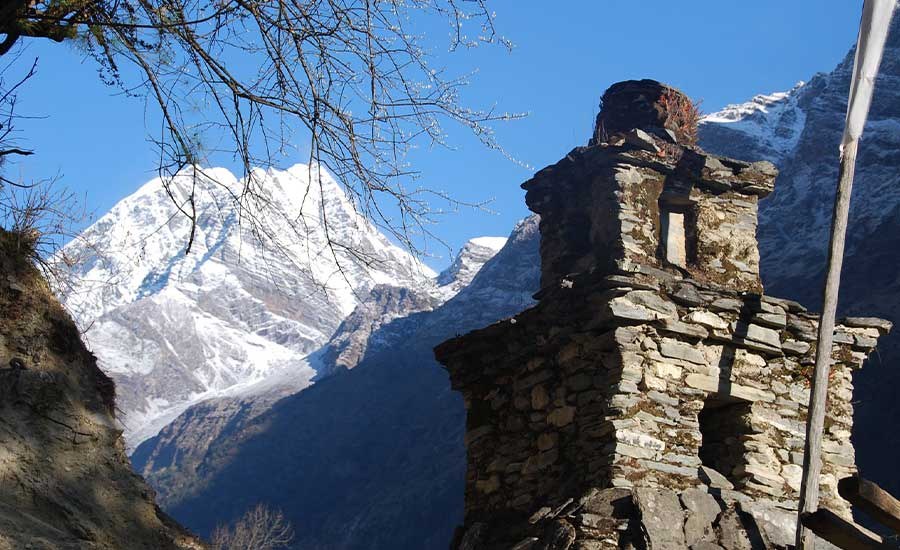
As you gain altitude, the environment changes. Villages become more Tibetan-influenced, Buddhist mani walls and chortens appear beside the trail, forests change, temperatures fall and snow-covered mountains become increasingly dominant.
Above Samagaun and Samdo, the landscape becomes distinctly alpine. Trees disappear, settlements become smaller and the trail enters a much more exposed high-altitude environment.
The culmination is the crossing of Larkya La Pass at 5,106 m, followed by a long descent to Bimthang.
This progression—from river valley to high mountain pass—is one of the qualities that makes the Manaslu Circuit so rewarding.
Where Is the Manaslu Circuit Trek?
The Manaslu Circuit lies in Gorkha District in north-central Nepal, close to the Tibetan border.
The trek circles the Manaslu massif, whose principal summit, Mount Manaslu (8,163 m), is the eighth-highest mountain in the world.
The standard circuit follows the Budhi Gandaki Valley north before turning west across Larkya La and descending toward Dharapani, where the route meets the Annapurna Circuit area.
What Does the Manaslu Circuit Route Look Like?
Himalayan Dream Team's current route follows:
Kathmandu → Machha Khola → Jagat → Deng → Ghap → Lho → Samagaun → Samdo → Dharamsala / Larkya Phedi → Larkya La Pass → Bimthang → Dharapani → Kathmandu
For a visual explanation of the trail, villages, side trips and high-altitude section, see our Manaslu Circuit Trek Map and Route Guide.
What to Expect Day by Day on the Manaslu Circuit
| Section | Altitude | What to Expect |
|---|---|---|
| Machha Khola | Approx. 870 m | Road journey from Kathmandu and beginning of the lower Budhi Gandaki Valley |
| Jagat | 1,340 m | River trails, suspension bridges, waterfalls and entry into the conservation/restricted trekking area |
| Deng | 1,860 m | Increasingly remote valley and transition toward Tibetan-influenced settlements |
| Ghap | 2,160 m | Forests, mani walls, river crossings and gradual altitude gain |
| Lho | 3,180 m | First major high-altitude stage and impressive views of Manaslu |
| Samagaun | 3,530 m | Important acclimatization stop, Buddhist culture and optional side hikes |
| Samdo | 3,860 m | High Himalayan village, colder conditions and increasingly barren landscape |
| Dharamsala / Larkya Phedi | 4,460 m | Very basic lodge, cold conditions and preparation for the pass |
| Larkya La Pass | 5,106 m | Highest point, early start, snow/ice possible and the most demanding trekking day |
| Bimthang | Approx. 3,590 m | Major descent after the pass with beautiful mountain scenery |
| Dharapani | 1,860 m | Return to greener valleys and completion of the trekking section |
How Difficult Is the Manaslu Circuit Trek?
The Manaslu Circuit Trek difficulty is best described as moderate to challenging.
You do not need technical climbing skills, ropes or previous mountaineering experience for the standard circuit. However, this should not be confused with an easy trek.
The challenge comes from combining:
- Consecutive trekking days
- Approximately 4–7 hours of walking on most days
- Long ascents and descents
- Rocky and uneven trails
- Numerous suspension bridges
- High altitude
- Cold mornings and nights
- Remote mountain conditions
- Basic facilities at higher elevations
- An 8–10 hour Larkya La crossing
A healthy trekker with good walking fitness, realistic expectations and sufficient preparation can complete the circuit without being an experienced mountaineer.
For a deeper explanation, read our Manaslu Circuit Trek Difficulty Guide.
Do You Need Previous Trekking Experience?
Previous multi-day trekking experience is useful but not compulsory.
More important is your ability to walk for several hours over hilly terrain, recover overnight and repeat the effort the following day.
If your normal lifestyle is relatively inactive, we recommend preparing several months before departure rather than expecting the trek itself to create your fitness.
How Fit Do You Need to Be?
You do not need to be an elite athlete, but good cardiovascular fitness, leg strength, balance and endurance are important.
Before travelling to Nepal, your preparation should ideally include:
- Regular hill walking
- Long weekend hikes
- Stair climbing
- Cardiovascular training
- Leg and core strengthening
- Walking with a light daypack
- Back-to-back walking days
The goal is not speed. The goal is to become comfortable walking steadily for many hours over consecutive days.
Manaslu Circuit Altitude: What Should You Expect?
Altitude is one of the most important considerations on the Manaslu Circuit.
The trek begins below 1,000 metres and gradually climbs above 5,000 metres.
This natural progression helps acclimatization, but once you reach Lho, Samagaun, Samdo and Dharamsala, altitude becomes a serious consideration.
The highest point is:
Larkya La Pass – 5,106 m / 16,752 ft
The highest sleeping point on our itinerary is:
Dharamsala / Larkya Phedi – approximately 4,460 m
For a detailed village-by-village elevation profile, see our Manaslu Circuit Trek Elevation, Altitude & Acclimatization Guide.
Manaslu Circuit Elevation Profile
| Location | Approx. Elevation | Altitude Experience |
|---|---|---|
| Machha Khola | 870 m | Low altitude |
| Jagat | 1,340 m | Low altitude |
| Deng | 1,860 m | Gradual ascent |
| Ghap | 2,160 m | Moderate elevation |
| Lho | 3,180 m | High altitude begins to become more relevant |
| Samagaun | 3,530 m | Important acclimatization location |
| Samdo | 3,860 m | High altitude |
| Dharamsala | 4,460 m | Highest overnight stop |
| Larkya La Pass | 5,106 m | Highest point of trek |
| Bimthang | Approx. 3,590 m | Significant descent after pass |
| Dharapani | 1,860 m | Return to lower altitude |
What Does High Altitude Feel Like?
Even fit trekkers often notice the effects of altitude.
At higher elevations you may:
- Walk more slowly than usual
- Breathe more heavily on climbs
- Feel colder
- Sleep less comfortably
- Lose some appetite
- Need more recovery time
A mild headache or fatigue can occur, but persistent or worsening symptoms should never simply be ignored.
Altitude Sickness on the Manaslu Circuit
Acute Mountain Sickness (AMS) can affect anyone, regardless of age or fitness.
Possible symptoms include headache, nausea, dizziness, unusual fatigue, poor appetite and disturbed sleep.
More serious altitude illness can be life-threatening.
The most important principle is simple: do not continue ascending when symptoms are becoming significantly worse.
Your guide should be informed immediately if you feel unwell at altitude.
How Himalayan Dream Team Plans Acclimatization
Our Manaslu Circuit itinerary does not rush directly toward Larkya La.
We spend two nights in Samagaun (3,530 m), providing an important acclimatization opportunity before continuing to Samdo and Dharamsala.
During the Samagaun acclimatization day, options include a gentler excursion around the village and Birendra Lake or, for strong and properly acclimatized trekkers when conditions allow, a longer hike toward Manaslu Base Camp (approximately 4,800 m).
The objective is not to exhaust yourself. Acclimatization hiking is about exposing the body gradually to higher elevation before returning to a lower sleeping altitude.
What to Expect at Samagaun
Samagaun is one of the most important villages on the Manaslu Circuit.
At approximately 3,530 m, it is surrounded by extraordinary Himalayan scenery and has strong Tibetan Buddhist cultural influences.
Most importantly for trekkers, Samagaun provides time for acclimatization before entering the higher section of the circuit.
Depending on your condition and weather, your acclimatization day can include:
- Exploring Samagaun
- Visiting nearby religious sites
- Walking toward Birendra Lake
- A higher acclimatization hike
- Hiking toward Manaslu Base Camp for strong trekkers when appropriate
What to Expect at Samdo
At approximately 3,860 m, Samdo feels noticeably more remote than the villages below.
The landscape becomes more open and barren, temperatures fall and the proximity to Tibet becomes an important part of the area's cultural geography.
Walking should remain slow and controlled because you are now sleeping close to 4,000 metres.
What to Expect at Dharamsala / Larkya Phedi
Dharamsala, also called Larkya Phedi, sits at approximately 4,460 m and is the final overnight stop before crossing Larkya La.
Do not expect luxury here.
Accommodation is among the simplest on the entire route. Rooms and facilities are limited, temperatures can be very cold and the location is remote.
The purpose of the stop is practical: eat, hydrate, prepare your clothing and equipment and get as much rest as possible before the early start for Larkya La.
What to Expect on Larkya La Pass Day
The crossing of Larkya La Pass (5,106 m) is the defining day of the Manaslu Circuit Trek.
It is normally the longest and most demanding day of the journey.
You should expect:
- A very early start, often before sunrise
- Cold pre-dawn temperatures
- Slow climbing at high altitude
- Rocky moraine
- Possible snow and ice
- Strong wind depending on conditions
- Approximately 8–10 hours of trekking
- A long descent after crossing the pass
The trail itself does not normally require technical mountaineering, but snow, ice and weather can make conditions considerably more difficult.
From the pass, clear weather can reveal views toward Himlung Himal, Cheo Himal, Kang Guru, Annapurna II and surrounding glaciers and ridges.
After crossing the pass, you descend toward Bimthang. For many trekkers, reaching Bimthang after the long pass day is one of the most satisfying moments of the entire journey.
Is Larkya La Dangerous?
Larkya La is a high Himalayan pass, so it deserves respect.
The principal risks include altitude, cold, snow, ice, strong wind, fatigue and rapidly changing weather.
Under normal conditions and with appropriate acclimatization, equipment and an experienced guide, it is a trekking pass rather than a technical climbing route.
However, conditions can change. Your guide's assessment of weather, snow and trail conditions should always take priority over a fixed schedule.
What Is the Trail Like?
The Manaslu Circuit is not a smooth walking path.
Expect a mixture of:
- Rocky trails
- Stone steps
- Forest paths
- Riverbanks
- Suspension bridges
- Narrow valley trails
- Steep ascents
- Long descents
- Alpine terrain
- Glacial moraine
- Possible mud during wet periods
- Possible snow and ice at higher elevations
Suspension Bridges on the Manaslu Circuit
The Budhi Gandaki Valley requires frequent river crossings, so suspension bridges are a normal part of the trek.
Some are high above the river and may move slightly when people or pack animals cross.
If you are uncomfortable with heights, knowing this before the trek is useful. Most trekkers become much more comfortable with the bridges after the first few days.
What Scenery Should You Expect?
One of the great strengths of the Manaslu Circuit is the variety of landscapes.
You move through:
- River gorges
- Terraced farmland
- Bamboo and subtropical vegetation
- Pine forests
- Rhododendron forests
- Waterfalls
- High Himalayan villages
- Alpine meadows
- Glacial valleys
- Rocky moraine
- Snow-covered mountain passes
The landscape changes almost daily as you gain elevation.
Mountains Seen on the Manaslu Circuit
Depending on your location and weather, the route provides views of Mount Manaslu and numerous surrounding Himalayan peaks.
Important mountains and massifs associated with the journey include:
- Mount Manaslu – 8,163 m
- Himalchuli
- Ngadi Chuli
- Shyala-area peaks
- Himlung Himal
- Cheo Himal
- Kang Guru
- Annapurna II from the western side of Larkya La
Culture on the Manaslu Circuit
The Manaslu Circuit is not only a mountain trek.
The lower route passes through communities with strong Gurung and other hill-culture influences. As you travel farther north, Tibetan Buddhist cultural traditions become increasingly visible.
Along the trail you can expect to encounter:
- Mani walls
- Prayer wheels
- Chortens
- Monasteries
- Prayer flags
- Traditional stone houses
- High-altitude pastoral life
Always pass mani walls and chortens respectfully according to local custom and follow your guide's advice regarding photography and monastery etiquette.
Pungyen Gompa
Our route from Lho toward Samagaun includes the opportunity to visit Pungyen Gompa, situated at approximately 4,000 m beneath the Manaslu massif.
The side trip combines acclimatization, Buddhist culture and exceptional mountain scenery.
Whether the full excursion is appropriate depends on weather, trail conditions and the condition of the group.
Manaslu Base Camp
Manaslu Base Camp is situated at approximately 4,800 m and can be approached as a demanding acclimatization hike from Samagaun when conditions and individual fitness allow.
This should not be treated as compulsory.
For some trekkers, a shorter acclimatization walk is more sensible. Your guide will help determine the appropriate plan based on how you are adapting to altitude.
Birendra Lake
Birendra Lake is a beautiful glacial lake near Samagaun and provides a shorter excursion than the full hike toward Manaslu Base Camp.
It can be a good choice for trekkers who need an active acclimatization day without undertaking an exceptionally long or strenuous hike.
Accommodation on the Manaslu Circuit Trek
The Manaslu Circuit is now primarily a teahouse trek.
You sleep in locally operated lodges rather than tents on Himalayan Dream Team's standard circuit.
However, accommodation standards vary substantially according to altitude and village.
| Location | What to Expect |
|---|---|
| Lower Villages | Simple but increasingly established mountain lodges; some attached bathrooms may be available |
| Middle Manaslu | Basic twin rooms, shared bathrooms and central dining areas |
| Samagaun | Several established trekking lodges, but facilities remain simple compared with cities |
| Samdo | Basic mountain accommodation |
| Dharamsala | Very basic accommodation, limited rooms and limited facilities |
| Bimthang | Mountain lodges with beautiful surroundings; facilities remain relatively simple |
For a village-by-village explanation, read our Manaslu Circuit Trek Accommodation Guide.
What Are Teahouse Rooms Like?
Most rooms are simple twin-sharing rooms containing:
- Two basic beds
- Mattresses
- Pillows
- Blankets
- A small table or hooks where available
Do not expect hotel-style insulation or heating.
At higher elevations, the room can become very cold overnight. A good-quality sleeping bag is therefore important even when blankets are provided.
Are Bedrooms Heated?
Generally, no.
Teahouse bedrooms are normally unheated.
Some dining rooms have a central stove that is lit during busy evening periods, making the dining room the social and warmest part of the lodge.
Once you return to your bedroom, expect much colder conditions.
What Are the Toilets Like?
Toilet standards vary considerably.
At lower elevations you may find Western-style toilets at some lodges. As you travel higher, shared bathrooms and squat toilets become more common.
At Dharamsala, facilities are particularly basic.
Always carry your own toilet paper and hand sanitizer.
Are Hot Showers Available?
Hot showers are available at many lower and middle-elevation lodges for an additional charge.
Higher on the trail, showers become less reliable and increasingly impractical because of cold temperatures and limited resources.
Many trekkers switch to a bowl wash or wet wipes during the highest section of the trek.
What Food Can You Expect?
Teahouses serve surprisingly varied menus considering the remoteness of the route.
Common choices include:
- Dal bhat
- Rice dishes
- Fried rice
- Noodles
- Thukpa
- Momos
- Potatoes
- Soups
- Eggs
- Porridge
- Pancakes
- Chapati or Tibetan-style bread
- Pasta at some lodges
- Tea, coffee and hot lemon
Dal Bhat on the Manaslu Circuit
Dal bhat—rice, lentil soup and vegetable accompaniments—is one of the most reliable trekking meals in Nepal.
It provides carbohydrates, protein and warmth and is widely available along the Manaslu route.
As food must be transported farther into the mountains, menus become more limited and prices generally increase with altitude.
Is Vegetarian Food Available?
Yes. Vegetarian meals are widely available and often the easiest choice during a Himalayan trek.
Because refrigeration and food transportation become more difficult in remote areas, many trekkers prefer vegetarian food at higher elevations.
Drinking Water on the Manaslu Circuit
Staying hydrated is particularly important as altitude increases.
Depending on the location, lodges may provide boiled water for a fee and other local water sources may be available.
We recommend using appropriate water purification methods rather than relying heavily on disposable plastic bottles.
A reusable bottle and water-treatment system are useful parts of your trekking equipment.
Electricity and Charging
Electricity is available in many villages, but it becomes less reliable as you travel higher.
Charging phones, cameras and power banks may require an additional fee.
Bring at least one good power bank and conserve battery during the high-altitude section.
Wi-Fi and Mobile Network
Do not expect continuous connectivity.
Some teahouses offer Wi-Fi for a fee and mobile signals may work in parts of the route, but coverage can be weak or unavailable.
Weather, power supply and location all affect connectivity.
Tell family and colleagues before departure that you may be offline for periods of time.
Can You Use ATMs on the Manaslu Circuit?
You should not depend on ATMs once the trek begins.
Carry sufficient Nepalese rupees in cash for personal expenses such as:
- Hot showers
- Charging
- Wi-Fi
- Extra drinks
- Snacks
- Personal purchases
- Tips
Small-denomination notes are especially useful.
How Remote Is the Manaslu Circuit?
Manaslu feels considerably more remote than many of Nepal's busiest trekking corridors.
There are no airports along the standard circuit, road access is limited and medical facilities are basic.
This remoteness is part of the attraction, but it also means trekkers need good organization, experienced support and realistic expectations.
Medical Facilities and Emergency Evacuation
Medical facilities along the Manaslu Circuit are limited.
For serious illness or injury, evacuation may be necessary depending on location, weather and circumstances.
Every trekker should have comprehensive travel insurance that specifically covers:
- High-altitude trekking above 5,000 m
- Emergency medical treatment
- Helicopter evacuation where medically necessary
- Trip interruption and relevant travel risks
Always read your policy carefully rather than assuming that standard travel insurance automatically covers high-altitude trekking.
Manaslu Circuit Weather: What to Expect
Manaslu Circuit weather varies dramatically because the trek climbs from below 1,000 metres to more than 5,000 metres.
You can experience warm conditions in the lower Budhi Gandaki Valley and freezing temperatures around Dharamsala and Larkya La during the same trek.
Mountain weather is never completely predictable, so temperatures should always be treated as approximate.
Manaslu Circuit Weather Month by Month
| Month | What to Expect | Overall Trekking Conditions |
|---|---|---|
| January | Very cold at high altitude; snow and ice can affect Larkya La; short daylight hours | Possible only with strong winter preparation and suitable pass conditions |
| February | Still very cold, particularly above Samagaun; snow may remain on the pass | Challenging winter conditions |
| March | Spring begins; temperatures gradually improve but high passes can still hold snow | Good, especially later in the month |
| April | Warmer days, flowering forests and generally favourable trekking conditions | Excellent |
| May | Warmer temperatures with good trekking conditions; increasing cloud and occasional showers later in the month | Very good |
| June | Monsoon begins; rain increases in lower areas, trails become muddy and clouds reduce views | Less favourable |
| July | Peak monsoon conditions, heavy rain in lower valleys, leeches, landslide risk and poor visibility | Generally not recommended |
| August | Continued monsoon rain, wet trails and possible road/trail disruption | Generally not recommended |
| September | Monsoon gradually withdraws; landscapes are green and visibility improves as the month progresses | Good, especially later September |
| October | Generally stable weather, excellent visibility and favourable pass conditions | Excellent and one of the most popular months |
| November | Clear skies and excellent views; colder mornings and nights, especially late in the month | Excellent |
| December | Cold winter conditions develop; snow becomes increasingly possible at Larkya La | Possible but increasingly challenging |
Manaslu Circuit in March
March marks the beginning of the spring trekking season.
Lower valleys become warmer, but snow can remain around Larkya La, particularly early in the month.
March is a good choice for trekkers who are comfortable with colder conditions and want to travel before the busiest part of spring.
Manaslu Circuit in April
April is one of the best months for the Manaslu Circuit.
Days are generally warmer, rhododendrons and other spring vegetation brighten the lower and middle forests, and high-altitude conditions are normally more manageable than in winter.
Manaslu Circuit in May
May is warmer and remains a strong trekking month.
As the monsoon approaches, afternoon clouds and occasional showers become increasingly possible, particularly later in the month.
Manaslu Circuit in June, July and August
The summer monsoon brings rain to the lower and middle sections of the Manaslu Circuit.
Expect:
- Muddy and slippery trails
- Leeches at lower elevations
- Cloud and reduced mountain visibility
- Possible landslides
- Road delays
- River and stream levels increasing
For most first-time Manaslu trekkers, Himalayan Dream Team recommends choosing spring or autumn instead.
Manaslu Circuit in September
September is a transition month.
Early September can still experience monsoon rainfall, while later in the month conditions usually become clearer and more stable.
The countryside is particularly green after the summer rains.
Manaslu Circuit in October
October is one of the most popular months for the Manaslu Circuit Trek.
It normally provides a strong combination of clear Himalayan views, relatively stable weather and favourable trail conditions.
Because it is peak trekking season, popular teahouses—especially in the higher villages—can be busy.
Manaslu Circuit in November
November is another excellent month.
Mountain visibility is often superb, while the trails generally remain favourable.
Temperatures fall noticeably as the month progresses, particularly in Samdo, Dharamsala and around Larkya La.
Manaslu Circuit in December, January and February
Winter trekking is possible only when weather and trail conditions allow, but it requires much greater preparation.
Expect:
- Very cold nights
- Snow and ice
- Possible heavy snow around Larkya La
- Shorter daylight hours
- Some seasonal lodge closures
- Greater uncertainty around crossing the pass
A winter itinerary should remain flexible. Larkya La should never be attempted simply because a fixed itinerary says it is “pass day.”
Best Time for the Manaslu Circuit Trek
For most trekkers, the best periods are:
Spring: March to May
Autumn: September to November
If you want warmer spring conditions and flowering forests, consider April or May.
If your priority is generally clear Himalayan visibility and classic post-monsoon trekking conditions, October and November are particularly attractive.
How Cold Does the Manaslu Circuit Get?
Temperature depends heavily on altitude, month, wind, cloud and time of day.
The lower Budhi Gandaki Valley can feel warm during the daytime, while temperatures around Samdo, Dharamsala and Larkya La can fall well below freezing during cold periods.
Rather than planning around one temperature figure, pack for a broad range of conditions.
What Clothing Do You Need?
A layered clothing system works best.
You should be prepared with:
- Moisture-wicking base layers
- Warm mid-layers
- Fleece
- Insulated/down jacket
- Waterproof/windproof shell
- Trekking trousers
- Thermal leggings
- Warm hat
- Sun hat
- Light and warm gloves
- Good trekking socks
- Waterproof trekking boots
For the complete equipment checklist, see our Ultimate Packing List for the Manaslu Circuit Trek.
Do You Need Trekking Poles?
Trekking poles are strongly recommended.
They are particularly useful on:
- Long descents
- Uneven rocky trails
- Muddy paths
- Snow or icy sections
- The descent from Larkya La
They also reduce some of the impact on your knees during long downhill sections.
Do You Need Crampons or Microspikes?
Technical crampons are not normally required for the standard Manaslu Circuit under normal trekking conditions.
However, lightweight traction devices such as microspikes can be useful if Larkya La is icy or snow-covered.
The need depends on the season and current conditions, so check with Himalayan Dream Team before departure.
How Much Luggage Should You Carry?
During the trek, you normally walk with a small daypack containing the items you need during the day.
Your porter carries your main trekking baggage according to the agreed baggage allowance.
At Himalayan Dream Team, we generally arrange one porter for every two trekkers.
Pack responsibly. Porters should never be expected to carry unnecessary luggage simply because a traveller does not want to make careful packing choices.
What Goes in Your Daypack?
Your daypack should normally contain:
- Water
- Waterproof jacket
- Warm layer
- Sun protection
- Personal medication
- Snacks
- Camera or phone
- Power bank
- Passport/permit items as advised
- Toilet paper
- Hand sanitizer
Getting from Kathmandu to the Manaslu Circuit
Unlike the Everest region, the Manaslu Circuit does not require a flight to Lukla.
The journey begins overland from Kathmandu toward Gorkha and the Budhi Gandaki Valley.
Our current itinerary drives directly from Kathmandu to Machha Khola, where the trekking section begins.
The drive is long and road conditions can be rough, particularly on the final sections.
What Is the Drive to Machha Khola Like?
Expect a full travel day.
The journey begins on established highways before gradually entering narrower rural roads toward the Manaslu region.
Road conditions change with weather, maintenance and construction, so driving times should always be considered approximate.
In monsoon months, landslides and road damage can cause additional delays.
How Does the Trek End?
After crossing Larkya La and descending through Bimthang, our route continues to Dharapani (1,860 m).
Dharapani lies on the Annapurna Circuit corridor.
From here, the trekking section ends and we continue overland back toward Kathmandu.
Manaslu Circuit Permits: What Do You Need?
The Manaslu Circuit passes through a restricted area and protected conservation areas.
For the standard route, foreign trekkers generally require:
- Manaslu Restricted Area Permit (RAP)
- Manaslu Conservation Area Permit (MCAP)
- Annapurna Conservation Area Permit (ACAP)
The ACAP permit is required because the route exits the Manaslu region toward Dharapani in the Annapurna Conservation Area.
Permit rules and government fees can change, so current requirements should always be checked before departure. Himalayan Dream Team arranges the necessary trekking permits for our guests.
Current Manaslu Restricted Area Permit Fee
| Season | Manaslu Restricted Area Permit |
|---|---|
| September–November | USD 100 per person for the first 7 days + USD 15 per person for each additional day |
| December–August | USD 75 per person for the first 7 days + USD 10 per person for each additional day |
The final Restricted Area Permit cost therefore depends on the number of days your itinerary spends inside the restricted zone rather than simply the total length of your Nepal holiday.
Can You Trek Manaslu Without a Guide?
The Manaslu Circuit is a restricted-area trek and should not be treated like an unrestricted independent hiking route.
Foreign trekkers need to follow the current restricted-area regulations and travel with the required licensed trekking support.
Himalayan Dream Team arranges the permits, licensed guide and trekking logistics as part of the journey.
Can a Solo Traveller Trek the Manaslu Circuit?
A traveller can come to Nepal alone and arrange a Manaslu trek through an authorized trekking company, but independent trekking without the required restricted-area arrangements is not permitted.
Because regulations can change, solo travellers should confirm the latest permit procedure with Himalayan Dream Team when booking.
Is the Manaslu Circuit Crowded?
The Manaslu Circuit generally receives fewer trekkers than Nepal's busiest Everest and Annapurna trails.
However, describing it as completely empty would be misleading.
During peak months such as October, popular teahouses and the approach to Larkya La can become busy.
The experience remains relatively remote, particularly compared with major commercial trekking corridors.
Manaslu Circuit vs Annapurna Circuit
| Manaslu Circuit | Annapurna Circuit |
|---|---|
| Larkya La – 5,106 m | Thorong La – 5,416 m |
| Restricted-area regulations apply | Different trekking regulations apply |
| Generally quieter | More established and busier |
| More basic facilities in remote sections | Broader range of trekking facilities |
| Strong Nubri/Tibetan Buddhist cultural influence | Very diverse cultural landscapes |
| Budhi Gandaki Valley | Marsyangdi and Kali Gandaki valleys |
Travellers interested in comparing the routes can also explore our Annapurna Circuit Trek.
Manaslu Circuit vs Everest Base Camp
The two treks offer very different experiences.
Everest Base Camp has famous Sherpa villages, larger trekking infrastructure and the iconic objective of reaching Everest Base Camp.
Manaslu Circuit feels more like a continuous journey around a mountain massif, culminating in a high-pass crossing rather than an out-and-back approach to a base camp.
Manaslu also avoids the Kathmandu–Lukla flight because the trek is reached by road.
If you are considering both, see our Everest Base Camp Trek.
Manaslu Circuit and Tsum Valley
Trekkers with more time can combine the Manaslu Circuit with the remote Tsum Valley.
Tsum Valley branches away from the main Manaslu Circuit and provides a deeper cultural journey through traditional Tsumba villages, monasteries and Tibetan Buddhist landscapes.
Our Manaslu and Tsum Valley Trek combines both areas into one extended Himalayan journey.
Can You Trek Only Tsum Valley?
Yes.
Travellers who are more interested in remote culture, monasteries and valley trekking than crossing Larkya La can choose our Tsum Valley Trek.
The Tsum Valley route explores places such as Chumling, Chhokang Paro, Nile, Mu Gompa and Gumba Lungdang without crossing Larkya La.
Who Should Choose the Manaslu Circuit?
The Manaslu Circuit is particularly suitable for trekkers who:
- Want a quieter alternative to Nepal's busiest trekking routes
- Enjoy long-distance mountain journeys
- Are comfortable with basic accommodation
- Want to cross a 5,000 m Himalayan pass
- Are interested in Tibetan Buddhist culture
- Prefer travelling through changing landscapes rather than following an out-and-back route
- Have good walking fitness
- Can accept unpredictable mountain conditions
Who May Not Enjoy the Manaslu Circuit?
The trek may not be the best choice if you require:
- Luxury accommodation every night
- Private bathrooms throughout
- Reliable Wi-Fi every day
- Short walking days only
- Easy road access throughout the journey
- A trek with no exposure to high altitude
Understanding these limitations before booking usually leads to a much more enjoyable trek.
Is the Manaslu Circuit Suitable for Beginners?
A fit and well-prepared first-time Himalayan trekker can complete the Manaslu Circuit, but it is not the easiest introduction to trekking in Nepal.
If this is your first multi-day trek, preparation becomes especially important.
You should be comfortable with long walking days, simple accommodation and the idea of being several days away from easy road access.
Is the Manaslu Circuit Suitable for Older Trekkers?
Age alone does not determine whether someone can complete the Manaslu Circuit.
Fitness, health, trekking experience, acclimatization and recovery ability are more important.
Older trekkers who are active and accustomed to long-distance walking often perform very well, while younger trekkers who arrive unprepared may struggle.
Anyone with significant medical concerns should discuss high-altitude trekking with an appropriate medical professional before booking.
Is the Manaslu Circuit Good for Women Travellers?
Yes. Women regularly trek the Manaslu Circuit as part of private and group departures.
Himalayan Dream Team welcomes women travelling alone, with friends or in groups, and a female trekking guide can be requested, subject to availability.
Because the route is remote and restricted, travelling with an organized and experienced team provides important logistical support.
What About Menstruation on the Trek?
Women should carry sufficient personal menstrual products because they may be difficult to purchase in remote villages.
A small sealable waste bag, hand sanitizer and personal hygiene supplies are useful.
Menstrual cups or reusable products can reduce waste, but only use products you are already comfortable with before the trek.
Hygiene on the Manaslu Circuit
Hygiene becomes more basic as altitude increases.
Useful items include:
- Hand sanitizer
- Toilet paper
- Biodegradable wipes
- Quick-dry towel
- Personal toiletries
- Lip balm
- Moisturizer
- Small waste bags
Do not expect a hot shower every day.
Responsible Trekking in Manaslu
The Manaslu region contains fragile mountain environments and traditional communities.
Responsible travellers should:
- Carry reusable water bottles
- Minimize disposable plastic
- Use water purification where appropriate
- Respect monasteries and sacred structures
- Ask before photographing people
- Stay on established trails
- Do not leave batteries or plastic waste behind
- Support locally operated lodges
- Respect porters and guides as professionals
- Follow local cultural customs
How Many Days Do You Need for the Manaslu Circuit?
Itineraries vary, but the circuit should not be rushed simply to advertise fewer days.
Himalayan Dream Team uses a 16-day Nepal itinerary that includes:
- Arrival in Kathmandu
- Kathmandu sightseeing and preparation
- Road journey to Machha Khola
- The complete trekking circuit
- Two nights in Samagaun for acclimatization
- Larkya La crossing
- Return from Dharapani
- A leisure/contingency day in Kathmandu
- Final departure
See the complete 16-Day Manaslu Circuit Trek Itinerary for daily walking times, meals, accommodation and elevation.
Why a Contingency Day Matters
Mountain travel is affected by weather, road conditions, health and trail conditions.
A spare day after returning from the trek creates useful flexibility rather than scheduling your international flight immediately after a remote Himalayan journey.
It also gives you time to rest, shop or enjoy Kathmandu before departure if everything runs according to plan.
What Travel Insurance Do You Need?
Before travelling, make sure your insurance policy covers trekking to at least the maximum altitude of the Manaslu Circuit.
The policy should clearly cover:
- Trekking above 5,000 m
- Emergency medical expenses
- Helicopter evacuation where medically required
- Trip interruption
- Relevant baggage and travel risks
Read the wording carefully and contact your insurer if anything is unclear.
How to Prepare Mentally for the Manaslu Circuit
Physical fitness is only part of preparation.
Expect some uncomfortable moments: cold mornings, basic toilets, long climbs, tired legs, limited internet, simple rooms and changing weather.
The trekkers who often enjoy Manaslu most are not necessarily the fastest. They are the ones who arrive with realistic expectations, patience and the ability to adapt.
What Makes the Manaslu Circuit Special?
The Manaslu Circuit combines several experiences that are increasingly difficult to find together on one trek:
- A complete circuit rather than an out-and-back route
- A major 8,000-metre Himalayan mountain
- A 5,106 m high pass
- Remote mountain villages
- Tibetan Buddhist culture
- Dramatic river gorges
- Forests and waterfalls
- Glacial landscapes
- Teahouse accommodation
- Fewer trekkers than Nepal's busiest routes
Frequently Asked Questions: What to Expect on the Manaslu Circuit Trek
1. How difficult is the Manaslu Circuit Trek?
The Manaslu Circuit is a moderate-to-challenging high-altitude trek. Most days involve approximately 4–7 hours of walking, while Larkya La day can take around 8–10 hours.
2. What is the highest point of the Manaslu Circuit?
The highest point is Larkya La Pass at 5,106 m / 16,752 ft.
3. How high is Mount Manaslu?
Mount Manaslu rises to 8,163 metres and is the eighth-highest mountain in the world.
4. How long is the Manaslu Circuit Trek?
Himalayan Dream Team's complete itinerary takes 16 days from arrival to departure, with the trekking section running from Machha Khola to Dharapani.
5. How far do you walk on the Manaslu Circuit?
The trekking section is approximately 110–120 km depending on the exact route and optional side hikes.
6. How many hours do you walk each day?
Most trekking days are approximately 4–7 hours. Larkya La Pass day is longer at around 8–10 hours.
7. Do I need climbing experience?
No technical climbing experience is required for the standard Manaslu Circuit.
8. Do I need previous trekking experience?
Previous trekking experience is helpful but not compulsory if you have good fitness and prepare properly.
9. What is the hardest day?
The crossing from Dharamsala over Larkya La to Bimthang is generally the hardest day because of altitude, cold, distance and the long descent.
10. Do I need a guide for the Manaslu Circuit?
The route passes through a restricted trekking area and foreign trekkers need to follow the current licensed-guide and permit requirements.
11. Can I trek Manaslu alone?
You can travel to Nepal alone and arrange the trek through a registered company, but you cannot simply enter the restricted Manaslu route as an unsupported independent trekker.
12. What permits do I need?
The standard circuit requires the Manaslu Restricted Area Permit, Manaslu Conservation Area Permit and Annapurna Conservation Area Permit, subject to current government regulations.
13. What is the best time for Manaslu Circuit Trek?
March to May and September to November are generally the best trekking periods.
14. Is October good for the Manaslu Circuit?
Yes. October is one of the most popular months because of generally stable weather and excellent mountain visibility.
15. Is April good for Manaslu?
Yes. April offers pleasant spring trekking conditions, flowering forests and generally good Himalayan views.
16. Can I trek Manaslu in winter?
Winter trekking is possible when conditions permit, but extreme cold and snow can make Larkya La difficult or temporarily impassable.
17. Can I trek Manaslu during monsoon?
It is possible, but rain, mud, leeches, landslides and poor visibility make June through August much less attractive for most trekkers.
18. What accommodation is available?
You stay in local teahouses and mountain lodges. Rooms are generally simple twin-sharing rooms, and facilities become increasingly basic with altitude.
19. Are there hot showers?
Hot showers are available at many lower and middle-elevation lodges for an additional fee but become limited at higher elevations.
20. Are there Western toilets?
Some lower lodges have Western-style toilets, while shared and squat toilets become more common in remote and higher villages.
21. Is Wi-Fi available?
Wi-Fi is available at some lodges but should not be considered reliable throughout the trek.
22. Can I charge my phone?
Charging is available at many lodges for a fee, but electricity becomes less reliable at higher elevations. Bring a power bank.
23. Is there mobile phone coverage?
Coverage exists in some locations but can be weak or unavailable in remote valleys.
24. Are there ATMs?
Do not rely on ATMs after leaving Kathmandu. Carry enough Nepalese cash for personal expenses.
25. What food is available?
Teahouses commonly serve dal bhat, rice, noodles, soups, potatoes, eggs, porridge, momos and other simple trekking meals.
26. Is vegetarian food available?
Yes. Vegetarian food is widely available and is often a practical choice at higher elevations.
27. Do I need a sleeping bag?
Yes. A warm sleeping bag is recommended because bedrooms are generally unheated and high-altitude nights can be very cold.
28. Do I need trekking poles?
They are strongly recommended, particularly for long descents and possible snow or ice around Larkya La.
29. Do I need crampons?
Technical crampons are not normally necessary, but lightweight traction devices may be recommended when snow or ice is present.
30. Will I get altitude sickness?
Not necessarily, but anyone can develop altitude illness. Proper acclimatization, gradual ascent and reporting symptoms early are essential.
31. Where do you acclimatize?
Our itinerary spends two nights in Samagaun at approximately 3,530 m.
32. Can I visit Manaslu Base Camp?
Yes, it can be approached as an optional acclimatization hike from Samagaun when weather, trail conditions, fitness and acclimatization allow.
33. Is Birendra Lake worth visiting?
Yes. It provides a beautiful shorter excursion around Samagaun and can form part of the acclimatization day.
34. Is Larkya La technically difficult?
It is a trekking pass rather than a technical climbing route under normal conditions, but snow, ice, weather and altitude can make it challenging.
35. How cold is Larkya La?
Conditions vary by season, but temperatures can be well below freezing during cold periods, especially around the pre-dawn start.
36. Are there many suspension bridges?
Yes. Suspension bridges are a normal feature of the Budhi Gandaki Valley.
37. Is Manaslu more difficult than Annapurna Circuit?
Both are demanding high-altitude circuits. Manaslu generally feels more remote and has more basic infrastructure, while the Annapurna Circuit reaches a higher pass at Thorong La (5,416 m).
38. Is Manaslu better than Everest Base Camp?
They are different experiences. Manaslu is a remote circuit with a high-pass crossing, while Everest Base Camp focuses on the Khumbu, Sherpa culture and reaching the base of Mount Everest.
39. Can I combine Manaslu with Tsum Valley?
Yes. Our Manaslu and Tsum Valley Trek combines both areas for travellers with more time.
40. Is Manaslu suitable for first-time trekkers?
A well-prepared and fit first-time Himalayan trekker can complete it, but it is more demanding than many introductory treks in Nepal.
41. Is Manaslu suitable for women travelling alone?
Yes. Solo women can join an organized Manaslu trek, and Himalayan Dream Team can arrange a female trekking guide on request, subject to availability.
42. Is travel insurance compulsory?
Comprehensive insurance covering high-altitude trekking and emergency evacuation is strongly recommended and should be arranged before travelling.
43. Do I need to bring cash?
Yes. Bring sufficient Nepalese rupees because cards and ATMs cannot be relied upon during the trek.
44. Can I buy trekking equipment in Kathmandu?
Yes. Kathmandu has numerous trekking shops, but important personal equipment such as boots should ideally be tested well before the trek.
45. Why trek Manaslu with Himalayan Dream Team?
Himalayan Dream Team provides a carefully paced itinerary, experienced licensed trekking guides, permit arrangements, accommodation, meals, transportation and porter support, with particular attention to acclimatization and the conditions around Larkya La.
Explore Our Complete Manaslu Trekking Guides
If you are planning the Manaslu Circuit, the following Himalayan Dream Team resources provide more detailed information about each important part of the journey:
- Manaslu Circuit Trek – 16 Days – complete itinerary, trip facts, inclusions and departure information
- Complete Guide to the Manaslu Circuit Trek – general planning guide to the route
- Manaslu Circuit Trek Elevation Guide – altitude profile, Larkya La and acclimatization
- Manaslu Circuit Trek Accommodation Guide – teahouses, rooms, toilets, showers, Wi-Fi and charging
- Manaslu Circuit Trek Difficulty Guide – fitness, trail challenges and preparation
- Manaslu Circuit Trek Map & Route Guide – route, villages and trekking stages
- Manaslu Circuit Trek Packing List – clothing, footwear and essential trekking gear
- Manaslu and Tsum Valley Trek – extended journey combining both regions
- Tsum Valley Trek – cultural trekking alternative without crossing Larkya La
- Annapurna Circuit Trek – alternative Himalayan circuit trek
- Everest Base Camp Trek – compare Manaslu with Nepal's classic Everest journey
What to Expect on the Manaslu Circuit Trek: Final Thoughts
The Manaslu Circuit Trek is not a luxury mountain holiday, and that is part of what makes it special.
Expect long walking days. Expect basic rooms. Expect cold mornings, suspension bridges, rocky trails and moments when the altitude forces you to slow down.
But also expect to wake beneath some of the highest mountains on Earth, walk through villages where Tibetan Buddhist traditions remain part of everyday life, follow the wild Budhi Gandaki Valley, watch Mount Manaslu rise above the trail and eventually stand at 5,106 metres on Larkya La Pass.
The most important thing is to arrive prepared—not only physically, but with realistic expectations.
At Himalayan Dream Team Treks & Tours, we believe a successful Manaslu trek should never be about rushing from one village to the next. Proper acclimatization, an experienced trekking team, sensible pacing and flexibility for Himalayan conditions are essential parts of the journey.
Our 16-Day Manaslu Circuit Trek includes a gradual approach through the Budhi Gandaki Valley, two nights in Samagaun for acclimatization, experienced guide support, porter assistance, permits, accommodation and full-board meals during the trekking section.
If you are looking for a quieter, culturally rich and genuinely challenging Himalayan circuit, Manaslu may be exactly the journey you are searching for.